
Blog
Insights on production scheduling, lean manufacturing, and manufacturing software from 35+ years of industry experience.
Everything we have published.
What Is a Dependency Graph in Scheduling?
A dependency graph maps each routing step as a node and each predecessor link as an edge, so steps schedule in the right order. Here is the dependency graph explained.
What Is a Gross Requirement in Manufacturing Planning?
A gross requirement is the total demand for an item before any netting against stock or receipts. See how it differs from net requirement and how EDGEBIC uses it.
What Is a Master Production Schedule (MPS)? Formulas and Examples
A master production schedule (MPS) is the committed, time-phased build plan for finished goods. The PAB and ATP formulas, time fences and three worked examples.
What Is a Net Requirement in Manufacturing Planning?
A net requirement is gross demand minus on-hand stock and scheduled receipts: the quantity you actually have to make or buy. See how EDGEBIC nets demand to it.
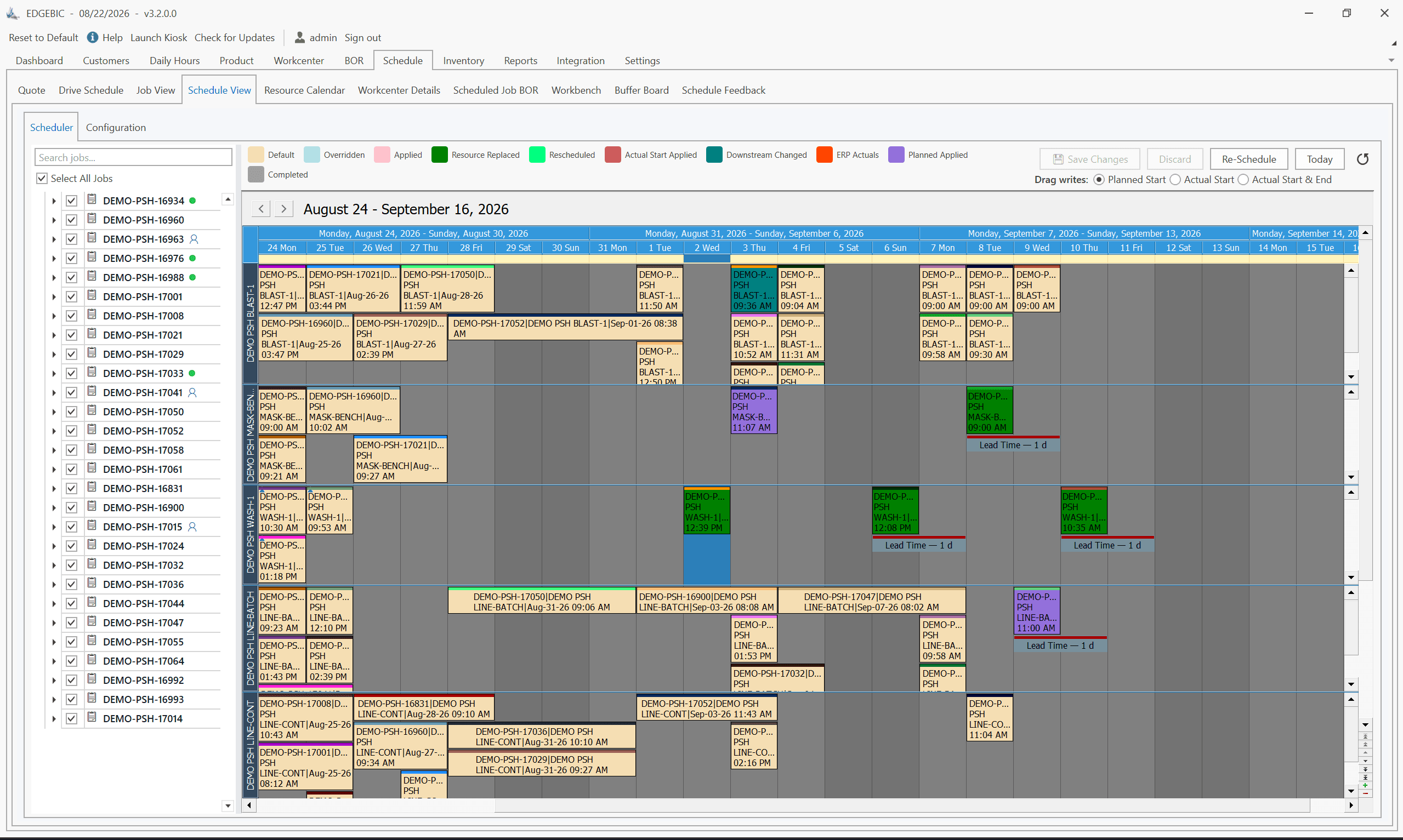
What Is a Reschedule in Production Scheduling?
A reschedule recomputes the plan for one or more orders, preserving completed work and picking up from the current state. Here is what rescheduling means, explained.
What Is a Shipping Buffer?
A shipping buffer is protected time after a bottleneck that shields the due date from downstream delays. Learn how it is sized and how it holds ship dates.
What Is a Work Center Dispatch List?
A work center dispatch list is the ordered run queue each station follows for the shift. See how EDGEBIC generates it from the finite-capacity schedule.
What Is a Work Center Rate?
A work center rate is the loaded cost per hour used to price scheduled labor. Learn how the rate drives quote costs and where a per-step override wins.
What Is Advanced Planning and Scheduling (APS) Software?
APS software schedules production on real, finite machines, honoring every capacity constraint at once. Definition, APS vs MRP vs ERP table and a worked example.
What Is Available Capacity in Production Scheduling?
Available capacity is the real working hours a work center can offer after shifts, instances, and a utilization target. See exactly how EDGEBIC computes it.
What Is Capacity Requirements Planning (CRP)?
Capacity requirements planning checks whether planned orders can physically be run given available capacity. See how EDGEBIC goes beyond flagging overloads.
What Is the Critical Path in Manufacturing?
The critical path is the longest chain of dependent routing steps that sets a job's earliest finish. Here is what critical path means in scheduling, explained.