
MRP System Built for Real Manufacturing
An MRP system works out what to buy and make, and when, by exploding your bills of material against demand and netting the result against stock and open orders. MRP software does that arithmetic for a whole plant in seconds. What most of it does not do is check whether the plant has the hours to build the plan it just produced.
EDGEBIC Complete (RMDB 2.0) by User Solutions runs material requirements planning and finite capacity scheduling on one model, so purchase dates come from a schedule the plant can actually hit. Built for small and mid-size manufacturers who plan materials in spreadsheets or have outgrown their ERP's MRP. $35,000 one time, working alongside your ERP.
Last updated
What Is an MRP System?
An MRP system answers three questions every manufacturer faces daily: what do we need to make, what materials does that require, and when must those materials be on hand? It does this by exploding a Bill of Materials against forecasted and firm demand, then netting against inventory and open purchase orders.
A modern MRP system goes further: it ties the material plan to a finite capacity schedule, feeds shop-floor completion data back into the plan (closed-loop MRP), and connects to purchasing so reorder points trigger automatically. RMDB delivers this as a single integrated MRP system, with no spreadsheet bridges and no end-of-month reconciliations.
Why an MRP Plan on Its Own Is Not a Plan You Can Build
Classic MRP assumes infinite capacity. It takes a due date, subtracts a fixed lead time per level of the bill of material, and tells you when to release. It never asks whether the work centers have the hours. So the purchase orders are right, the dates are wrong, and the shortage list and the expediting start in week three.
A worked example. Say you need 200 assemblies on day 20. The bill of material has two machined parts per assembly, so 400 parts, and the mill runs them at 6 minutes each: 2,400 minutes, 40 hours of mill time. MRP sees a 5-day purchase lead time for the bar stock and a 3-day standard lead time on the machining step, so it releases the order on day 12 and reports the plan as feasible.
Now look at the mill. It is staffed one shift, 8 hours a day, and it already has 26 hours of other work booked in that window. The job has to be finished by day 20, so the eight working days from day 12 to day 19 are what it gets: 64 hours of capacity, 38 of them free. The job needs 40. It does not fit, by two hours, and nothing in the material plan knows that. Finite capacity scheduling catches it while there is still time to move a job, add an hour of overtime, or tell the customer before the date is missed.
That is the whole difference between MRP as arithmetic and MRP as a plan. In EDGEBIC Complete the material requirements and the capacity schedule are the same model, running on the RMDB finite capacity engine that has been scheduling plants since 1991, so the dates MRP writes back are dates the floor can keep. The method behind it is finite capacity scheduling, and the gross-to-net arithmetic itself is worked through in the MRP net requirements formula.
MRP I vs. MRP II: What's the Difference?
MRP I: Material Requirements Planning
- Calculates material needs from BOMs and demand
- Time-phased reorder by lead time
- Nets against on-hand stock and open POs
- Does not consider capacity constraints
- Does not feed back actual production
MRP II: Manufacturing Resource Planning (RMDB)
- Everything in MRP I, plus:
- Finite capacity scheduling: machines, labor, materials, tooling
- Closed-loop feedback from work-order completions
- Costing tied to actual production data
- Master production schedule and rough-cut capacity planning
- Purchasing, receiving, and vendor performance integrated
RMDB MRP System Capabilities
- Multi-level BOM explosion up to 10 levels deep
- Time-phased material requirements with vendor lead times
- Net requirements after on-hand stock and open POs
- Lot sizing rules: lot-for-lot, EOQ, fixed-period, min/max
- Closed-loop MRP: automatic adjustment from shop-floor reality
- Finite capacity scheduling against materials, labor, machines, tooling
- Purchase order generation driven by MRP demand
- Vendor performance and lead-time tracking
- Lot traceability and inventory valuation
- Costing rolled live from production data
- Master production schedule and rough-cut capacity planning
- ERP integration (SAP, Oracle, Epicor, NetSuite, QuickBooks)
The material plan feeds the finite capacity schedule. This is the EDGEBIC planning board the MRP results land on, with every operation placed against real machine time.
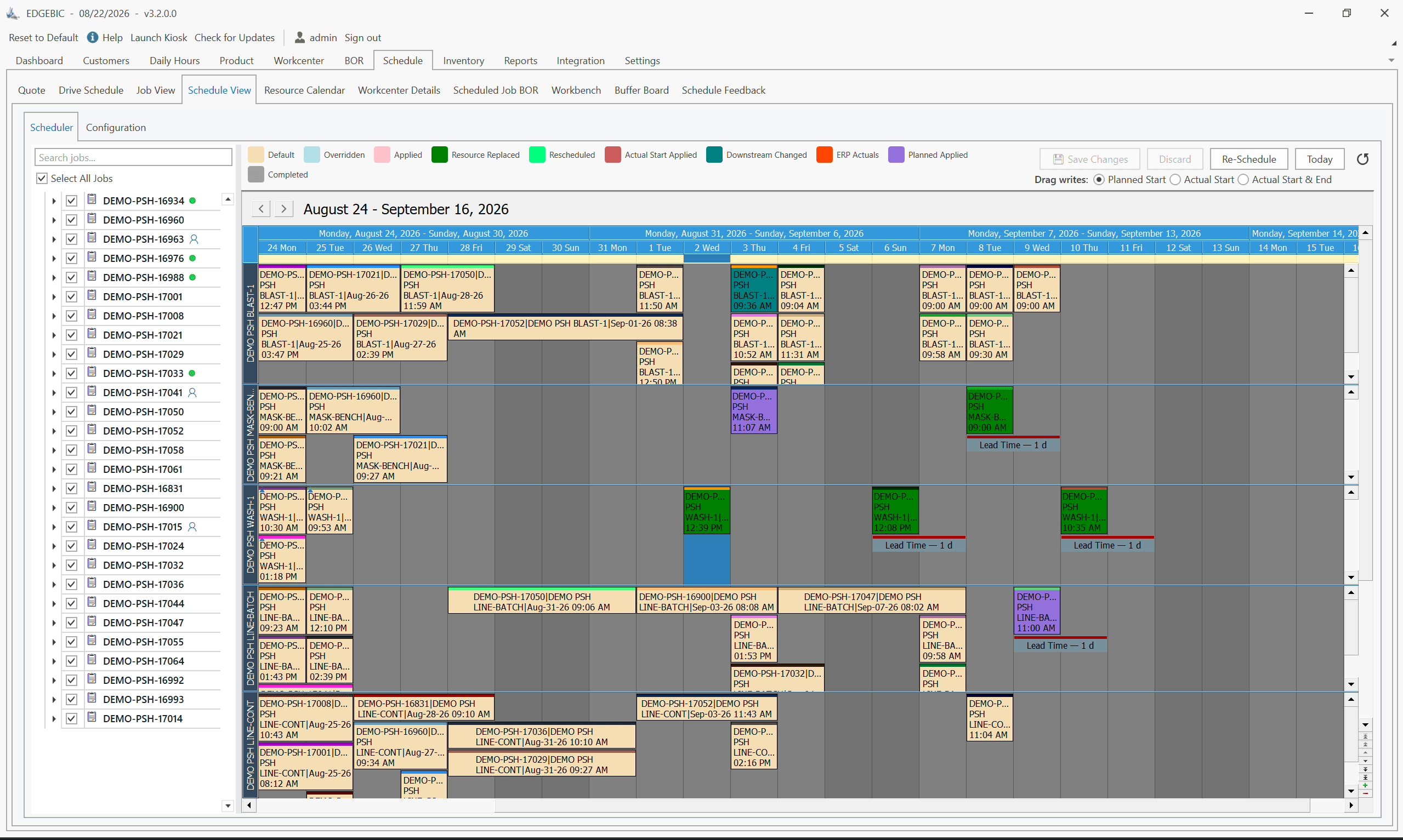
The biggest benefit relative to other systems looked at is its simplicity to operate and speed at which it can generate results in whichever area you want to start on.
MRP System Implementation Results
- Shop constraints, BOMs, calendar, materials, vendors and customers enteredTurner Suspension Bicycles
- A few days
- From start to an optimized schedule integrated with the ERPPlastilite Corporation
- 1 week
- Deep sub-assembly scheduling, with MRP and full lot traceabilityEnevate Corporation
- 10 levels
- Manufacturer running RMDB MRP from domestic to international operationsSleepmaster Ltd
- AUD$50M
EDGEBIC Complete vs Spreadsheets, ERP MRP Modules and Enterprise APS
A material plan is only useful if the plant can build it. The difference between these options is whether material and capacity are planned together or reconciled by hand afterwards.
| Spreadsheet | ERP MRP module | Enterprise APS | EDGEBIC Complete | |
|---|---|---|---|---|
| Material plan | Hand-built formulas | Yes, MRP | Usually read from the ERP | MRP, BOM explosion, inventory and purchasing |
| Capacity in the plan | None | Usually infinite capacity with fixed lead times | Finite | Finite capacity schedule across machines, labor and tooling |
| Material shortages | Found on the shop floor | Exception reports | Yes, as a constraint | Material pegging, so a shortage constrains the schedule |
| Works with your ERP | Manual re-keying | It is the ERP | Pre-built connectors to major ERPs | Any ERP that exports Excel, CSV or database tables |
| Implementation | Hours | Part of a 6 to 12 month ERP project | Months, usually consultant-led | Days to weeks (Plastilite: 5 days with ERP integration) |
| Pricing | Free | Part of the ERP license | Annual per-seat subscription or a $50K+ project | $35,000 one time ($25,000 without MRP) |
MRP System Pricing: Published, One-Time
Two editions of EDGEBIC by User Solutions, both perpetual licenses with updates included and no per-seat annual fee. EDGEBIC is an installed Windows application, not a subscription service. See EDGEBIC pricing and editions or how this compares with the market.
| Edition | What it includes | One-time license |
|---|---|---|
| EDGEBIC APS | Finite capacity scheduling and optimization: graphical routing designer, forward and backward scheduling, Theory of Constraints anchoring, parallel work centers, sequence-dependent setup, lot streaming, operator skills, and a two-layer schedule optimizer. | $25,000 |
| EDGEBIC Complete | Everything in EDGEBIC APS plus MRP, inventory, purchasing and material pegging, so material availability constrains the schedule alongside machines and labor. | $35,000 |
Works Alongside Your ERP
Keep your ERP as the system of record. Orders, routings, work centers and actuals come into EDGEBIC from Excel, CSV or database tables, and finite capacity schedules and realistic dates go back out. No middleware and no custom API project. Step-by-step integration guides:
- EDGEBIC with SAP
- EDGEBIC with Epicor
- EDGEBIC with NetSuite
- EDGEBIC with Microsoft Dynamics
- EDGEBIC with QuickBooks
- EDGEBIC with Sage
- EDGEBIC with JobBOSS
- EDGEBIC with Infor
- EDGEBIC with Acumatica
- EDGEBIC with Odoo
- EDGEBIC with Fourth Shift
- EDGEBIC with SYSPRO
- EDGEBIC with Global Shop Solutions
- EDGEBIC with Plex
- EDGEBIC with IQMS / DELMIAworks
- EDGEBIC with Made2Manage
Using a different system? Any ERP that exports Excel, CSV or database tables works. See EDGEBIC ERP integration and the ERP scheduling add-on.
MRP System FAQs
MRP System Success Stories
See how manufacturers replaced spreadsheets and enterprise ERP with the RMDB MRP system.
Transportation
Repair Shops Triple On-Time Shipping from 30% to 90%
GE Railcar Services
Read storyElectronics
Li-Ion Battery Production Scheduling for Enevate
Enevate Corporation
Read storyConsumer Products
Affordable MRP for Smaller Manufacturer
Sleepmaster Ltd
Read storyWoodworking
Amish Manufacturer Rapidly Amortizes Scheduling System
Homestead Furniture
Read storyGlass Manufacturing
Job Shop Increases Throughput and On-Time Shipping
Technical Glass Products
Read storySoftware / Manufacturing
ERP Vendor and Manufacturer Turn to RMDB
ERP Partners
Read storyExplore Related Solutions
Discover how these capabilities work together to transform your manufacturing operations.
MRP for Small Manufacturers
Material requirements planning without ERP complexity
Learn moreBill of Materials (BOM)
Multi-level BOM management tied to scheduling
Learn moreInventory Management Software
Manufacturer-built inventory with lot traceability and live MRP integration
Learn moreMaster Production Schedule
Long-horizon capacity planning and MPS generation
Learn moreManufacturing Software
Integrated platform for scheduling, MRP, inventory, BOMs, and analytics
Learn moreSee an MRP System That Implements in Days
Get a free live demo with your own BOMs and demand data. See how material planning, scheduling, and purchasing tie together in one MRP system.
Or see MRP for small manufacturers or RMDB features.