
Engineer-to-Order Scheduling Software
Every job we build is different, engineering is always late, and we quote delivery dates on a hunch. What works for an engineer-to-order job shop?
An engineer-to-order shop needs one finite capacity plan that includes engineering, sub-assemblies and shop work. EDGEBIC by User Solutions schedules each one-off job backward from its due date, treats engineering and drafting as capacity like any machine, handles sub-assemblies ten levels deep, and quotes delivery dates from the real load before you commit.
Last updated
Why ETO Shops Outgrow Their Scheduling
In an engineer-to-order shop the routing does not exist until engineering creates it, and the bill of materials may change while the job is on the floor. MRP and ERP scheduling assume repeat products with fixed routings and lead times, so they either leave ETO work out of the plan or plan it with numbers nobody believes.
The real constraint is often upstream of the shop: engineering hours, drafting and long-lead purchased parts. If those are not in the same plan as the machines, the shop schedule starts from a date that was never real.
- Delivery dates are quoted before anyone checks engineering or shop load
- Engineering finishes late and the shop is expected to absorb the slip
- Sub-assemblies arrive after the final assembly was scheduled to start
- Engineering changes overwrite the routing of a job already in progress
- The ERP schedule uses fixed lead times for work that has never been built
- Project managers track dates in their own spreadsheets
How EDGEBIC Schedules Engineer-to-Order Work
EDGEBIC by User Solutions was built for high-mix work where every job can be different. For ETO shops, the parts that matter are how fast a new routing can be built, whether engineering is part of the plan, and whether a date can be tested before it is promised.
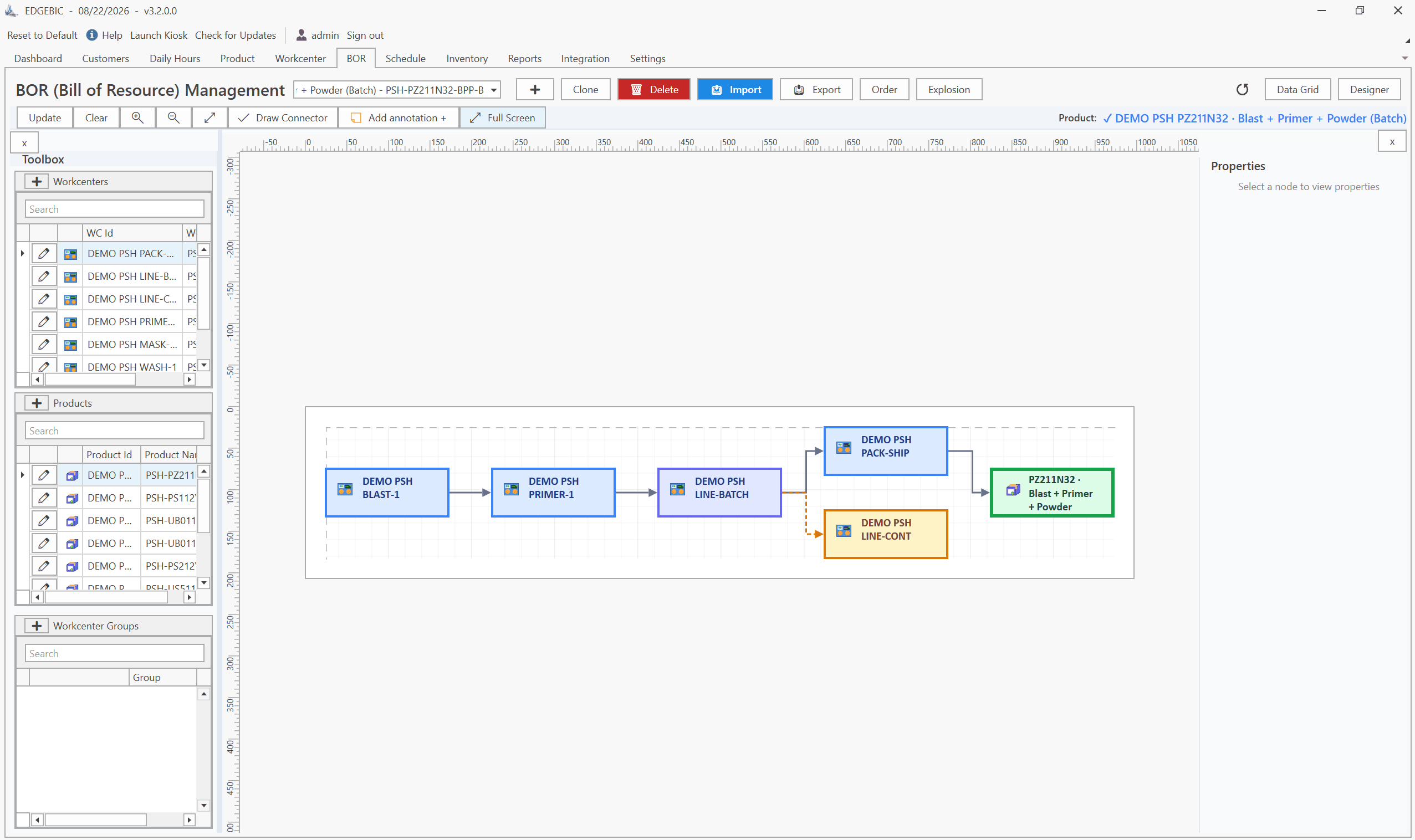
Draw a one-off routing in minutes
The graphical routing designer shows each routing as a flow chart of steps and dependencies. Copy a similar past job and edit it, instead of building a routing from scratch for every order.
Engineering is scheduled like a machine
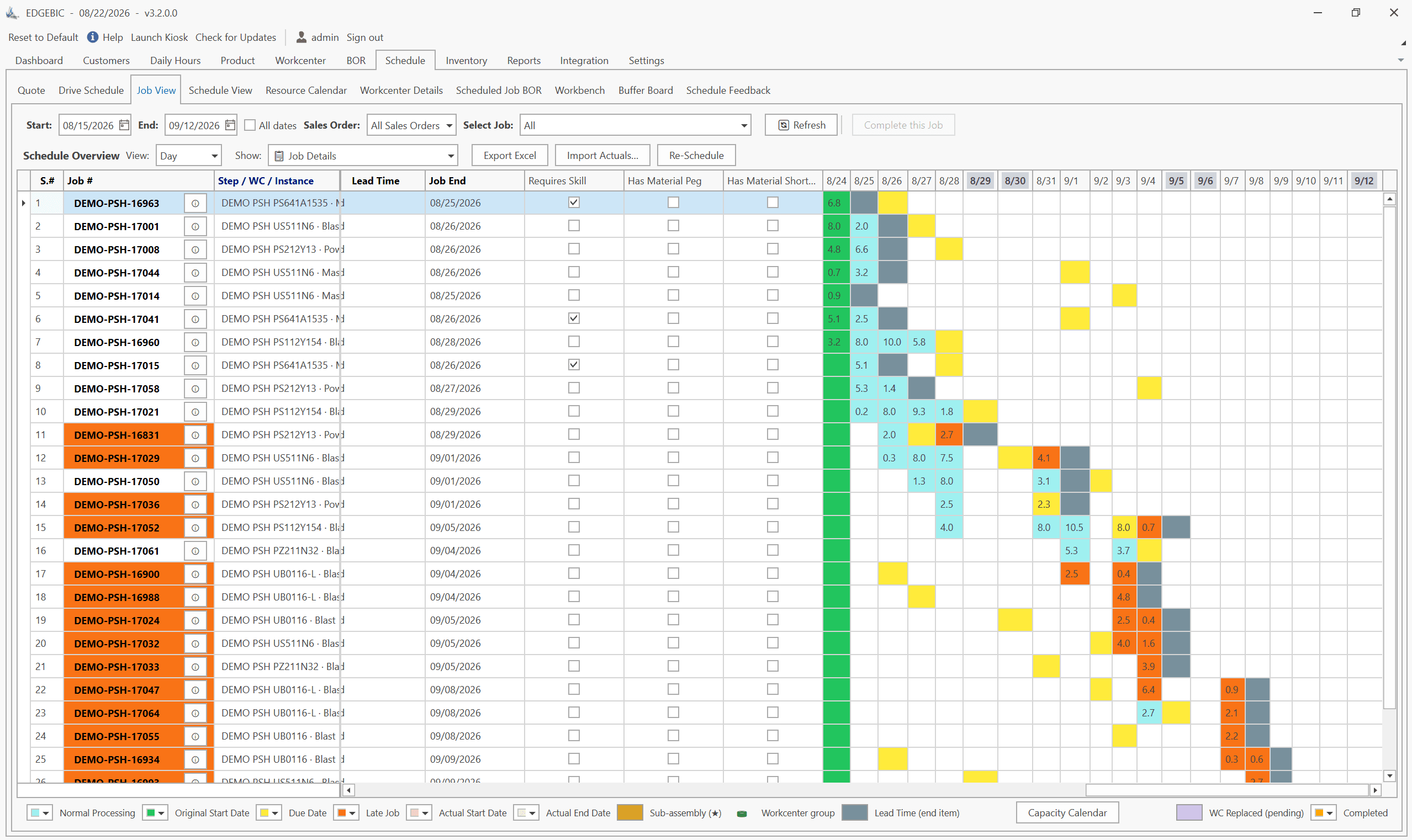
Model design, drafting and programming as work centers or skilled labor with real hours. The shop steps cannot start before the engineering steps finish, so a late drawing shows up as a late job immediately.
Sub-assemblies up to ten levels deep
Each sub-assembly is scheduled to feed its parent on time. You see a late weldment or a late purchased component before final assembly is booked on top of it.
Plan backward from the due date
Backward scheduling places the last operation at the due date and works back, giving the latest safe start for engineering and each shop step, and warning you when that start is already in the past.
Engineering changes without chaos
Each job keeps a snapshot of the routing it was scheduled with. Re-importing a revised routing from the ERP updates future jobs without silently re-planning a job already on the floor.
Quote from the real load
Quote simulation schedules a prospective job against the current plan without changing it, so the delivery date in the proposal reflects the engineering and shop capacity you actually have.
Over 31,000 distinct tasks level-loaded against shared resources in one plan
US Navy (USS Nimitz)
Maintenance of the USS Nimitz power plant has the same shape as engineer-to-order work: thousands of distinct tasks, each with its own resource needs, competing for the same skilled people over a schedule that runs two years out. The Navy had built an impressive scheduling system from 10 separate Excel master files, but it could not do finite capacity planning or load leveling.
Using Resource Manager for Excel by User Solutions, the lineage that EDGEBIC continues, the team consolidated over 31,000 maintenance tasks across four nuclear plants into one system, balancing 26,000 preventive tasks with 5,000 corrective jobs by priority without exceeding capacity.
Who Makes EDGEBIC
EDGEBIC is made by User Solutions, Inc. of South Lyon, Michigan, which has built manufacturing scheduling software since 1991. EDGEBIC is RMDB 2.0: the current generation of RMDB (Resource Manager DB), the scheduling engine behind results at the US Navy, GE, Cummins and BAE Systems. RMDB customers remain supported. EDGEBIC is an installed Windows application (.NET 8, SQLite or SQL Server) that works alongside any ERP through Excel, CSV and database import and export. See the EDGEBIC product overview.
EDGEBIC Pricing: Published, One-Time
Two editions of EDGEBIC by User Solutions, both perpetual licenses with updates included and no per-seat annual fee. EDGEBIC is an installed Windows application, not a subscription service. See EDGEBIC pricing and editions or how this compares with the market.
| Edition | What it includes | One-time license |
|---|---|---|
| EDGEBIC APS | Finite capacity scheduling and optimization: graphical routing designer, forward and backward scheduling, Theory of Constraints anchoring, parallel work centers, sequence-dependent setup, lot streaming, operator skills, and a two-layer schedule optimizer. | $25,000 |
| EDGEBIC Complete | Everything in EDGEBIC APS plus MRP, inventory, purchasing and material pegging, so material availability constrains the schedule alongside machines and labor. | $35,000 |
Read More on This Problem
- What is engineer-to-order (ETO)?
- Make-to-order shops: scheduling backward from the due date
- Sub-assembly scheduling in EDGEBIC explained
- How sub-assembly visibility ends the late component surprise
- Routing snapshots explained
- Handling engineering changes through ERP re-import
- How a quote simulation produces a realistic date
Engineer-to-Order Scheduling FAQs
Customer Stories
Manufacturers scheduling with EDGEBIC and RMDB, the User Solutions engine behind it.
See a one-off job scheduled in a demo
Bring one recent engineer-to-order job with its engineering steps and due date. We will build the routing in EDGEBIC and schedule it against your real load.
Or see EDGEBIC pricing or the EDGEBIC product overview.