
High-Mix Low-Volume Scheduling Software
We run hundreds of small jobs a week, every one different, and the schedule is out of date by lunch. What should a high-mix low-volume job shop use?
A high-mix low-volume shop needs finite capacity scheduling that charges setups by sequence, uses any capable machine, and reschedules fast. EDGEBIC by User Solutions loads hundreds of small jobs against real machines, operators and shifts, groups similar work with a setup matrix, pools interchangeable machines, and rebuilds the plan whenever priorities change.
Last updated
Why High-Mix Work Breaks Ordinary Scheduling
Repetitive-manufacturing tools assume long runs of the same product on the same line. A high-mix low-volume shop is the opposite: many part numbers, short runs, unique routings, and setups that can take longer than the run itself. Whether a setup is 10 minutes or 90 depends on what ran before it.
A spreadsheet or ERP schedule that uses one fixed setup time per operation, and one fixed machine per step, is wrong the moment the mix changes, which in a high-mix shop is every day.
- Setup time eats capacity because similar jobs are not grouped
- Jobs wait for one machine while an identical machine sits idle
- The schedule assumes an operator who is not qualified or not on shift
- Rebuilding the plan after a change takes hours, so nobody does it
- Promise dates come from standard lead times, not from the current load
- One experienced scheduler carries the whole plan in their head
How EDGEBIC Schedules High-Mix Low-Volume Work
EDGEBIC by User Solutions was built for job shops: high mix, unique routings and constant change. It schedules every operation to finite capacity, so the plan reflects the machines, people and setups you actually have today.
Setups charged by sequence
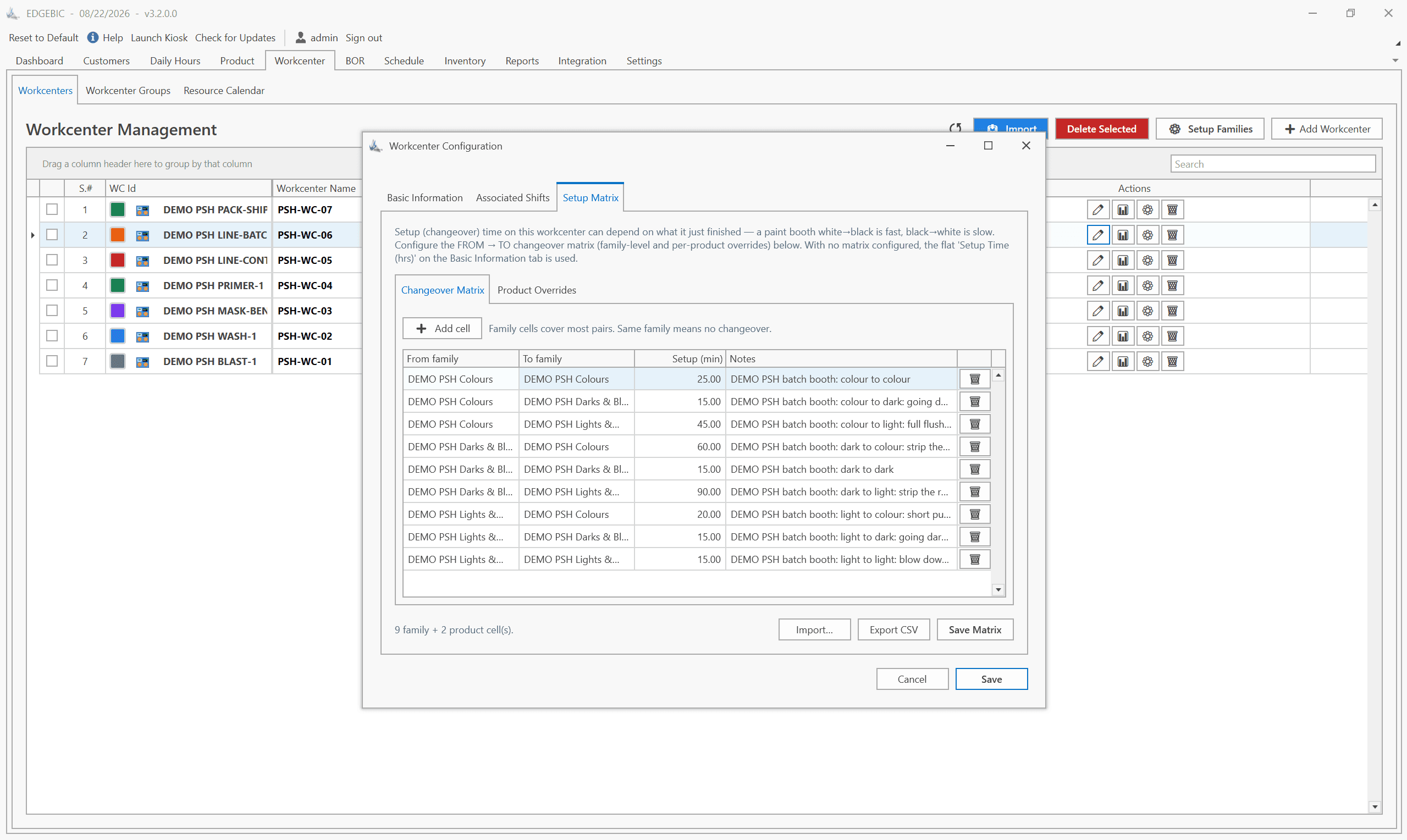
A setup matrix holds changeover minutes from one setup family to the next. The scheduler charges the real changeover for each sequence and can group similar work to cut total setup time.
Any capable machine, not just one
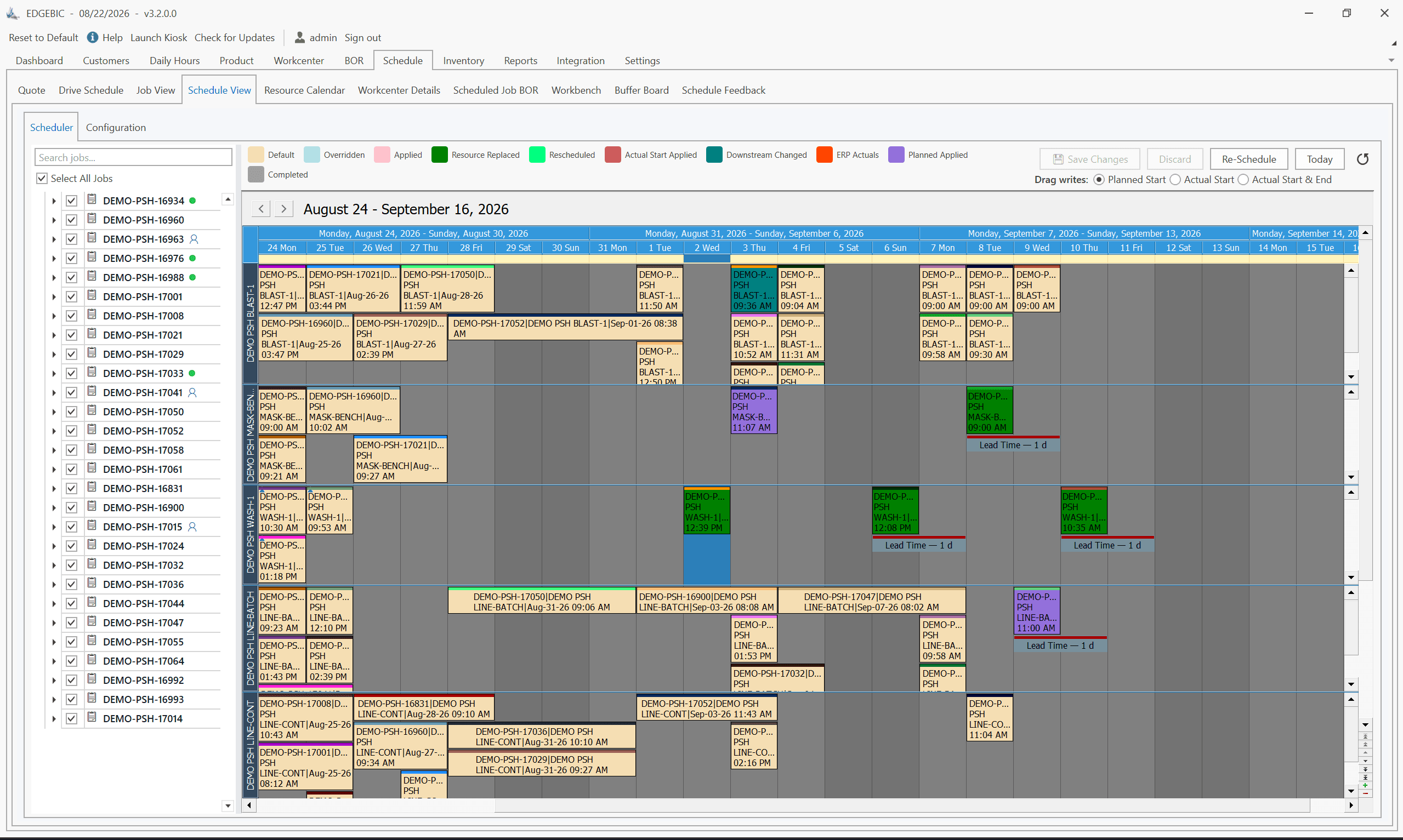
Route a step to a work center group or allow alternates, and each job lands on whichever capable machine frees up first. Parallel work centers split big jobs across identical machines.
Operators and skills in the same plan
Operator skills, certifications and shift rosters are constraints, so a job is only placed where a qualified person is actually working.
Reschedule as often as you need
Drag a job on the Gantt or change a priority, and the whole plan reflows to finite capacity. Started and completed work stays where it ran, so rescheduling several times a day is practical.
Optimize the sequence
The two-layer optimizer runs a multi-run search that is never worse than your current plan, then Google OR-Tools CP-SAT optimization with a proven optimality gap. You review and accept each result.
Promise dates from the real load
Quote simulation schedules a new job against the current plan without changing it, so the date you give reflects the mix you are running now.
Two weeks off lead time and 4% more business with the same workforce
Technical Glass Products
Technical Glass Products, a job shop in Snoqualmie, Washington, has used RMDB by User Solutions, the engine behind EDGEBIC, for finite capacity scheduling for years. When its task-duration standards and workcenter skill balance drifted, User Solutions helped it blend new time studies and cross-trained skill demands into the live schedule and a master plan six months out, in a few days of remote support.
The plan confirmed its cross-training initiatives and let it redeploy people quickly. By shaving two weeks off lead time for deliverables, it accommodated a 4% increase in business with the current workforce while keeping its customer service standard.
Who Makes EDGEBIC
EDGEBIC is made by User Solutions, Inc. of South Lyon, Michigan, which has built manufacturing scheduling software since 1991. EDGEBIC is RMDB 2.0: the current generation of RMDB (Resource Manager DB), the scheduling engine behind results at the US Navy, GE, Cummins and BAE Systems. RMDB customers remain supported. EDGEBIC is an installed Windows application (.NET 8, SQLite or SQL Server) that works alongside any ERP through Excel, CSV and database import and export. See the EDGEBIC product overview.
EDGEBIC Pricing: Published, One-Time
Two editions of EDGEBIC by User Solutions, both perpetual licenses with updates included and no per-seat annual fee. EDGEBIC is an installed Windows application, not a subscription service. See EDGEBIC pricing and editions or how this compares with the market.
| Edition | What it includes | One-time license |
|---|---|---|
| EDGEBIC APS | Finite capacity scheduling and optimization: graphical routing designer, forward and backward scheduling, Theory of Constraints anchoring, parallel work centers, sequence-dependent setup, lot streaming, operator skills, and a two-layer schedule optimizer. | $25,000 |
| EDGEBIC Complete | Everything in EDGEBIC APS plus MRP, inventory, purchasing and material pegging, so material availability constrains the schedule alongside machines and labor. | $35,000 |
Read More on This Problem
High-Mix Low-Volume Scheduling FAQs
Customer Stories
Manufacturers scheduling with EDGEBIC and RMDB, the User Solutions engine behind it.
Woodworking
Amish Manufacturer Rapidly Amortizes Scheduling System
Homestead Furniture
Read storyGlass Manufacturing
Job Shop Increases Throughput and On-Time Shipping
Technical Glass Products
Read storyConsumer Products
Production What-If Scenario Secures Largest Customer Order
Turner Suspension Bicycles
Read storySchedule your real mix in a demo
Send an export of a normal week of open jobs and routings. We will schedule it in EDGEBIC with your setups and machines and show you the result.
Or see EDGEBIC pricing or the EDGEBIC product overview.