
RMDB vs DELMIA Ortems: APS Software Comparison for Manufacturers
 User Solutions Team
RMDB vs DELMIA Ortems is a comparison between a focused scheduling tool for small to mid-size manufacturers and an enterprise APS platform backed by Dassault Systemes, one of the world's largest industrial software companies. Both deliver finite capacity scheduling, but they serve fundamentally different market segments with dramatically different cost structures and implementation approaches. This guide helps you determine which fits your operation.
For context across the full APS landscape, see our production scheduling software comparison guide.
Company Background
DELMIA Ortems
Ortems was founded in 1997 in France as a specialist APS vendor. The company built a strong reputation in European manufacturing, particularly in food and beverage, pharmaceutical, automotive, and consumer goods industries. Dassault Systemes acquired Ortems in 2014 and integrated it into the DELMIA portfolio - Dassault's manufacturing operations platform that also includes MES, manufacturing simulation, and supply chain planning.
DELMIA Ortems is now positioned as part of Dassault's 3DEXPERIENCE platform, connecting scheduling with product design (CATIA), PLM (ENOVIA), and simulation (SIMULIA). For manufacturers in the Dassault ecosystem, this integration creates a digital thread from design through production.
RMDB by User Solutions
RMDB is developed by User Solutions, founded in 1991 with 35+ years in manufacturing scheduling. RMDB is a dedicated finite capacity scheduling system that works as an add-on to any ERP, serving small to mid-size manufacturers across aerospace, defense, automotive, electronics, and job shop machining.
Feature Comparison
| Feature | RMDB | DELMIA Ortems |
|---|---|---|
| Finite capacity scheduling | Advanced multi-constraint | Advanced multi-constraint |
| Gantt visualization | EDGEBI interactive Gantt | Built-in Gantt and dashboards |
| What-if scenarios | Yes | Yes |
| Multi-plant scheduling | Single plant | Multi-plant capable |
| Supply chain planning | Via ERP | Native within DELMIA |
| MES integration | Via ERP | Native DELMIA Apriso |
| PLM connection | No | ENOVIA integration |
| 3D simulation | No | DELMIA digital manufacturing |
| Sequence-dependent setups | Yes | Yes |
| ERP integration | Any ERP system | SAP, Oracle, major ERPs |
| Deployment | On-premise | Cloud (3DEXPERIENCE) + on-premise |
| Pricing | One-time perpetual license | Enterprise subscription/license |
| Implementation | 5 business days | 6-18 months |
| Target company size | 10-500 employees | 500-10,000+ employees |
Scheduling Engine Comparison
Both RMDB and DELMIA Ortems provide genuine finite capacity scheduling - not the simplified capacity planning found in most ERP systems.
DELMIA Ortems Strengths
DELMIA Ortems offers three tiers of scheduling capability:
- Production Planner: Basic scheduling and capacity visualization for initial planning
- Production Scheduler: Advanced finite capacity scheduling with constraints and optimization
- Manufacturing Planner: Multi-site planning with supply chain synchronization
The scheduler handles complex constraint networks, material pegging, multiple optimization criteria, and what-if analysis. Its particular strength is in process manufacturing environments (food, beverage, pharmaceutical, chemical) where batch sequencing, cleaning constraints, and shelf-life considerations add layers of complexity.
RMDB Strengths
RMDB delivers advanced finite capacity scheduling with particular strength in discrete manufacturing:
- Multi-constraint optimization across machines, labor, tooling, and materials
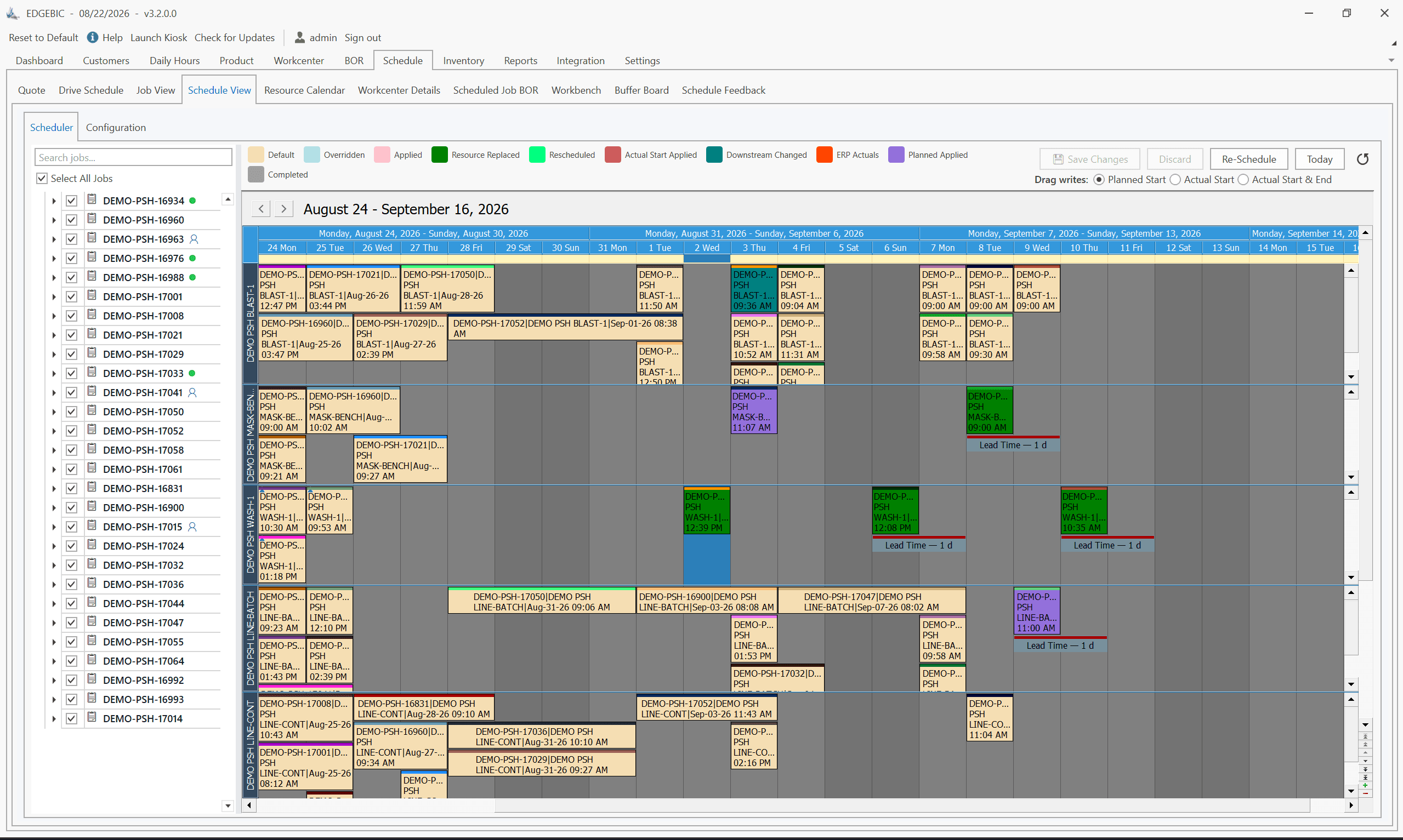
- EDGEBI visual Gantt with drag-and-drop for real-time schedule adjustment
- What-if scenario analysis for testing schedule changes
- Sequence-dependent setup optimization
- Job shop and make-to-order specialization
- 5-day implementation with real production data
For discrete manufacturers - job shops, machine shops, fabricators, assembly operations - RMDB's scheduling engine handles the same complexity at a fraction of the cost.
The Dassault Ecosystem Factor
The biggest differentiator for DELMIA Ortems is not the scheduling engine itself - it is the Dassault Systemes ecosystem.
For manufacturers already invested in CATIA for design, ENOVIA for PLM, and SIMULIA for simulation, DELMIA Ortems creates a unified digital thread where product changes flow automatically from design through scheduling. This integration is powerful for large enterprises where design-to-manufacturing synchronization is a competitive advantage.
For manufacturers who are not Dassault shops - which includes the vast majority of small to mid-size manufacturers - this ecosystem integration adds no value while adding significant cost. RMDB's vendor-agnostic approach works with whatever systems you already have, whether that is SAP, Epicor, JobBOSS, Sage, or any other platform.
Pricing: Enterprise vs Practical
DELMIA Ortems Pricing
As part of the Dassault 3DEXPERIENCE platform, Ortems pricing reflects enterprise software economics:
- Software: $100,000-$300,000+ depending on modules and user count
- Implementation: $75,000-$250,000+
- Annual maintenance/subscription: Significant recurring costs
- Total first-year: $175,000-$550,000+
RMDB Pricing
- One-time license: $25,000 (EDGEBIC APS) or $35,000 (EDGEBIC Complete), sold today as EDGEBIC (RMDB 2.0) by User Solutions
- Implementation: typically 5 days
- Updates: Included, with no per-seat annual fee
- Total first-year: $25,000-$35,000
The cost differential is roughly 3-20x. For small to mid-size manufacturers, this is not a negotiable difference - it is the difference between feasible and not.
When DELMIA Ortems Is the Better Choice
DELMIA Ortems makes sense when:
- You are a large enterprise (500+ employees) with significant scheduling complexity across multiple plants.
- You are invested in the Dassault ecosystem and want design-to-manufacturing digital thread integration.
- You operate in process manufacturing (food, pharma, chemical) where Ortems' batch scheduling and constraint handling excels.
- You have the budget and timeline for a 6-18 month enterprise APS deployment.
- Supply chain planning across facilities is a core requirement.
When RMDB Is the Better Choice
RMDB is the stronger fit when:
- You are a small to mid-size manufacturer who needs enterprise-grade scheduling without enterprise-grade costs.
- Scheduling is your primary need. You do not need PLM integration, 3D simulation, or multi-plant supply chain planning - you need your jobs scheduled correctly and on time.
- Budget is constrained. At 90%+ less than DELMIA Ortems, RMDB makes advanced scheduling accessible.
- Time is critical. Five days to live scheduling vs 6-18 months is decisive when delivery problems are costing customers now.
- You are not a Dassault shop. If your CAD is SolidWorks or Autodesk, your ERP is Epicor or SAP, and your PLM is Teamcenter, the DELMIA ecosystem adds complexity, not value.
- You run discrete manufacturing - job shops, machine shops, fabrication, assembly - where RMDB's specialization aligns perfectly.
The Bottom Line
DELMIA Ortems is a world-class APS platform with deep roots in European manufacturing and strong integration within the Dassault ecosystem. For large enterprises pursuing digital manufacturing transformation within the Dassault technology stack, it delivers genuine value.
For the vast majority of small to mid-size manufacturers, DELMIA Ortems is dramatically over-scoped and over-priced. RMDB delivers the finite capacity scheduling, visual planning, what-if analysis, and constraint management these manufacturers need - in a week, at a fraction of the cost, without ecosystem dependencies.
Frequently Asked Questions
DELMIA Ortems is an Advanced Planning and Scheduling solution owned by Dassault Systemes. Originally developed by Ortems (a French APS company acquired by Dassault in 2014), it is now part of the DELMIA manufacturing operations portfolio alongside MES, quality, and supply chain planning tools.
DELMIA Ortems pricing is not publicly available and is typically sold as part of the broader DELMIA platform. Enterprise deployments commonly range from $100,000 to $500,000+ including software, implementation, and first-year maintenance. RMDB, now EDGEBIC (RMDB 2.0) by User Solutions, costs $25,000 (APS) or $35,000 (Complete) as a one-time perpetual license.
While technically possible, DELMIA Ortems is designed for mid-to-large enterprises. The cost, implementation complexity, and Dassault ecosystem dependencies make it impractical for manufacturers under 200-300 employees. RMDB serves this market segment with equivalent scheduling depth at a fraction of the cost.
RMDB integrates with any ERP system through flexible data exchange. While it does not have native DELMIA connectors, it can exchange scheduling data with any system that supports standard file formats or APIs, including Dassault platforms.
DELMIA Ortems implementations typically take 6-18 months depending on scope and integration complexity. Multi-module deployments within the broader DELMIA platform can extend to 24+ months. RMDB implements in 5 business days.
See Enterprise Scheduling at an SMB Price
You do not need a six-figure APS investment to schedule like one. Contact User Solutions for a demo using your actual production data. See what finite capacity scheduling does to your delivery dates, bottlenecks, and throughput - in five days, not five months. Request a demo today.
Frequently Asked Questions
Ready to Transform Your Production Scheduling?
User Solutions has been helping manufacturers optimize their production schedules for over 35 years. One-time license, 5-day implementation.

User Solutions Team
Manufacturing Software Experts
User Solutions has been developing production planning and scheduling software for manufacturers since 1991. Our team combines 35+ years of manufacturing software expertise with deep industry knowledge to help factories optimize their operations.
Share this article
Related Articles
10 Best APS Software for Manufacturers in 2026
Compare the 10 best Advanced Planning and Scheduling (APS) software solutions, from EDGEBIC (RMDB 2.0) to PlanetTogether, Siemens Opcenter and SAP. Features, pricing, implementation timelines, and recommendations by manufacturer size.

Free vs Paid Production Scheduling Software: What Manufacturers Need to Know
Compare free and paid production scheduling software for manufacturers. Real costs, hidden limitations, and when to invest in a paid scheduling solution.

One-Time License vs SaaS Scheduling Software: Total Cost Comparison
Compare perpetual license and SaaS subscription pricing for manufacturing scheduling software. 5-year TCO analysis, pros, cons, and which model fits your shop.