

Advanced Planning and Scheduling (APS) software is the most impactful technology investment most manufacturers can make. While ERP systems manage orders and inventory, APS software creates production schedules that respect real-world constraints - machine capacity, labor availability, tooling, materials, and customer priorities - simultaneously. The result is fewer late deliveries, less overtime, and better resource utilization.
The challenge is choosing the right APS from a market that ranges from $25,000 one-time focused tools to $500,000+ enterprise platforms. This guide evaluates the 10 best APS software solutions in 2026, organized by manufacturer size and complexity, with honest assessments of strengths and limitations. For deeper comparisons between specific tools, see our production scheduling software comparison guide. Disclosure: User Solutions publishes this comparison and makes EDGEBIC and RMDB, which are included in the list.
Our pick for small to mid-size manufacturers: EDGEBIC, the RMDB 2.0
EDGEBIC is the next generation of RMDB, the finite capacity scheduler User Solutions has refined for 35+ years. Same proven engine, now with a schedule optimizer, Theory of Constraints scheduling and operator skill constraints. One-time license: $25,000 (APS) or $35,000 (Complete, with MRP). No subscription.
How We Evaluated APS Software
We assessed each APS solution across seven criteria:
- Scheduling depth - finite capacity logic, constraint handling, optimization quality
- Usability - interface quality, planner learning curve, daily workflow efficiency
- Implementation speed - time from purchase to productive use
- Integration - ERP compatibility, API quality, data exchange flexibility
- Pricing model - total cost of ownership over 5 years
- Customer fit - manufacturer size, industry vertical, production type
- Vendor stability - company track record, support quality, product investment
The 10 Best APS Software Solutions in 2026
1. EDGEBIC (RMDB 2.0) by User Solutions - Best APS for Small to Mid-Size Manufacturers
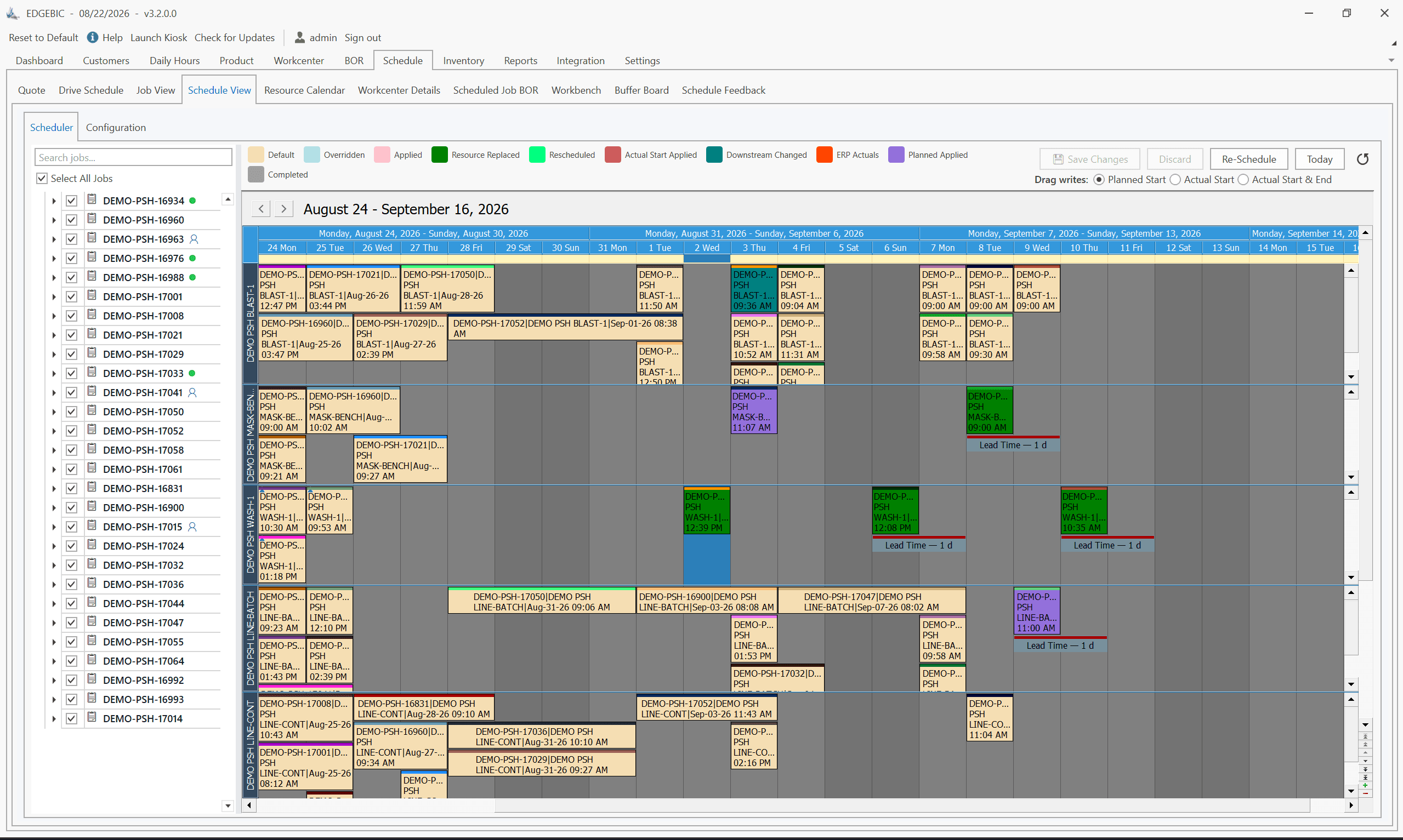
EDGEBIC is RMDB 2.0. It takes RMDB (Resource Manager DB), the finite capacity scheduling system User Solutions has built over 35+ years for small to mid-size manufacturers, and unifies the RMDB scheduling engine with the EDGEBI graphical experience in one modern Windows application. It delivers genuine APS capability - multi-constraint scheduling, what-if analysis, sequence-dependent setups and mathematical schedule optimization - at a fraction of the cost of enterprise APS platforms.
Why RMDB 2.0 matters: RMDB earned its reputation over 35 years in job shops and make-to-order plants. EDGEBIC keeps that proven scheduling engine and the same rapid implementation method, and adds the capabilities that used to separate small-shop tools from enterprise APS.
Key strengths:
- Published one-time perpetual license: $25,000 (EDGEBIC APS) or $35,000 (EDGEBIC Complete) - no recurring per-seat fee
- Two-layer schedule optimizer using Google OR-Tools CP-SAT, which reports how close each schedule is to optimal
- Theory of Constraints anchor scheduling around bottleneck work centers
- Forward and backward (just-in-time) finite capacity scheduling against real shift calendars, holidays and downtime
- Labor as a real constraint: operator skills, certifications and shift rosters
- Sequence-dependent setup matrices, lot streaming and work center groups
- Drag-and-drop Gantt rescheduling and what-if scenarios compared side by side
- Implementation in days, following the 5-day RMDB methodology with your real production data
- Integrates with any ERP through Excel, CSV and database import masks (SAP, Oracle, Epicor, JobBOSS, Fourth Shift, Sage, and more)
Limitations:
- Single-plant focus (not designed for multi-plant supply chain synchronization)
- Installed Windows desktop application, not browser-based SaaS
- Does not include MES or quality management modules
- The APS edition has no MRP or purchasing (EDGEBIC Complete adds them)
Best for: Job shops, make-to-order manufacturers, and any operation with 10-500 employees where scheduling is the primary operational challenge. Existing RMDB users get a direct upgrade path.
Pricing: $25,000 for EDGEBIC APS or $35,000 for EDGEBIC Complete (adds MRP, inventory, purchasing and material pegging), both one-time. See EDGEBIC pricing.
2. PlanetTogether - Best Mid-Market APS
PlanetTogether's Galaxy APS platform provides strong scheduling capabilities for mid-size manufacturers with more complex requirements than the EDGEBIC and RMDB target market. It offers multi-plant scheduling, AI-assisted optimization, and broad ERP integration.
Key strengths:
- Advanced scheduling with AI-assisted optimization
- Multi-plant capable with supply chain synchronization
- Strong ERP integration library (SAP, Oracle, Microsoft Dynamics, Epicor)
- Visual scheduling with what-if scenarios
- Cloud and on-premise deployment options
Limitations:
- Higher cost than EDGEBIC or RMDB ($50,000-$200,000+), usually with recurring fees
- Implementation takes 3-6 months
- Can be complex for smaller operations
Best for: Mid-size manufacturers (100-1,000 employees) with multi-plant operations or complex supply chains.
Pricing: $50,000-$200,000+ depending on configuration. Annual subscription or license.
3. Siemens Opcenter APS - Best Enterprise APS
Siemens Opcenter APS (formerly Preactor) is one of the most established enterprise APS platforms, now integrated into Siemens' comprehensive Xcelerator manufacturing portfolio.
Key strengths:
- Three tiers (Express, Standard, Advanced) scaling from basic to sophisticated optimization
- Native integration with Siemens MES, PLM, and digital twin platforms
- Advanced optimization algorithms including linear programming
- Massive installed base with strong partner network
- Industry-specific configurations available
Limitations:
- Expensive ($75,000-$500,000+)
- Long implementation cycles (6-18 months)
- Requires IT infrastructure and expertise
- Best value within the Siemens ecosystem
Best for: Large enterprises (500+ employees) already invested in or adopting Siemens manufacturing technology.
Pricing: $75,000-$500,000+. Annual maintenance 18-22%.
4. Asprova - Best for High-Volume Manufacturing
Asprova is a Japanese APS system renowned for scheduling speed, capable of processing 100,000+ operations in seconds. It dominates the Asian APS market and serves high-volume manufacturers globally.
Key strengths:
- Industry-leading scheduling speed for massive operation counts
- Deep pegging and lot traceability
- Strong in automotive and electronics manufacturing
- Multi-plant and supply chain planning capabilities
- Configurable dispatching rules
Limitations:
- Higher cost ($30,000-$150,000+)
- North American support infrastructure is thinner than in Asia
- Implementation takes 3-9 months
- Better suited for high-volume than job shop environments
Best for: High-volume manufacturers, automotive tier-1 suppliers, and electronics manufacturers - especially those with Asian operations.
Pricing: $30,000-$150,000+. Annual maintenance.
5. DELMIA Ortems (Dassault Systemes) - Best for Process Manufacturing
DELMIA Ortems provides APS capability within Dassault Systemes' DELMIA manufacturing operations platform. It has particular strength in process manufacturing industries.
Key strengths:
- Strong process manufacturing scheduling (food, pharma, chemical)
- Integration with Dassault's 3DEXPERIENCE platform
- Batch optimization and shelf-life constraint handling
- Multi-site planning with supply chain synchronization
- Connected to CATIA/ENOVIA for design-to-production digital thread
Limitations:
- Expensive ($100,000-$500,000+)
- Long implementation (6-18 months)
- Most valuable within Dassault ecosystem
- Over-scoped for small discrete manufacturers
Best for: Process manufacturers (food, pharmaceutical, chemical) and companies in the Dassault ecosystem.
Pricing: $100,000-$500,000+. Enterprise subscription.
6. Infor APS - Best Industry-Specific Enterprise APS
Infor APS is embedded within Infor's industry-specific CloudSuite platforms, offering tailored scheduling for automotive, aerospace, food, and other verticals.
Key strengths:
- Industry-specific scheduling logic for multiple verticals
- Infor Coleman AI for predictive scheduling
- Deep integration with Infor ERP and MES
- Cloud-native on AWS
- Strong analytics through Infor Birst
Limitations:
- Only available within Infor CloudSuite ecosystem
- Enterprise pricing ($200,000-$1,000,000+ for CloudSuite)
- 9-18 month implementation cycles
- Overkill for small manufacturers
Best for: Mid-to-large manufacturers already on or moving to Infor CloudSuite.
Pricing: Part of Infor CloudSuite subscription. $200,000-$1,000,000+ total deployment.
7. Epicor APS - Best ERP-Integrated Scheduling
Epicor APS provides scheduling within the Epicor Kinetic ERP platform, offering convenience for existing Epicor customers who want scheduling without adding another vendor.
Key strengths:
- Tight integration with Epicor Kinetic ERP data
- Finite capacity scheduling with capacity visualization
- Familiar interface for Epicor users
- No separate vendor relationship needed
- Available in cloud and on-premise Epicor deployments
Limitations:
- Less scheduling depth than dedicated APS tools
- Limited what-if scenario analysis
- Tied to Epicor ecosystem
- APS modules cost extra beyond base Epicor subscription
Best for: Existing Epicor customers with moderate scheduling complexity.
Pricing: Add-on to Epicor subscription. Bundled pricing.
8. SAP IBP/PP-DS - Best for SAP Enterprise Customers
SAP Integrated Business Planning (IBP) and PP-DS (Production Planning & Detailed Scheduling) provide APS capability within the SAP ecosystem. PP-DS in SAP S/4HANA handles detailed finite capacity scheduling.
Key strengths:
- Deep integration with SAP S/4HANA
- Comprehensive constraint-based scheduling
- Advanced optimization with SAP's scheduling heuristics
- Global supply chain planning through SAP IBP
- Massive global support infrastructure
Limitations:
- Extremely expensive (SAP S/4HANA deployments often exceed $1M)
- Very long implementation timelines (12-36 months)
- Requires dedicated SAP technical resources
- Significant overkill for small manufacturers
Best for: Large enterprises already running SAP S/4HANA.
Pricing: Part of SAP S/4HANA. Total deployment $500,000-$5,000,000+.
9. Lillyworks Visual DBR - Best Drum-Buffer-Rope Scheduling
Lillyworks Visual DBR takes a different approach, applying Theory of Constraints (TOC) Drum-Buffer-Rope methodology to production scheduling.
Key strengths:
- Purpose-built for Theory of Constraints scheduling
- Clear bottleneck identification and management
- Visual scheduling focused on constraint resource
- Designed for job shops and make-to-order
- Simpler than traditional APS for TOC-oriented shops
Limitations:
- TOC-specific approach may not suit all manufacturing models
- Smaller vendor with limited market presence
- Less feature-rich than full APS platforms
- Narrower integration options
Best for: Manufacturers committed to Theory of Constraints methodology.
Pricing: Mid-range. Contact vendor.
10. Optessa - Best for Automotive Sequencing
Optessa specializes in advanced sequencing and scheduling optimization, particularly for automotive assembly and other sequence-sensitive manufacturing.
Key strengths:
- Advanced sequencing optimization algorithms
- Automotive assembly line balancing
- Multi-objective optimization
- Handles complex sequencing constraints
- Used by major automotive OEMs
Limitations:
- Highly specialized for automotive/sequencing
- Enterprise pricing
- Not designed for general-purpose job shop scheduling
- Limited applicability outside automotive and assembly
Best for: Automotive OEMs and assembly operations with complex sequencing requirements.
Pricing: Enterprise. Contact vendor.
APS Comparison Summary Table
| APS Software | Best For | Price Range | Implementation | Deployment |
|---|---|---|---|---|
| EDGEBIC (RMDB 2.0) | SMB job shops and MTO | $25K-$35K one-time | Days | Windows, on-premise |
| PlanetTogether | Mid-market | $50K-$200K | 3-6 months | Cloud/on-prem |
| Siemens Opcenter | Siemens enterprises | $75K-$500K | 6-18 months | Cloud/on-prem |
| Asprova | High-volume | $30K-$150K | 3-9 months | On-premise |
| DELMIA Ortems | Process mfg | $100K-$500K | 6-18 months | Cloud/on-prem |
| Infor APS | Infor customers | $200K-$1M+ (suite) | 9-18 months | Cloud |
| Epicor APS | Epicor customers | Add-on pricing | Part of ERP | Cloud/on-prem |
| SAP PP-DS | SAP customers | $500K-$5M+ (suite) | 12-36 months | Cloud/on-prem |
| Lillyworks | TOC shops | Mid-range | 1-3 months | On-premise |
| Optessa | Automotive | Enterprise | 6-12 months | On-premise |
How to Choose the Right APS
By Manufacturer Size
- 10-50 employees: EDGEBIC. Enterprise APS is overkill and unaffordable. EDGEBIC, the RMDB 2.0, delivers the scheduling depth you need at a price that makes sense.
- 50-200 employees: EDGEBIC (RMDB 2.0) for a single plant, or PlanetTogether if you need multi-plant synchronization.
- 200-1,000 employees: PlanetTogether, Siemens Opcenter, or your ERP vendor's APS (Epicor, Infor), depending on ecosystem and complexity.
- 1,000+ employees: Siemens Opcenter, SAP PP-DS, Infor APS, or DELMIA Ortems, depending on your existing technology stack.
By Manufacturing Type
- Job shops: EDGEBIC (RMDB 2.0) or Lillyworks
- High-volume discrete: Asprova or Siemens Opcenter
- Process manufacturing: DELMIA Ortems or Infor APS
- Automotive assembly: Optessa or Asprova
- Mixed-mode: PlanetTogether or Siemens Opcenter
By Budget
- $25,000-$35,000 one-time: EDGEBIC, the RMDB 2.0 (APS edition $25,000, Complete with MRP $35,000, no subscription)
- $50,000-$200,000: PlanetTogether or Asprova
- $200,000+: Siemens Opcenter, DELMIA Ortems, Infor, or SAP
Common APS Selection Mistakes
Mistake 1: Over-buying. A 30-person job shop does not need Siemens Opcenter. The implementation alone would take longer than the ROI timeline.
Mistake 2: Choosing based on demo impressions. Every APS looks great in a demo with sample data. Insist on seeing your data in the system before committing.
Mistake 3: Ignoring total cost of ownership. A $50/user/month tool with 10 users costs $60,000 over 10 years. Compare against one-time license options.
Mistake 4: Underestimating implementation. Budget 2-3x the software cost for implementation services on enterprise APS. Or choose a tool like EDGEBIC, built on the RMDB implementation method, where going live takes days, not months.
Mistake 5: Treating APS as an IT project. APS adoption succeeds when production planners drive requirements. IT should support, not lead, the selection process.
Frequently Asked Questions
APS (Advanced Planning and Scheduling) software uses finite capacity logic, constraint-based algorithms, and optimization techniques to create production schedules that account for machine capacity, labor availability, material constraints, and customer priorities simultaneously. It replaces the infinite-capacity assumptions of basic MRP with realistic, executable schedules.
APS costs vary dramatically by segment. EDGEBIC, the RMDB 2.0 from User Solutions, is a published one-time perpetual license: $25,000 for EDGEBIC APS and $35,000 for EDGEBIC Complete (adds MRP, inventory and purchasing), with no recurring per-seat fee. Mid-market APS like PlanetTogether or Asprova range from $50,000-$200,000. Enterprise APS from Siemens, SAP, or Infor can exceed $500,000. Cloud subscriptions add ongoing costs of $100-$500+ per user per month.
MRP plans materials based on infinite capacity assumptions - it assumes unlimited production capacity. APS adds finite capacity scheduling that respects real-world constraints like machine hours, labor availability, and tooling. APS answers "when can we actually make this?" while MRP answers "what materials do we need?"
Implementation timelines range from days (EDGEBIC, following the 5-day RMDB methodology) to 18+ months (enterprise solutions like Siemens Opcenter or SAP IBP). Most mid-market APS tools take 3-6 months. The timeline depends on system complexity, integration requirements, data readiness, and organizational change management.
If your shop experiences late deliveries, bottleneck confusion, excessive overtime, or inability to give customers accurate delivery dates, you likely need APS - regardless of size. Small manufacturers often see the fastest ROI because their scheduling pain is concentrated and improvements are immediately visible.
Yes. Most APS tools are designed to work as add-ons to existing ERP systems. EDGEBIC (RMDB 2.0), PlanetTogether, and Siemens Opcenter all integrate with major ERPs including SAP, Oracle, Epicor, Infor, and JobBOSS. The APS handles scheduling while the ERP manages orders, inventory, and financials.
For job shops, the best APS software handles high-mix variability, sequence-dependent setups, alternate routings, and frequent rescheduling. EDGEBIC excels in this environment: it is RMDB 2.0, carrying the RMDB engine and 35+ years of job shop scheduling expertise, and adds Theory of Constraints anchor scheduling, operator skill constraints and a schedule optimizer, on a one-time license. PlanetTogether and Opcenter APS also serve job shops but at significantly higher cost.
EDGEBIC is RMDB 2.0: the next generation of RMDB (Resource Manager DB), the finite capacity scheduling system User Solutions has built for 35+ years. It unifies the RMDB scheduling engine and the EDGEBI graphical experience in one Windows application and adds backward (just-in-time) scheduling, Theory of Constraints anchor scheduling, sequence-dependent setup matrices, operator skills and shift rosters, and a two-layer optimizer using Google OR-Tools CP-SAT. It sells as EDGEBIC APS ($25,000) or EDGEBIC Complete ($35,000, adds MRP), both one-time licenses.
Start With the APS That Fits Your Scale
The best APS is the one your planners will actually use every day. For small to mid-size manufacturers, that means a tool that implements fast, costs reasonably, and delivers scheduling intelligence without enterprise complexity. That tool is EDGEBIC, the RMDB 2.0: the RMDB engine proven over 35+ years, now with optimization, TOC scheduling and labor constraints, on a published one-time license. Contact User Solutions to see EDGEBIC with your data - days to live scheduling, no subscription. Request a demo today.
Frequently Asked Questions
Ready to Transform Your Production Scheduling?
User Solutions has been helping manufacturers optimize their production schedules for over 35 years. One-time license, 5-day implementation.

User Solutions Team
Manufacturing Software Experts
User Solutions has been developing production planning and scheduling software for manufacturers since 1991. Our team combines 35+ years of manufacturing software expertise with deep industry knowledge to help factories optimize their operations.
Share this article
Related Articles

Free vs Paid Production Scheduling Software: What Manufacturers Need to Know
Compare free and paid production scheduling software for manufacturers. Real costs, hidden limitations, and when to invest in a paid scheduling solution.

One-Time License vs SaaS Scheduling Software: Total Cost Comparison
Compare perpetual license and SaaS subscription pricing for manufacturing scheduling software. 5-year TCO analysis, pros, cons, and which model fits your shop.
RMDB vs Asprova: Production Scheduling Software Compared (2026)
Compare RMDB and Asprova APS for manufacturing scheduling. Features, pricing, implementation, and which solution fits your production environment.