
One-Time License vs SaaS Scheduling Software: Total Cost Comparison
 User Solutions Team
The pricing model of your scheduling software matters as much as the features. One-time license vs SaaS is not just a financial decision - it affects data ownership, vendor dependency, operational resilience, and long-term flexibility. For manufacturers evaluating production scheduling solutions, understanding both models is essential before committing budget.
This guide provides a detailed comparison of perpetual licensing and SaaS subscription models specifically for manufacturing scheduling software, including 5-year total cost analysis and practical recommendations. For feature comparisons across specific tools, see our production scheduling software comparison guide. For the data-control, ITAR and uptime side of the decision, including why many RMDB users run their scheduling on their own servers, see on-premise vs cloud manufacturing software.
How Each Model Works
One-Time Perpetual License
You pay once for the right to use the software indefinitely. The license fee covers the software itself. Optional annual maintenance provides updates and support. If you stop paying maintenance, the software keeps working - you just do not get new versions or vendor support.
Example: RMDB by User Solutions uses this model, sold today as EDGEBIC (RMDB 2.0). You pay $25,000 (APS) or $35,000 (Complete) once, with updates included, and own the scheduling software outright.
SaaS (Software as a Service) Subscription
You pay monthly or annually for access to the software, which runs in the vendor's cloud. As long as you pay, you have access. When you stop paying, access ends. Updates are included in the subscription. Your data lives on the vendor's servers.
Example: MRPeasy, Katana, and many modern manufacturing tools use this model. Monthly fees range from $49 to $500+ per user.
5-Year Total Cost of Ownership
The real comparison is total cost over the lifespan of your use - not the sticker price.
Scenario: 5 Users, Mid-Level Scheduling Capability
| Cost Element | One-Time License (RMDB) | SaaS Subscription (Typical) |
|---|---|---|
| Year 1 | $25,000 (license) | $15,000 ($250/user/month) |
| Year 2 | $0 (updates included) | $15,000 |
| Year 3 | $0 | $15,000 |
| Year 4 | $0 | $15,000 |
| Year 5 | $0 | $15,000 |
| 5-Year Total | $25,000 | $75,000 |
| 10-Year Total | $25,000 | $150,000 |
The gap widens every year. By year 3, the one-time license has paid for itself. By year 10, the savings are dramatic.
SaaS Price Escalation Risk
SaaS vendors can (and do) raise prices. Average B2B SaaS price increases run 5-10% annually. That $250/user/month in year 1 becomes $325-$400/user/month by year 5 if the vendor raises prices. Your negotiating leverage after you are dependent on the system is minimal.
One-time licenses lock in your cost. RMDB's perpetual license price does not change after purchase. Maintenance is optional and typically fixed or predictable.
Beyond Price: Operational Considerations
Data Ownership and Control
One-time license (on-premise): Your data lives on your servers. You control backups, security, access, and retention. No third party can access your production scheduling data. This matters for manufacturers with defense contracts, ITAR requirements, or strict customer NDAs.
SaaS: Your data lives on the vendor's cloud infrastructure (usually AWS, Azure, or Google Cloud). The vendor manages backups and security. You are dependent on the vendor's data policies and must trust their security practices. Data export capabilities vary by vendor - some make it easy, others make it painful.
Internet Dependency
One-time license (on-premise): The software runs on your local network. No internet required for daily operation. Your scheduling tool works during internet outages, which is critical for manufacturers in areas with unreliable connectivity or with air-gapped networks for security purposes.
SaaS: Requires internet access for every use. Internet outages mean no scheduling. For a production planner who needs to adjust the schedule at 6 AM when a machine goes down, cloud-dependent tools create risk.
Vendor Dependency
One-time license: If the vendor goes out of business, your software keeps working. You own it. You may lose future updates, but your current scheduling capability is preserved.
SaaS: If the vendor goes out of business, raises prices beyond your budget, or deprecates the product, you lose access. The switching costs include not just finding a new tool but migrating data and retraining staff.
Updates and Maintenance
One-time license: Updates come through optional maintenance contracts. You choose when to update - no forced changes. This stability matters when your scheduling processes are dialed in and you do not want surprises.
SaaS: Updates are automatic and continuous. You always have the latest version, which is convenient. However, you also have no control over changes. A UI redesign or feature change can disrupt your planner's workflow without warning.
Arguments for SaaS
Despite the cost disadvantage, SaaS has legitimate benefits:
Lower Upfront Investment
SaaS spreads the cost over time, which helps cash-constrained businesses. A $250/month payment is easier to approve than a $10,000 purchase order, even though the long-term cost is much higher.
No IT Infrastructure
SaaS eliminates the need for servers, backups, and IT administration. For manufacturers with no IT staff, this is a genuine advantage. The vendor handles everything.
Cloud Accessibility
Access scheduling from anywhere with an internet connection - home, the road, another facility. For distributed teams, this flexibility matters.
Automatic Updates
Always on the latest version without manual upgrade processes. New features appear automatically.
Easy Evaluation
Start with a free trial or pay monthly. If it does not work, cancel and walk away. Low commitment makes evaluation easier.
Arguments for One-Time License
Lower Total Cost
Over any period beyond 2-3 years, one-time licenses cost significantly less. For manufacturers who plan to use scheduling software for 5-10+ years (as most do), the savings are substantial.
Complete Data Ownership
Your scheduling data - jobs, routings, resources, historical schedules - lives on your infrastructure. No third-party access, no cloud security risks, no data migration concerns.
Operational Independence
No internet requirement. No vendor dependency for daily operation. No risk of access loss from billing disputes, vendor changes, or price increases.
Price Stability
Your cost is locked in at purchase. No annual price increases, no "new pricing tier" surprises, no forced upgrades to higher plans.
Long-Term Ownership
The software is an asset you own, not a service you rent. Like buying a CNC machine vs leasing one - ownership builds value.
Which Model Fits Which Manufacturer?
SaaS Makes Sense When:
- You are a startup or very new manufacturer testing whether scheduling software delivers value
- Cash flow is extremely tight and $25,000 upfront is difficult
- You have no IT infrastructure and no plans to build one
- Your team is distributed across multiple locations and needs cloud access
- You expect to use the tool for less than 2-3 years
One-Time License Makes Sense When:
- You plan to use scheduling software for 3+ years (nearly every manufacturer)
- Long-term cost matters (it always should)
- Data security and ownership are important (defense, aerospace, regulated industries)
- You want to own your tools, not rent them
- Internet reliability is a concern
- You prefer fixed, predictable costs without escalation risk
For most manufacturers, the one-time license model is the more rational financial decision. The SaaS model's lower upfront cost is appealing but creates a permanent expense that compounds over time.
RMDB: One-Time License, Enterprise Scheduling
RMDB by User Solutions is one of the few remaining APS tools offering a one-time perpetual license. This is a deliberate choice based on 35+ years of working with manufacturers who value ownership, predictable costs, and long-term partnerships over vendor lock-in.
What you get with RMDB's one-time license:
- Full finite capacity scheduling with multi-constraint optimization
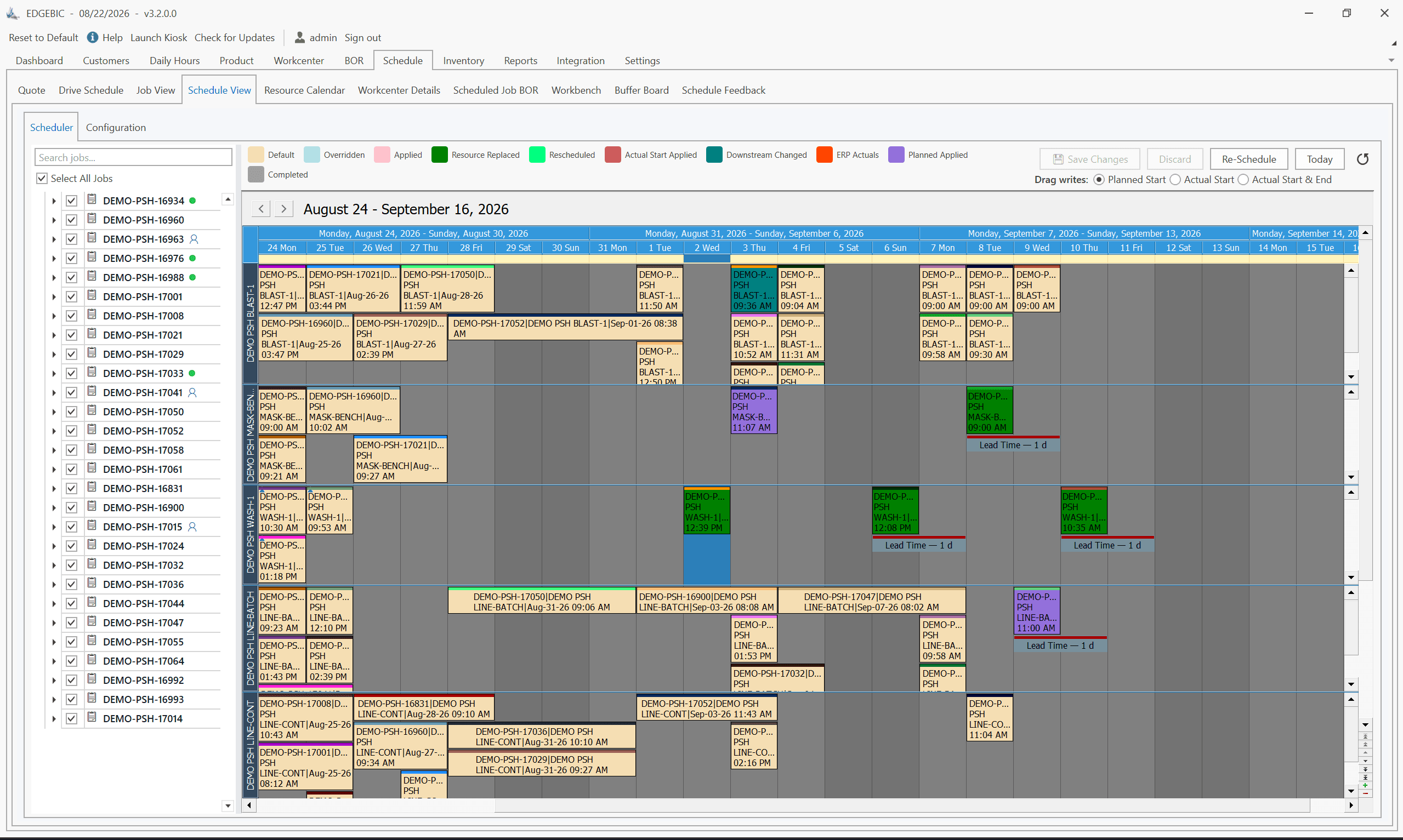
- EDGEBI interactive Gantt charts with drag-and-drop
- What-if scenario analysis
- Integration with any ERP system
- 5-day implementation with your real production data
- Scheduling expertise from a team with 35+ years of manufacturing knowledge
No monthly fees. No price escalation. No vendor lock-in. One investment, permanent value.
Frequently Asked Questions
Over 3+ years, one-time perpetual licenses are almost always cheaper. A $10,000 one-time license with $2,000 annual maintenance costs $18,000 over 5 years. A comparable SaaS tool at $300/month costs $18,000 in the same period, but your cost continues forever with SaaS - you never own the software.
You lose access to the software and, in most cases, your data becomes inaccessible. Some vendors allow data export before cancellation, but your scheduling history, configurations, and customizations are lost. With a perpetual license, the software keeps working even if you cancel maintenance.
Yes. RMDB by User Solutions offers a one-time perpetual license for finite capacity scheduling. Several on-premise APS vendors also offer perpetual licensing. The market has shifted toward SaaS, but perpetual license options still exist for manufacturers who prefer ownership.
SaaS advantages include lower upfront cost, automatic updates, cloud accessibility from anywhere, reduced IT infrastructure requirements, and predictable monthly budgeting. SaaS is easier to start with but more expensive to sustain long-term.
Perpetual license advantages include lower total cost over 3+ years, complete data ownership and control, no internet dependency for operation, no price escalation risk, and the ability to continue using the software indefinitely even if you stop paying maintenance.
Own Your Scheduling Software
Stop renting. Start owning. Contact User Solutions to learn about RMDB's one-time perpetual license model and see how 5-day implementation gets you scheduling with real data in a single business week. Request a demo today.
Frequently Asked Questions
Ready to Transform Your Production Scheduling?
User Solutions has been helping manufacturers optimize their production schedules for over 35 years. One-time license, 5-day implementation.

User Solutions Team
Manufacturing Software Experts
User Solutions has been developing production planning and scheduling software for manufacturers since 1991. Our team combines 35+ years of manufacturing software expertise with deep industry knowledge to help factories optimize their operations.
Share this article
Related Articles
10 Best APS Software for Manufacturers in 2026
Compare the 10 best Advanced Planning and Scheduling (APS) software solutions, from EDGEBIC (RMDB 2.0) to PlanetTogether, Siemens Opcenter and SAP. Features, pricing, implementation timelines, and recommendations by manufacturer size.

Free vs Paid Production Scheduling Software: What Manufacturers Need to Know
Compare free and paid production scheduling software for manufacturers. Real costs, hidden limitations, and when to invest in a paid scheduling solution.
RMDB vs Asprova: Production Scheduling Software Compared (2026)
Compare RMDB and Asprova APS for manufacturing scheduling. Features, pricing, implementation, and which solution fits your production environment.