
Free vs Paid Production Scheduling Software: What Manufacturers Need to Know
 User Solutions Team
Every manufacturer starts the scheduling software search with the same question: "Is there something free that works?" It is a reasonable question. Software budgets are tight, and many manufacturers have gotten by with spreadsheets for years. The honest answer is that free scheduling tools exist, but they have significant limitations that cost manufacturers far more than a paid solution ever would. This guide breaks down what free options actually provide, where they fail, and when investing in paid production scheduling software delivers meaningful ROI.
For a comparison of paid scheduling tools, see our production scheduling software comparison guide.
What Free Scheduling Options Actually Exist
Spreadsheets (Excel, Google Sheets)
The most common "free" scheduling tool is the spreadsheet that your planner has been building for years. Custom Excel or Google Sheets workbooks with color-coded cells, VLOOKUP formulas, and manually maintained Gantt-style views are the scheduling backbone of thousands of small manufacturers.
What spreadsheets do well:
- Flexible - can model almost anything with enough effort
- Familiar - no training required
- Free (if you already have Office or Google Workspace)
- Full control over layout and logic
What spreadsheets cannot do:
- Finite capacity scheduling - spreadsheets do not automatically resolve resource conflicts
- Cascading impact analysis - changing one job does not automatically show effects on other jobs
- What-if scenarios - testing alternatives requires duplicating and manually modifying entire workbooks
- Multi-constraint optimization - simultaneously considering machines, labor, tooling, and materials is beyond spreadsheet logic
- Real-time updates - spreadsheets are static snapshots that go stale the moment something changes on the floor
Open-Source Tools
A few open-source scheduling and project management tools can be adapted for manufacturing:
- LibrePlan: Open-source project planning and scheduling. Handles resource allocation and Gantt charts but was designed for project management, not manufacturing.
- ERPNext Manufacturing: Open-source ERP with a manufacturing module. Includes basic production planning but not finite capacity scheduling.
- Odoo Manufacturing (Community): Open-source ERP with manufacturing operations. Provides work order management and basic planning.
These tools are technically free (no license cost) but require significant setup, customization, and ongoing maintenance. None provide the APS-level scheduling that manufacturers with complexity need.
Free Tiers of Cloud Tools
Some cloud manufacturing tools offer limited free tiers:
- MRPeasy: Free trial, but no permanent free tier for production use
- Katana: Free trial only
- Various PM tools: Trello, Asana, and Monday.com have free tiers but are not manufacturing scheduling tools
Free tiers are useful for evaluation but are not viable for ongoing production scheduling.
The Real Cost of "Free" Scheduling
The price tag on scheduling software is easy to see. The cost of not having proper scheduling is invisible but far larger.
Late Deliveries
Without finite capacity logic, schedules promise delivery dates that the shop cannot physically achieve. The result is chronic lateness. According to manufacturing industry data, manufacturers without APS software average 70-80% on-time delivery. With APS, that number typically reaches 90-95%+.
Every late delivery risks customer relationships, expediting costs, and potential lost business. If a single lost customer represents $50,000-$200,000 in annual revenue, the cost of "free" scheduling is catastrophic.
Overtime and Expediting
Poor scheduling creates artificial urgency. Jobs that should flow smoothly through the shop stack up at bottleneck work centers, forcing overtime, weekend shifts, and premium freight. Manufacturers consistently report 15-25% reduction in overtime after implementing proper scheduling software.
For a shop spending $100,000/year on overtime, a 20% reduction saves $20,000 annually - enough to cover RMDB's one-time license, now $25,000 for EDGEBIC APS, in about 15 months.
Planner Productivity
The average production planner using spreadsheets spends 4-6 hours per day maintaining the schedule - updating cells, checking conflicts, making phone calls to verify status, and firefighting emergencies. With APS software, schedule maintenance drops to 1-2 hours, freeing the planner to focus on strategic decisions rather than data entry.
Throughput Loss
Inefficient scheduling leaves capacity on the table. Sequence-dependent setups that are not optimized waste machine time. Unbalanced work center loading creates bottlenecks that reduce total throughput. Manufacturers typically see 10-20% throughput improvement after implementing APS - equivalent to adding capacity without capital investment.
The Hidden Cost Calculation
| Cost Category | Annual Cost Without APS | Improvement With APS | Annual Savings |
|---|---|---|---|
| Late delivery penalties/losses | $50,000-$200,000 | 20-40% reduction | $10,000-$80,000 |
| Overtime | $75,000-$150,000 | 15-25% reduction | $11,250-$37,500 |
| Planner time (opportunity cost) | $40,000-$60,000 | 50% time savings | $20,000-$30,000 |
| Throughput loss | $100,000-$500,000 | 10-20% improvement | $10,000-$100,000 |
| Total annual hidden cost | $51,250-$247,500 |
Against these costs, even enterprise APS software pays for itself. A $25,000-$35,000 one-time investment in RMDB-engine scheduling (EDGEBIC by User Solutions) typically pays back within months.
When Free Tools Are Acceptable
Free scheduling tools work when:
- Your operation is very small: Under 10 machines, under 20 active orders, 1-2 work centers
- Production flow is simple: Linear routing, predictable cycle times, minimal setup variability
- Schedule changes are rare: Stable demand with few rush orders or disruptions
- On-time delivery is not a competitive factor: Your customers tolerate variable lead times
- You have one product line: Minimal mix complexity
If all five conditions are true, a well-maintained spreadsheet may serve you adequately. The moment any condition stops being true, the limitations of free tools become costly.
When to Invest in Paid Scheduling Software
Invest when you experience any of these signals:
- Delivery dates are regularly missed - customers are complaining, and your planner cannot explain why
- The schedule is constantly wrong - what is on paper does not match what is happening on the floor
- Rush orders cause chaos - inserting a rush order cascades confusion through the entire schedule
- Bottlenecks are invisible - you do not know which work center is actually constraining throughput
- Quoting is guesswork - you cannot give customers accurate delivery dates because you do not know your actual capacity
- Overtime is driven by scheduling, not demand - you are working weekends because of poor sequencing, not because you have too much work
- Your planner is the single point of failure - all scheduling knowledge lives in one person's head (or their spreadsheet)
Paid Scheduling Options by Budget
$25,000-$35,000 (One-Time)
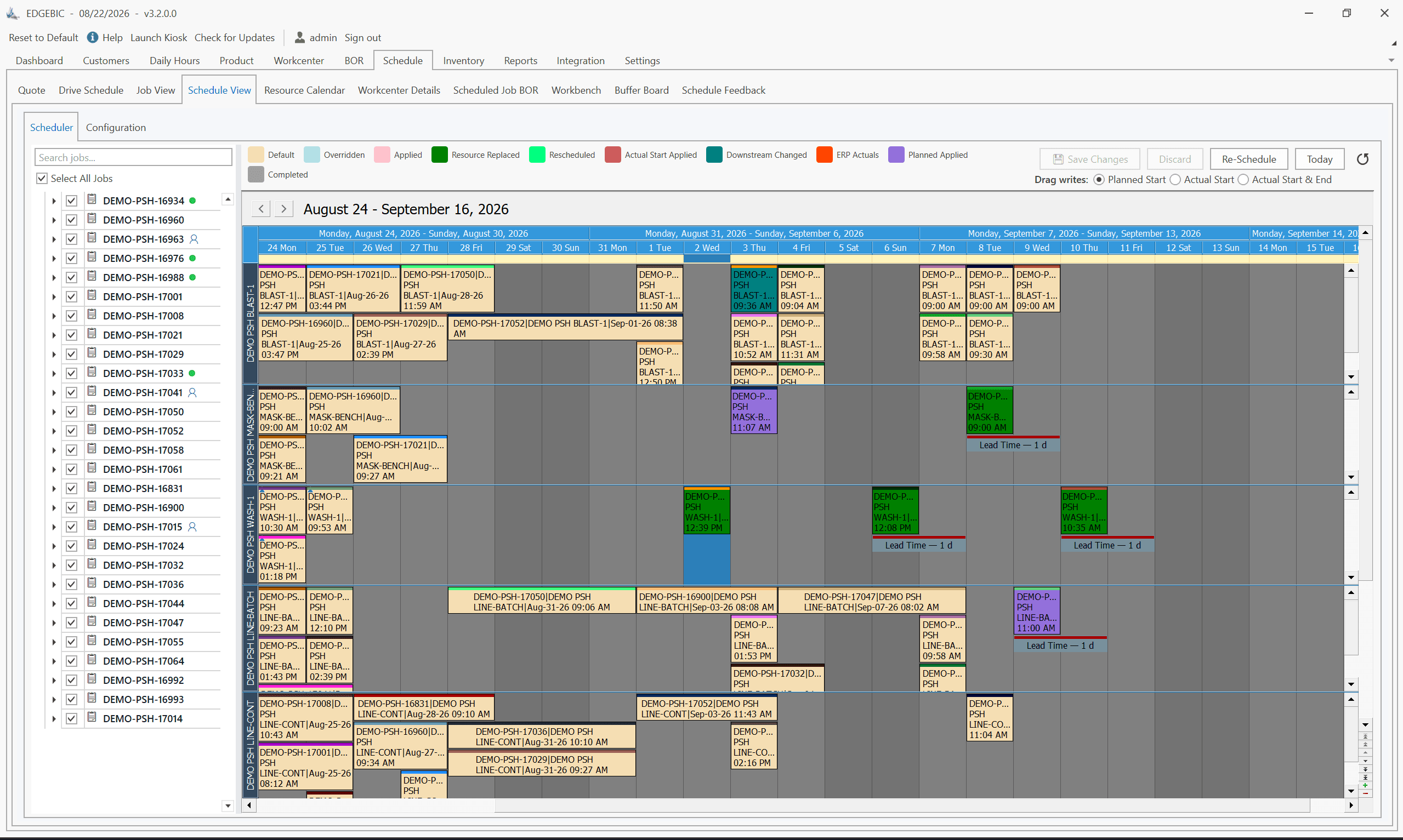
RMDB by User Solutions: Full finite capacity scheduling, Gantt visualization (successor to the legacy EDGEBI visual layer), what-if analysis, multi-constraint optimization. One-time perpetual license, sold today as EDGEBIC (RMDB 2.0) by User Solutions at $25,000 (APS) or $35,000 (Complete). 5-day implementation. For most small manufacturers, this is the sweet spot - enterprise scheduling capability at a practical price with no recurring fees.
$5,000-$15,000/Year (Subscription)
Cloud MRP/ERP tools with basic scheduling: MRPeasy, Katana, DELMIAWorks. These provide broader ERP functionality with lighter scheduling capability. Good if you need ERP and scheduling but have simple scheduling requirements.
$50,000-$200,000+
Mid-market dedicated APS: PlanetTogether, Asprova. Deeper optimization, multi-plant capability, and AI-assisted scheduling for mid-size manufacturers with higher complexity.
$200,000+
Enterprise APS: Siemens Opcenter, Infor APS, SAP PP-DS, DELMIA Ortems. Full enterprise-grade scheduling for large manufacturers with multi-site operations.
The Bottom Line
Free scheduling tools exist but do not provide the finite capacity logic, constraint optimization, or what-if analysis that manufacturing scheduling actually requires. The hidden costs of "free" - late deliveries, overtime, throughput loss, and planner inefficiency - typically exceed the cost of paid software by 10-50x.
For small to mid-size manufacturers, RMDB offers the most practical path from free-tool limitations to genuine scheduling intelligence: a one-time investment that pays for itself within months and costs less annually than the overtime savings it generates.
Frequently Asked Questions
Yes, several options exist including Google Sheets templates, open-source tools like LibrePlan, free tiers of cloud MRP tools, and basic project management tools adapted for production. However, none provide the finite capacity scheduling, multi-constraint optimization, or what-if analysis that dedicated APS software offers.
Spreadsheets work for very small operations (under 10 machines, under 20 active orders) with simple production flows. They fail when scheduling complexity increases because they cannot model finite capacity constraints, do not automatically resolve resource conflicts, and cannot show cascading impacts of schedule changes.
Hidden costs include planner time building and maintaining spreadsheet models, missed deliveries from lack of finite capacity logic, overtime caused by poor schedule optimization, customer losses from inaccurate delivery promises, and the opportunity cost of not having scheduling intelligence. These typically cost 10-50x more than a paid scheduling tool.
Invest when you experience any of these: regularly missing delivery dates, scheduling conflicts that require manual firefighting, inability to give customers accurate lead times, overtime driven by poor scheduling rather than genuine demand, or when your planner spends more time updating spreadsheets than making decisions.
Paid scheduling ranges from $25,000-$35,000 one-time (RMDB, now EDGEBIC by User Solutions) to $50,000-$500,000+ for enterprise APS. Cloud subscriptions run $100-$500+ per user per month. For small manufacturers, RMDB's one-time license offers the best value - enterprise scheduling capability without enterprise costs.
Stop Paying the Hidden Cost of Free
The most expensive scheduling software is the one that does not work. Contact User Solutions to see what proper finite capacity scheduling does with your actual production data - in five days, for a one-time investment. Request a demo today.
Frequently Asked Questions
Ready to Transform Your Production Scheduling?
User Solutions has been helping manufacturers optimize their production schedules for over 35 years. One-time license, 5-day implementation.

User Solutions Team
Manufacturing Software Experts
User Solutions has been developing production planning and scheduling software for manufacturers since 1991. Our team combines 35+ years of manufacturing software expertise with deep industry knowledge to help factories optimize their operations.
Share this article
Related Articles
10 Best APS Software for Manufacturers in 2026
Compare the 10 best Advanced Planning and Scheduling (APS) software solutions, from EDGEBIC (RMDB 2.0) to PlanetTogether, Siemens Opcenter and SAP. Features, pricing, implementation timelines, and recommendations by manufacturer size.

One-Time License vs SaaS Scheduling Software: Total Cost Comparison
Compare perpetual license and SaaS subscription pricing for manufacturing scheduling software. 5-year TCO analysis, pros, cons, and which model fits your shop.
RMDB vs Asprova: Production Scheduling Software Compared (2026)
Compare RMDB and Asprova APS for manufacturing scheduling. Features, pricing, implementation, and which solution fits your production environment.