
Capacity Planning vs Production Scheduling: What's the Difference?
 User Solutions Team
Capacity planning vs production scheduling is a distinction that many manufacturers blur - and the confusion causes real operational problems. Capacity planning tells you whether you have enough resources to meet demand. Production scheduling tells you exactly how to deploy those resources to meet specific orders. Both are essential. Neither substitutes for the other.
This guide clarifies the differences, explains how the two disciplines interact, and shows how the right tools make both more effective. At User Solutions, we help manufacturers bridge the gap between planning and scheduling every day through our production scheduling software.
What Is Capacity Planning?
Capacity planning is the process of determining whether your manufacturing resources can meet anticipated demand over a given time horizon. It operates at an aggregate level - looking at total hours, total machines, and total labor across weeks or months rather than individual job sequences.
Types of capacity planning:
Rough-Cut Capacity Planning (RCCP): A high-level check that validates the Master Production Schedule against available capacity at critical work centers. RCCP answers: "Is this MPS feasible at our bottleneck resources?"
Capacity Requirements Planning (CRP): A more detailed check that uses planned orders from MRP to calculate capacity needs by work center and time period. CRP answers: "Given our planned production, which work centers are overloaded and which have slack?"
Strategic Capacity Planning: Long-term analysis (6-18 months) that evaluates whether current capacity can support projected business growth. This drives decisions about equipment purchases, facility expansion, and workforce planning.
Key outputs of capacity planning:
- Capacity load profiles by work center and period
- Identification of overloaded and underloaded periods
- Input for overtime, outsourcing, and hiring decisions
- Validation (or invalidation) of the production plan
What Is Production Scheduling?
Production scheduling is the process of determining the specific sequence, timing, and resource assignment for individual manufacturing jobs. It operates at the granular level - assigning Operation X of Job Y to Machine Z at 10:00 AM on Tuesday.
Key activities in production scheduling:
- Job sequencing using priority dispatch rules
- Finite capacity loading that prevents resource double-booking
- Multi-constraint scheduling across machines, labor, tooling, and materials
- Setup optimization to minimize changeover time
- Rescheduling in response to disruptions
- What-if analysis for decision support
Key outputs of production scheduling:
- Gantt charts showing each job on each resource over time
- Dispatch lists for each work center
- Projected delivery dates for every order
- KPI metrics for schedule performance
Side-by-Side Comparison
| Dimension | Capacity Planning | Production Scheduling |
|---|---|---|
| Level of detail | Aggregate (work center, weekly) | Granular (machine, hourly) |
| Time horizon | Weeks to months | Hours to days |
| Primary question | Do we have enough capacity? | How should we use our capacity? |
| Capacity model | Often infinite or rough-cut | Finite capacity required |
| Job visibility | Aggregate load per period | Individual jobs with specific times |
| Primary tool | ERP (RCCP/CRP modules) | Scheduling software (APS) |
| Decision type | Strategic (overtime, hiring, equipment) | Tactical (job sequence, priorities) |
| Update frequency | Weekly or monthly | Daily or per-shift |
How They Work Together
Capacity planning and production scheduling are complementary processes that feed each other:
1. Capacity planning validates the plan. Before building a detailed schedule, capacity planning checks whether the aggregate demand can be met. If your MPS calls for 200 hours on a work center that only has 160 hours available, capacity planning flags this before you waste time trying to schedule the impossible.
2. Production scheduling creates the execution plan. Once capacity is validated at the aggregate level, production scheduling builds the detailed, minute-by-minute plan that the shop floor follows.
3. Scheduling feeds back to planning. The detailed schedule may reveal problems that aggregate capacity planning missed - a specific machine within a work center that is overloaded, a week where labor constraints create a bottleneck the aggregate view hid. This feedback helps planners adjust.
4. Both update on their own cycles. Capacity planning updates weekly or monthly as demand changes. Scheduling updates daily as shop floor conditions evolve.
The Critical Gap: Aggregate vs. Detailed
The most dangerous situation is when capacity planning says "we are fine" but scheduling reveals "we cannot make it." This happens because of the aggregation gap:
Capacity planning might show: 160 hours needed, 180 hours available this week = 89% utilization (comfortable)
Production scheduling reveals: 100 of those 160 hours need CNC Lathe #2, which only has 45 hours available = 222% overload (impossible)
This gap is invisible to aggregate planning tools. Only finite capacity scheduling at the machine level reveals these hidden bottlenecks.
This is precisely why manufacturers need both capacity planning (for the big picture) and production scheduling (for the detailed reality). And it is why RMDB from User Solutions provides both views - aggregate capacity profiles for planning conversations and detailed finite capacity Gantt charts for shop floor execution.
Which Problem Do You Have?
Here is a diagnostic framework:
You have a capacity problem if:
- Even with perfect scheduling, you cannot complete all orders on time
- Overtime is consistently above 15-20%
- You regularly outsource work that you could do in-house
- Lead times are growing despite scheduling improvements
- Adding a machine or shift would be the only real solution
You have a scheduling problem if:
- You have enough total capacity but still miss deliveries
- Some machines sit idle while others are overloaded
- Setup time consumes more than 20% of machine time
- The shop floor does not follow the published schedule
- Rush orders create disproportionate disruption
You have both if:
- Capacity is tight AND scheduling is reactive
- Some resources are overloaded while the schedule is also sub-optimal
- This is the most common situation for manufacturers we work with
Solving Both Problems
For capacity problems, the solutions are operational:
- Add overtime or shifts at bottleneck resources
- Outsource selectively to relieve constraints
- Invest in additional equipment
- Improve yield to reduce rework
For scheduling problems, the solutions are systematic:
- Implement finite capacity scheduling
- Apply scheduling optimization techniques
- Use what-if analysis for decision support
- Track scheduling KPIs and continuously improve
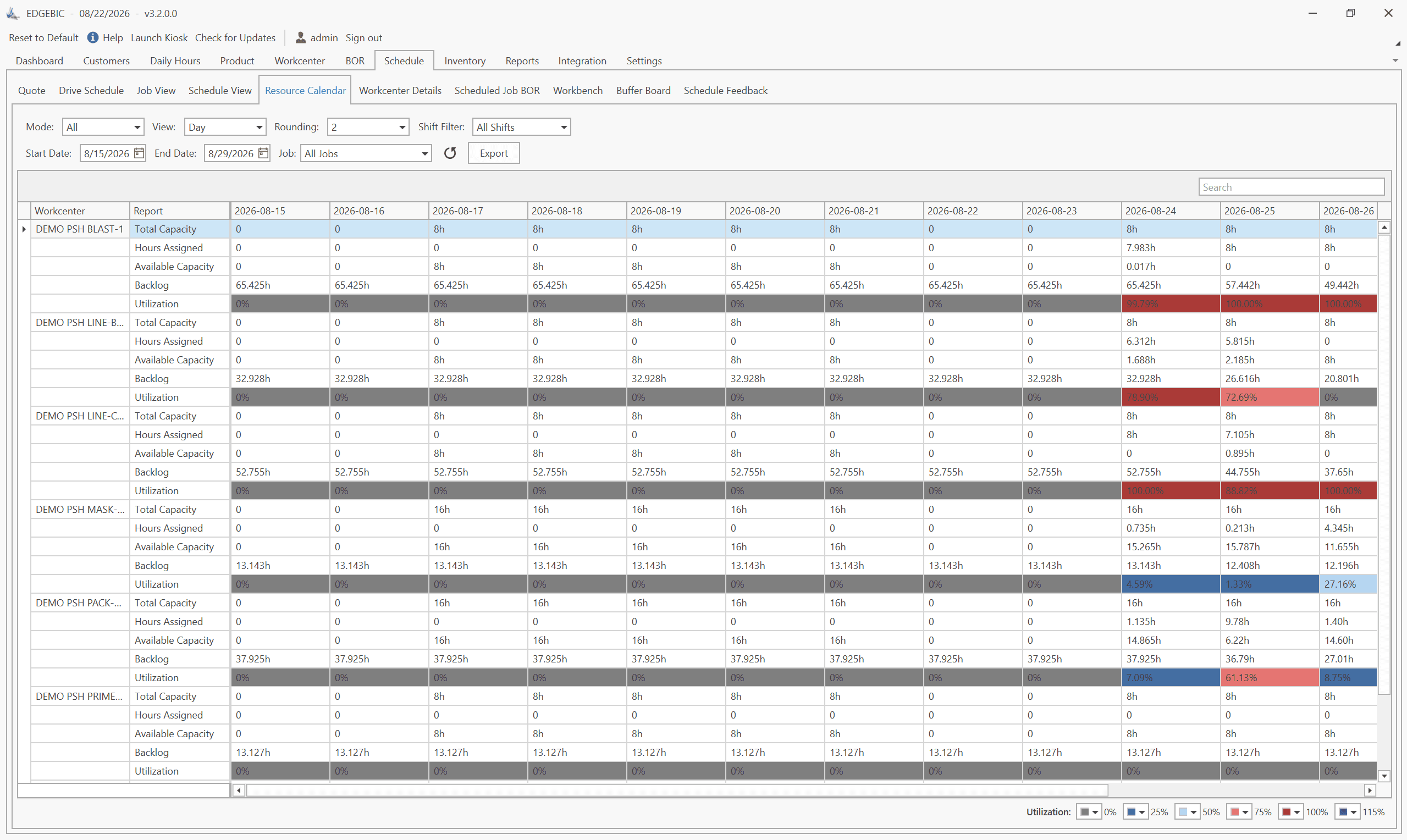
RMDB addresses scheduling problems directly and makes capacity problems visible. In EDGEBIC, the current generation of RMDB, manufacturers get both the aggregate capacity view (the Resource Load view) for planning conversations and the detailed Gantt chart for shop floor execution.
Contact User Solutions to discuss your specific capacity and scheduling challenges. We will help you determine where the biggest improvement opportunities are and show you how EDGEBIC (RMDB 2.0) addresses them.
Capacity planning determines whether you have enough resources to meet demand at an aggregate level over weeks or months. Production scheduling determines the detailed sequence and timing of specific jobs on specific machines at the hourly or daily level. Capacity planning asks "can we?" Scheduling asks "how will we?"
Capacity planning comes first. You need to know that you have enough aggregate capacity before building a detailed schedule. If capacity planning reveals a significant shortfall, that must be addressed before detailed scheduling is meaningful.
Some tools provide both capabilities. RMDB from User Solutions provides both capacity visibility at the aggregate level and detailed finite capacity scheduling at the job level. ERP systems often handle rough-cut capacity planning while a dedicated tool like RMDB handles the detailed scheduling.
If you consistently cannot complete all orders even with overtime and perfect scheduling, you have a capacity problem. If you have enough total hours but still miss deliveries because of poor sequencing or bottleneck mismanagement, you have a scheduling problem. Most manufacturers have both.
Expert Q&A: Deep Dive
Q: Our ERP shows we have enough capacity but we still miss deliveries. What is going on?
A: This is one of the most common disconnects in manufacturing. Your ERP's capacity planning module likely uses infinite capacity or aggregate buckets - it checks whether total available hours exceed total required hours per week. But it does not check whether those hours are available on the specific machines needed at the specific times needed. For example, your ERP might show 160 machine hours available and only 140 hours required - a comfortable 87% utilization. But if 80 of those required hours all need the same CNC lathe, and the lathe only has 40 available hours, you have a bottleneck the aggregate view completely hides. Finite capacity scheduling with RMDB reveals this instantly.
Frequently Asked Questions
Ready to Transform Your Production Scheduling?
User Solutions has been helping manufacturers optimize their production schedules for over 35 years. One-time license, 5-day implementation.

User Solutions Team
Manufacturing Software Experts
User Solutions has been developing production planning and scheduling software for manufacturers since 1991. Our team combines 35+ years of manufacturing software expertise with deep industry knowledge to help factories optimize their operations.
Share this article
Related Articles
How to Create a Production Schedule in 7 Steps (Free Template)
How to create a production schedule step by step: horizon, real capacity, work orders, load check, sequence, dates, then publish. Worked example included.
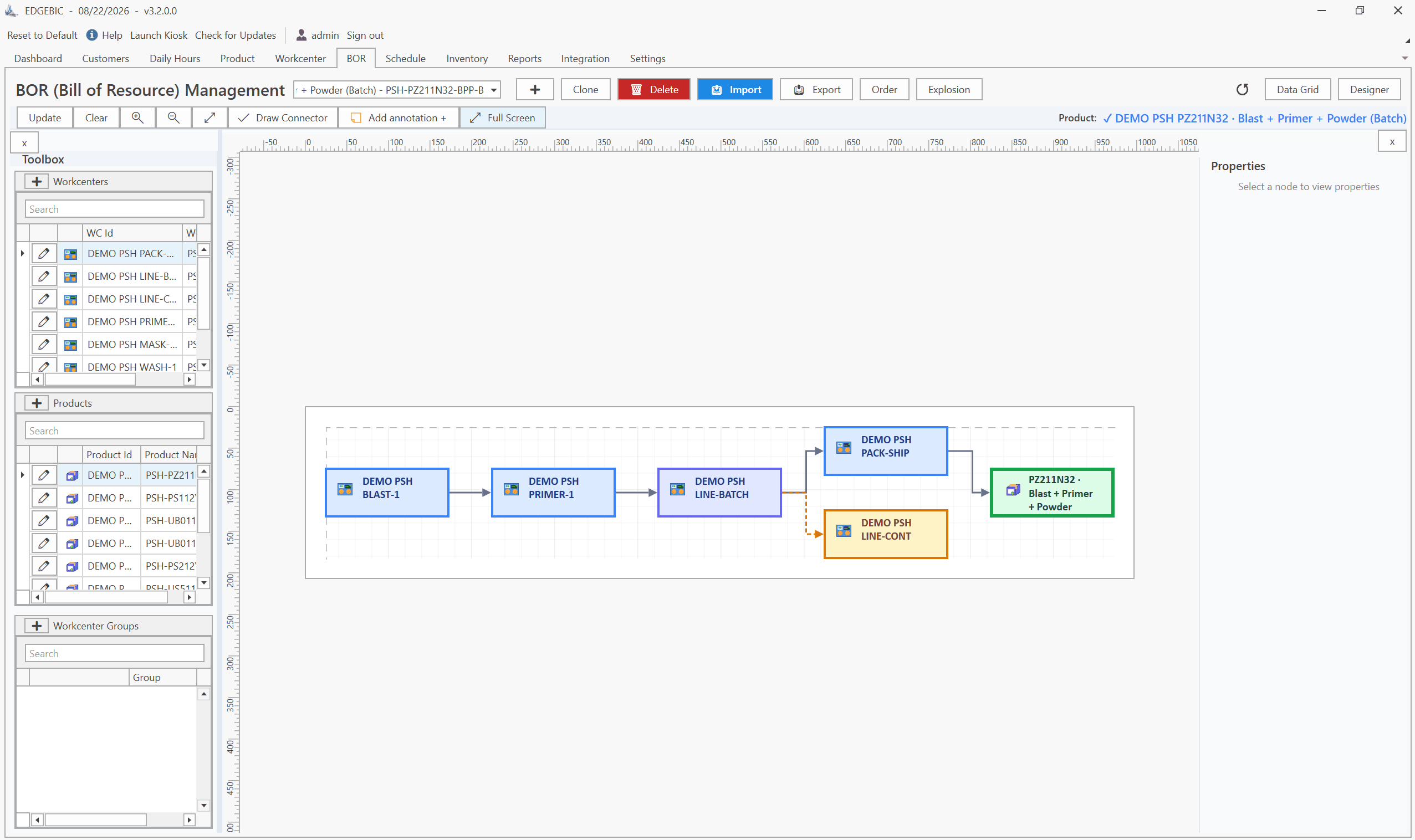
Production Planning and Control (PPC): Functions and Examples
Production planning and control explained: routing, loading, scheduling, sequencing, dispatching and expediting, the types of scheduling, and worked examples.

Sequence-Dependent Setup Times: The Scheduling Problem That Costs You Capacity
When changeover time depends on what ran before, standard scheduling fails. Learn how setup matrices, sequence optimization, and APS software recover 10-25% of hidden capacity in paint lines, food, and coating operations.