
Production Schedule Optimization: 10 Proven Techniques
 User Solutions Team
Production schedule optimization is the art and science of improving how jobs flow through your manufacturing operation. It is not about working harder or adding capacity - it is about working smarter with the resources you already have. The right optimization techniques can deliver 15-25% lead time reductions, 20-40% setup time savings, and significant improvements in on-time delivery without purchasing a single new machine.
This guide presents 10 proven optimization techniques drawn from 35+ years of scheduling experience at User Solutions. Each technique is practical, measurable, and applicable to most manufacturing environments. For foundational concepts, see our production scheduling software guide.
Technique 1: Bottleneck-First Scheduling
The single most impactful optimization is scheduling your bottleneck resource first and subordinating everything else to it.
How it works: Identify the resource that constrains your throughput. Schedule it optimally - minimizing idle time, reducing setups, and running the highest-priority jobs. Then schedule all other resources to support the bottleneck's schedule.
Expected impact: 10-20% throughput increase without adding capacity.
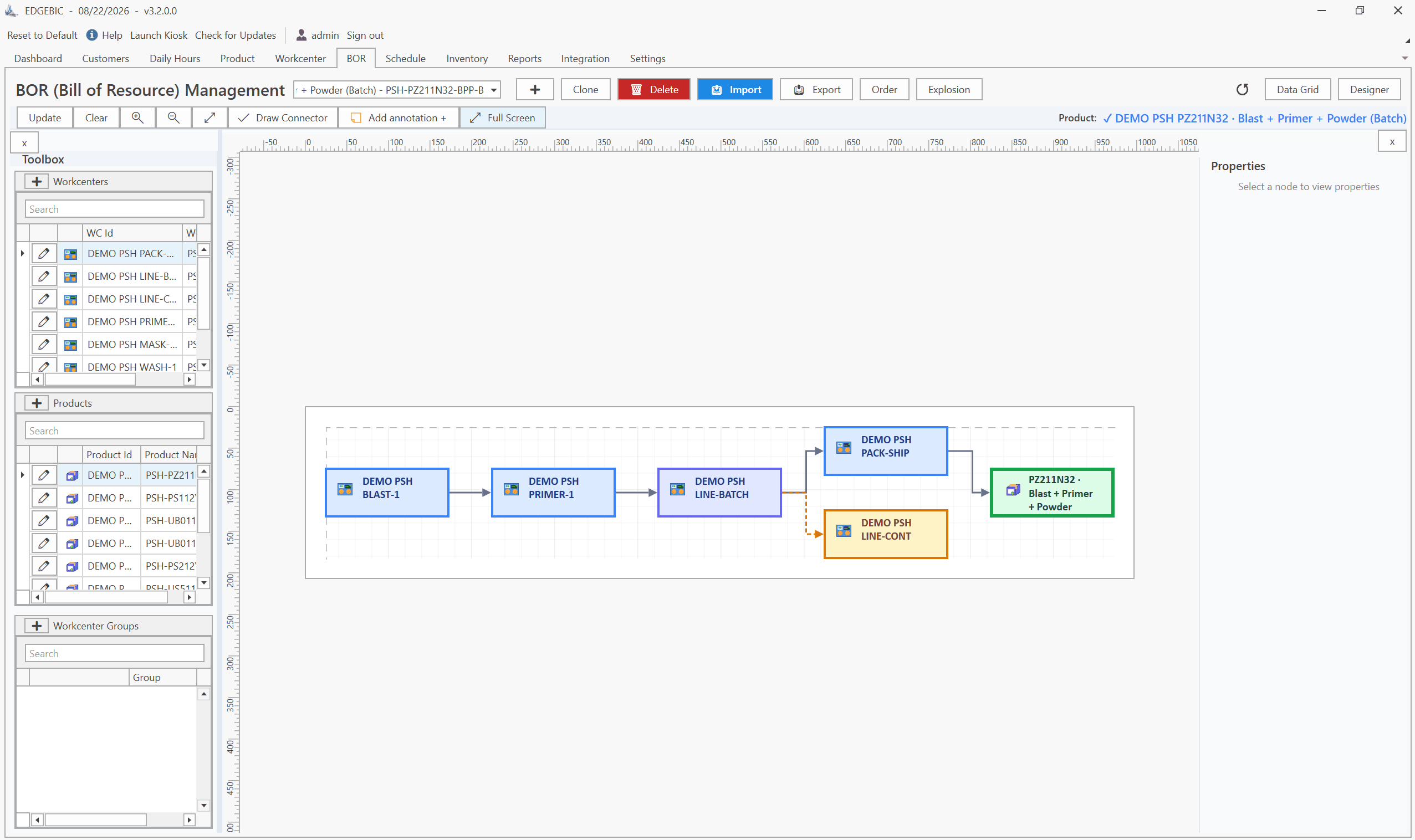
Implementation: In RMDB, designate your bottleneck as the primary scheduling resource. The engine optimizes its sequence first, then schedules upstream and downstream resources to synchronize.
Technique 2: Setup Time Optimization
Setup and changeover time is non-productive time. Reducing it directly increases available capacity.
How it works: Group similar jobs together on the same machine to minimize changeovers. Use sequence-dependent setup matrices to find the optimal job order. Schedule major changeovers during off-hours when possible.
Expected impact: 20-40% reduction in total setup time on optimized resources.
Implementation: Define setup families and changeover times in your scheduling system. RMDB's scheduling engine considers setup dependencies when sequencing, automatically grouping similar jobs when due dates allow.
Technique 3: Overlapping Operations
Instead of waiting for an entire lot to complete one operation before starting the next, transfer partial lots as they are completed.
How it works: If Operation 10 produces 100 parts and Operation 20 needs them next, you do not have to wait for all 100 to finish. Once the first 25 are complete, move them to Operation 20 while Operation 10 finishes the remaining 75. Both operations run simultaneously.
Expected impact: 20-40% reduction in job lead time for multi-operation routings.
Implementation: Configure operation overlap percentages in your routing definitions. The scheduling system accounts for the overlap when calculating start times and resource loads.
Technique 4: Alternate Routing Utilization
When the primary machine is overloaded, route jobs to capable alternate machines.
How it works: Define alternate resources for each operation. When the scheduling engine detects an overloaded primary resource, it automatically shifts jobs to alternates, balancing the load across available machines.
Expected impact: 10-15% improvement in lead time by reducing queue time at overloaded resources.
Implementation: In RMDB, define alternate resource groups with their respective efficiency factors. The system considers run time differences between primary and alternate resources when making routing decisions.
Technique 5: Priority Rule Tuning
The rules that determine job sequence have a direct impact on scheduling outcomes. Tuning these rules to match your business objectives is a high-leverage optimization.
How it works: Test different priority dispatch rules and measure their impact on your key KPIs. Earliest due date (EDD) optimizes for on-time delivery. Shortest processing time (SPT) optimizes for throughput. Critical ratio balances both.
Expected impact: 5-15% improvement in the targeted KPI, depending on how misaligned current rules are.
Implementation: Use what-if analysis to compare scheduling outcomes under different priority rules. Run the same job set with EDD, SPT, and critical ratio, then compare on-time delivery rates, utilization, and lead times.
Technique 6: Capacity Smoothing
Level-loading work across time periods prevents the peaks and valleys that cause overtime in busy weeks and idle time in slow weeks.
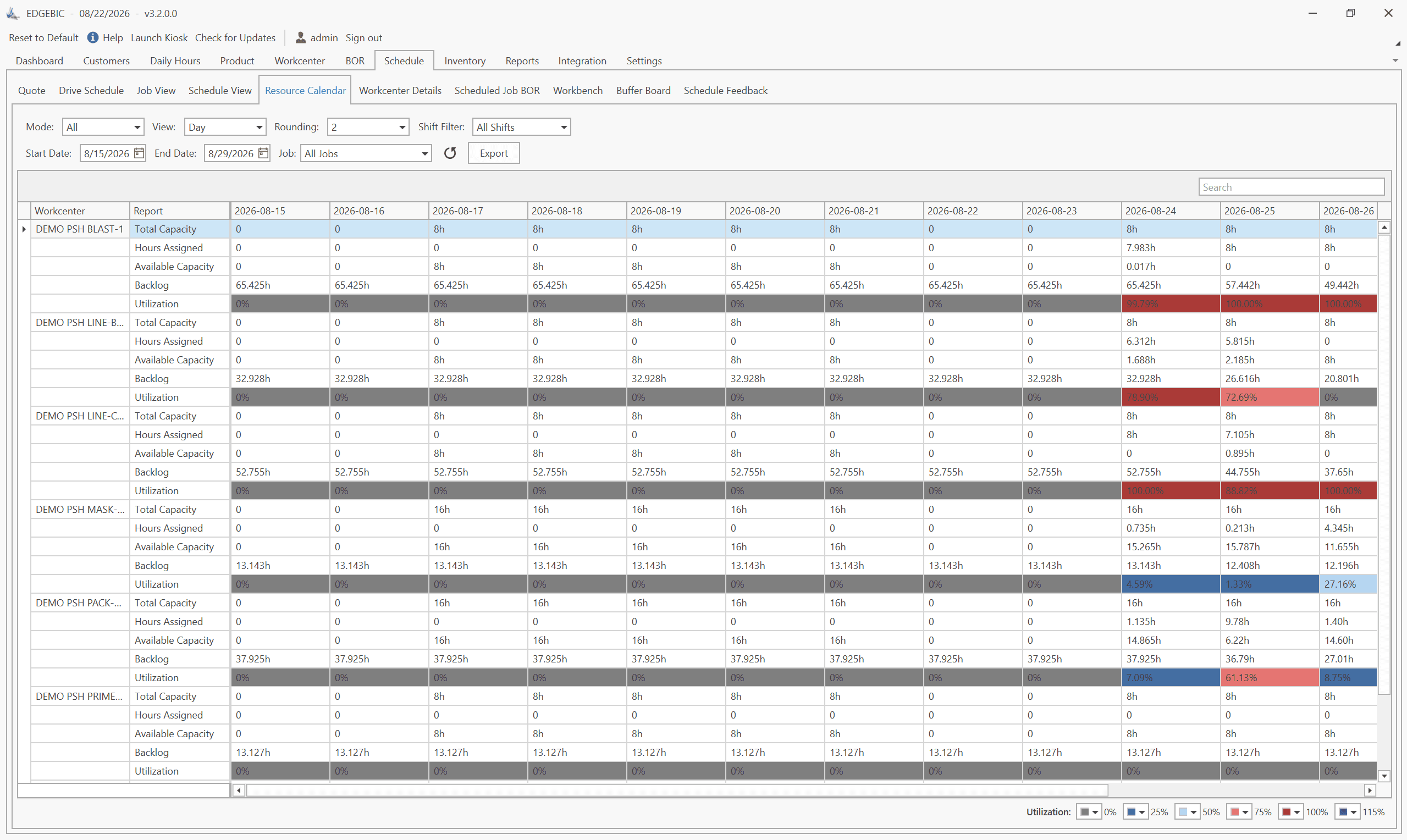
How it works: When forward scheduling shows an overloaded week followed by a light week, pull some work forward into the light week. This smooths the capacity profile and reduces the need for overtime.
Expected impact: 15-25% reduction in overtime costs.
Implementation: Review the capacity profile in EDGEBI's visual Gantt chart. Identify peaks that exceed capacity and valleys with available time. Use drag-and-drop scheduling to redistribute work.
Technique 7: Batch Size Optimization
Running smaller batches reduces lead time and WIP. Running larger batches reduces setup frequency. The optimal batch size balances both.
How it works: For each product, calculate the economic batch quantity that minimizes total cost (setup cost + carrying cost). Adjust batch sizes in your master production schedule and detailed schedule accordingly.
Expected impact: 10-20% reduction in lead time and WIP through smaller, more frequent batches. See our batch vs discrete scheduling guide.
Technique 8: Queue Time Reduction
In most manufacturing environments, parts spend 70-80% of their lead time waiting in queue, not being processed. Reducing queue time is often the fastest path to lead time improvement.
How it works: Finite capacity scheduling reduces queue time by sequencing jobs more tightly and eliminating unnecessary waiting. When each operation is scheduled to start shortly after the previous one finishes, queue time shrinks.
Expected impact: 20-40% reduction in average queue time, translating to 15-25% lead time reduction.
Technique 9: Constraint Relaxation
Sometimes the most effective optimization is removing a constraint rather than scheduling around it.
How it works: Identify the constraints that most frequently limit your schedule - a machine that is always overloaded, an operator skill that is always in short supply, tooling that creates conflicts. Then evaluate the cost of relaxing each constraint:
- Cross-train operators to add skill flexibility
- Purchase duplicate tooling for shared fixtures
- Add a shift on the bottleneck machine
- Outsource specific operations to relieve capacity
Expected impact: Variable, but constraint relaxation often produces step-function improvements rather than incremental gains.
Technique 10: Continuous Schedule Refinement
Optimization is not a one-time event. The most successful scheduling operations continuously refine their schedules by comparing planned performance to actual performance.
How it works: After each scheduling period, compare actual run times to planned run times, actual sequences to planned sequences, and actual completions to scheduled completions. Update routing data, adjust scheduling rules, and refine resource definitions based on what you learn.
Expected impact: 2-5% improvement per quarter, compounding over time. After a year of continuous refinement, the cumulative improvement is substantial.
Implementation: Review scheduling KPIs weekly. Identify the largest variances between plan and actual. Prioritize data corrections and rule adjustments that address the biggest gaps.
Prioritizing the Techniques
Not every technique delivers equal impact in every environment. Here is a prioritization framework:
| Priority | Technique | When It Matters Most |
|---|---|---|
| 1 | Bottleneck-first scheduling | Always - this is the foundation |
| 2 | Setup time optimization | When setup exceeds 15% of machine time |
| 3 | Queue time reduction | When lead times are longer than customers expect |
| 4 | Priority rule tuning | When on-time delivery is below 90% |
| 5 | Overlapping operations | When multi-operation jobs have long lead times |
| 6 | Alternate routing utilization | When primary resources are overloaded |
| 7 | Capacity smoothing | When overtime is excessive |
| 8 | Batch size optimization | When WIP is high and lead times are long |
| 9 | Constraint relaxation | When a single constraint dominates |
| 10 | Continuous refinement | Always - compound improvement |
Start with Techniques 1-4. These deliver the most impact for the least effort. Layer in Techniques 5-10 as your scheduling maturity grows.
The Tools You Need
Effective schedule optimization requires tools that support:
- Finite capacity scheduling (foundation for all optimization)
- What-if analysis (testing techniques before committing)
- Visual Gantt charts (seeing the optimization impact)
- KPI tracking (measuring improvement)
- Setup optimization logic
- Alternate routing support
RMDB from User Solutions provides all of these capabilities in a single, affordable platform. Paired with EDGEBI for visual scheduling, it gives manufacturers the complete toolkit for production schedule optimization.
Ready to optimize your production schedule? Contact us for a demo and we will show you which techniques will deliver the biggest impact for your specific operation.
Production schedule optimization is the process of improving the sequence, timing, and resource assignment of manufacturing jobs to achieve better outcomes - higher on-time delivery, lower lead times, reduced setup time, improved utilization, and less overtime - without adding capacity.
Typical improvements include 15-25% reduction in lead times, 10-20% improvement in on-time delivery, 20-40% reduction in setup times, and 10-15% increase in machine utilization. The magnitude depends on how far from optimal your current scheduling is.
Some optimization techniques (like setup grouping and bottleneck focus) can be applied manually. However, the full range of optimization techniques requires scheduling software with finite capacity, what-if analysis, and automated sequencing capabilities. The ROI on the software is typically 3-6 months.
Bottleneck scheduling - focusing optimization effort on the constraining resource - typically delivers the biggest impact. An hour saved at the bottleneck increases output for the entire factory. All other optimization techniques are secondary to getting the bottleneck right.
Expert Q&A: Deep Dive
Q: We have already implemented scheduling software but our results are mediocre. What are we missing?
A: The most common issue is data quality. If your routings have inaccurate run times or missing setup times, even the best software will produce subpar schedules. The second most common issue is using default settings without tuning the scheduling rules to match your specific objectives. Start by auditing your top 20 highest-volume routings. Compare estimated run times to actual. If there is more than a 20% variance, update the estimates. Then review your priority rules - are they aligned with your business objectives? If on-time delivery matters most, make sure your scheduling rules prioritize due dates, not just machine utilization. Small changes in rules and data quality can produce significant improvements.
Frequently Asked Questions
Ready to Transform Your Production Scheduling?
User Solutions has been helping manufacturers optimize their production schedules for over 35 years. One-time license, 5-day implementation.

User Solutions Team
Manufacturing Software Experts
User Solutions has been developing production planning and scheduling software for manufacturers since 1991. Our team combines 35+ years of manufacturing software expertise with deep industry knowledge to help factories optimize their operations.
Share this article
Related Articles
How to Create a Production Schedule in 7 Steps (Free Template)
How to create a production schedule step by step: horizon, real capacity, work orders, load check, sequence, dates, then publish. Worked example included.
Production Planning and Control (PPC): Functions and Examples
Production planning and control explained: routing, loading, scheduling, sequencing, dispatching and expediting, the types of scheduling, and worked examples.

Sequence-Dependent Setup Times: The Scheduling Problem That Costs You Capacity
When changeover time depends on what ran before, standard scheduling fails. Learn how setup matrices, sequence optimization, and APS software recover 10-25% of hidden capacity in paint lines, food, and coating operations.