
How to Identify & Eliminate Production Scheduling Bottlenecks
 User Solutions Team
Every manufacturing operation has at least one production bottleneck - a resource whose limited capacity constrains the throughput of the entire system. Identifying that bottleneck and scheduling around it is one of the most effective ways to improve delivery performance, reduce lead times, and increase output without capital investment.
Yet many manufacturers do not know where their bottleneck is, or worse, they focus scheduling effort on the wrong resources. This guide shows you how to find your bottleneck, understand its impact, and use scheduling strategies to manage it effectively. For broader scheduling context, see our production scheduling software guide.
What Makes a Bottleneck
A bottleneck is defined by a simple relationship: demand on the resource exceeds its available capacity. When more work arrives at a resource than it can process, a queue forms. That queue becomes the chokepoint for the entire operation.
Key characteristics of a bottleneck resource:
- Longest queue - work-in-process builds up before it
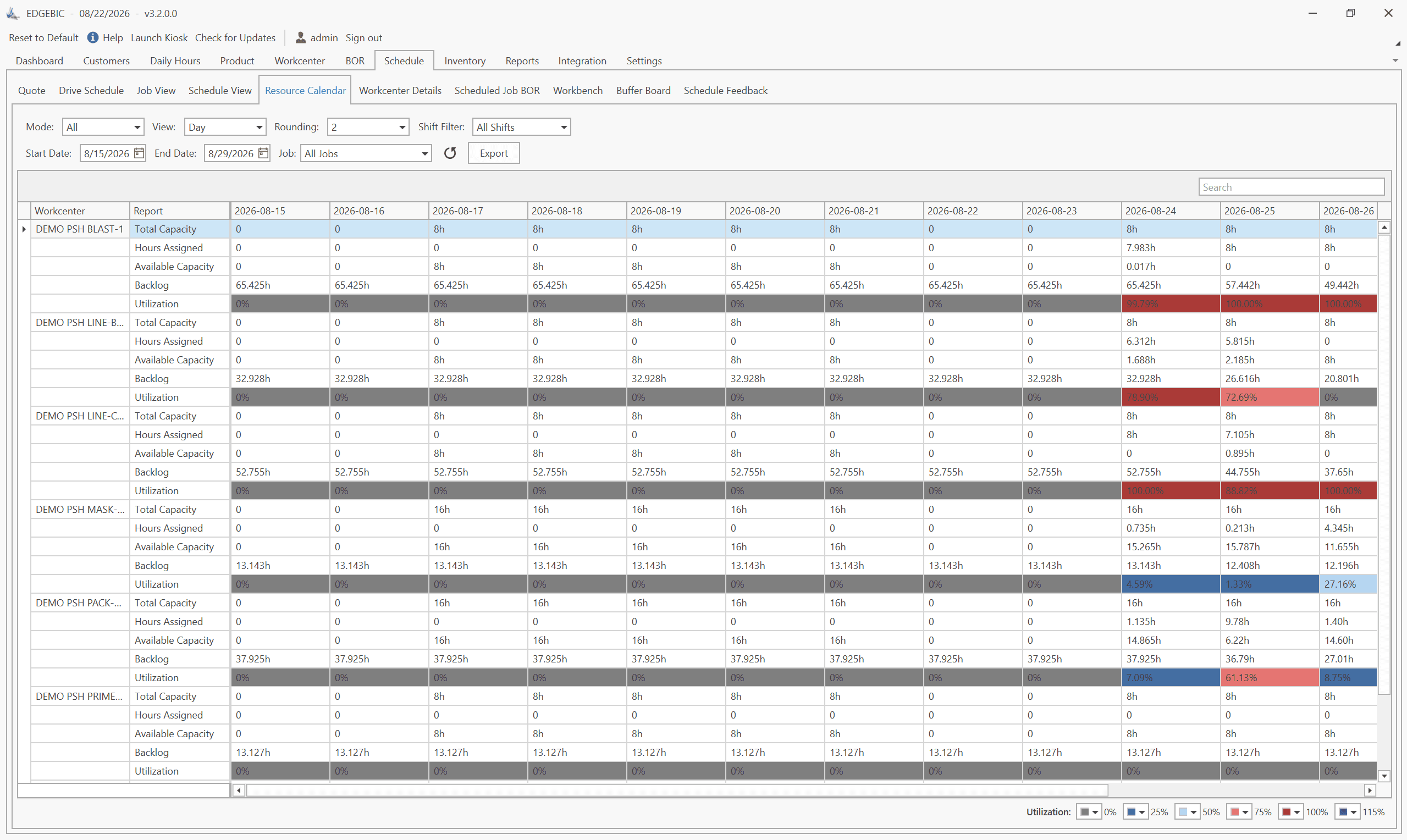
- Highest utilization - running at or near 100% of available capacity
- Most overtime - frequently requires extra hours to keep up
- Most expediting - the resource most often mentioned when discussing late orders
- Dictates lead time - total manufacturing lead time is heavily influenced by wait time at this resource
The bottleneck does not have to be the most expensive machine or the most complex process. It is simply the resource where supply and demand are most imbalanced.
How to Identify Your Bottleneck
Method 1: The Queue Method
Walk your shop floor and observe: where is WIP accumulating? The resource with the largest queue of waiting work is typically the bottleneck. This simple observation is remarkably accurate and takes minutes.
Method 2: Utilization Analysis
Calculate utilization rates for each resource:
Utilization = (Actual production hours / Available hours) x 100
The resource with the highest utilization (typically above 85-90%) is your primary bottleneck candidate. If you have scheduling software like RMDB, this data is available automatically from the finite capacity schedule.
Method 3: Late Order Root Cause Analysis
For every late delivery in the past month, trace back to the operation that caused the delay. If one resource appears repeatedly, it is your bottleneck. This method connects the bottleneck directly to its business impact.
Method 4: Scheduling Software Analysis
Load your jobs into a finite capacity scheduling system and examine the results. The resource with the longest schedule - the one whose last job extends furthest into the future - is your bottleneck. This method is the most precise because it accounts for actual job routings and run times, not just aggregate averages.
The Five-Step Bottleneck Management Process
Based on Eli Goldratt's Theory of Constraints, the process for managing a bottleneck follows five steps:
Step 1: Identify the Constraint
Use the methods above to determine which resource constrains your throughput. Be specific - name the machine, the work center, the operator pool. "CNC Lathe #2" is actionable. "The machine shop" is not.
Step 2: Exploit the Constraint
Before investing in additional capacity, maximize the throughput of the existing bottleneck:
- Eliminate idle time - ensure the bottleneck never waits for work. Maintain a buffer of ready jobs in its queue.
- Reduce setup time - invest in quick-change tooling, standardize setups, and group similar jobs. See our scheduling methods guide for setup optimization techniques.
- Prevent bad parts - inspect material before it reaches the bottleneck. Running defective material through the bottleneck wastes its precious capacity.
- Schedule the bottleneck first - in your scheduling system, load the bottleneck before other resources. Its schedule should drive the rest of the shop.
- Minimize planned downtime - schedule maintenance during off-hours. Stagger breaks to keep the bottleneck running.
These actions can increase bottleneck throughput by 15-25% without any capital investment.
Step 3: Subordinate Everything Else
Non-bottleneck resources should be scheduled to support the bottleneck's schedule, not independently optimized:
- Release work to the shop floor at a pace the bottleneck can absorb (the "rope" in Drum-Buffer-Rope)
- Schedule upstream operations to feed the bottleneck on time - early enough that the buffer stays full, but not so early that WIP floods the floor
- Schedule downstream operations to pull work from the bottleneck promptly
This subordination principle is counterintuitive. It means non-bottleneck machines may have idle time - and that is acceptable. Idle time on a non-bottleneck costs nothing. Idle time on the bottleneck costs throughput.
Step 4: Elevate the Constraint
If exploiting and subordinating are not enough, invest in additional bottleneck capacity:
- Add overtime or shifts on the bottleneck resource
- Outsource bottleneck operations to relieve the load
- Purchase additional equipment to add parallel capacity
- Cross-train operators to increase labor flexibility at the bottleneck
Use what-if analysis in your scheduling software to evaluate these options before committing. A scenario that adds a weekend shift to the bottleneck shows exactly how many additional jobs can be completed and which deliveries move from late to on-time.
Step 5: Repeat
When you successfully elevate a constraint, the bottleneck often shifts to a different resource. Go back to Step 1 and identify the new constraint. Continuous improvement in scheduling means continuously managing the moving bottleneck.
Scheduling Strategies for Bottleneck Management
Buffer Management
Place a time buffer before the bottleneck - a window of ready work that ensures the bottleneck always has something to run. A typical buffer is 1-2 days of work sitting ready for the bottleneck machine.
Monitor the buffer status:
- Green (full): The bottleneck has plenty of work. No action needed.
- Yellow (depleted): Work is arriving later than planned. Monitor and expedite if needed.
- Red (empty): The bottleneck is at risk of starving. Expedite upstream operations immediately.
Priority at the Bottleneck
Apply the most sophisticated priority rules at the bottleneck. Use critical ratio or weighted priority rather than simple FIFO. Every hour at the bottleneck is valuable - make sure the highest-value work runs first.
Setup Optimization at the Bottleneck
Setup time at the bottleneck is the most expensive setup time in the factory. Invest disproportionately in reducing it:
- Group similar jobs when due dates allow
- Invest in quick-change fixtures for the bottleneck
- Pre-stage tools and material so changeover starts immediately when the current job finishes
Visual Monitoring
Use EDGEBI's Gantt chart to visually monitor the bottleneck schedule. The bottleneck should always show a full queue with minimal gaps. Gaps represent lost throughput that can never be recovered.
Measuring Bottleneck Performance
Track these KPIs specifically for your bottleneck resource:
| KPI | Target | Why It Matters |
|---|---|---|
| Utilization | 85-95% | Bottleneck should run as close to capacity as possible |
| Setup time ratio | Below 10% | Every minute of setup is lost throughput |
| Buffer status | Green 80%+ of the time | Bottleneck should never starve |
| Schedule adherence | 90%+ | Bottleneck sequence must be followed |
| Unplanned downtime | Below 5% | Breakdowns at the bottleneck are catastrophic |
Using RMDB for Bottleneck Scheduling
RMDB from User Solutions supports bottleneck-focused scheduling directly:
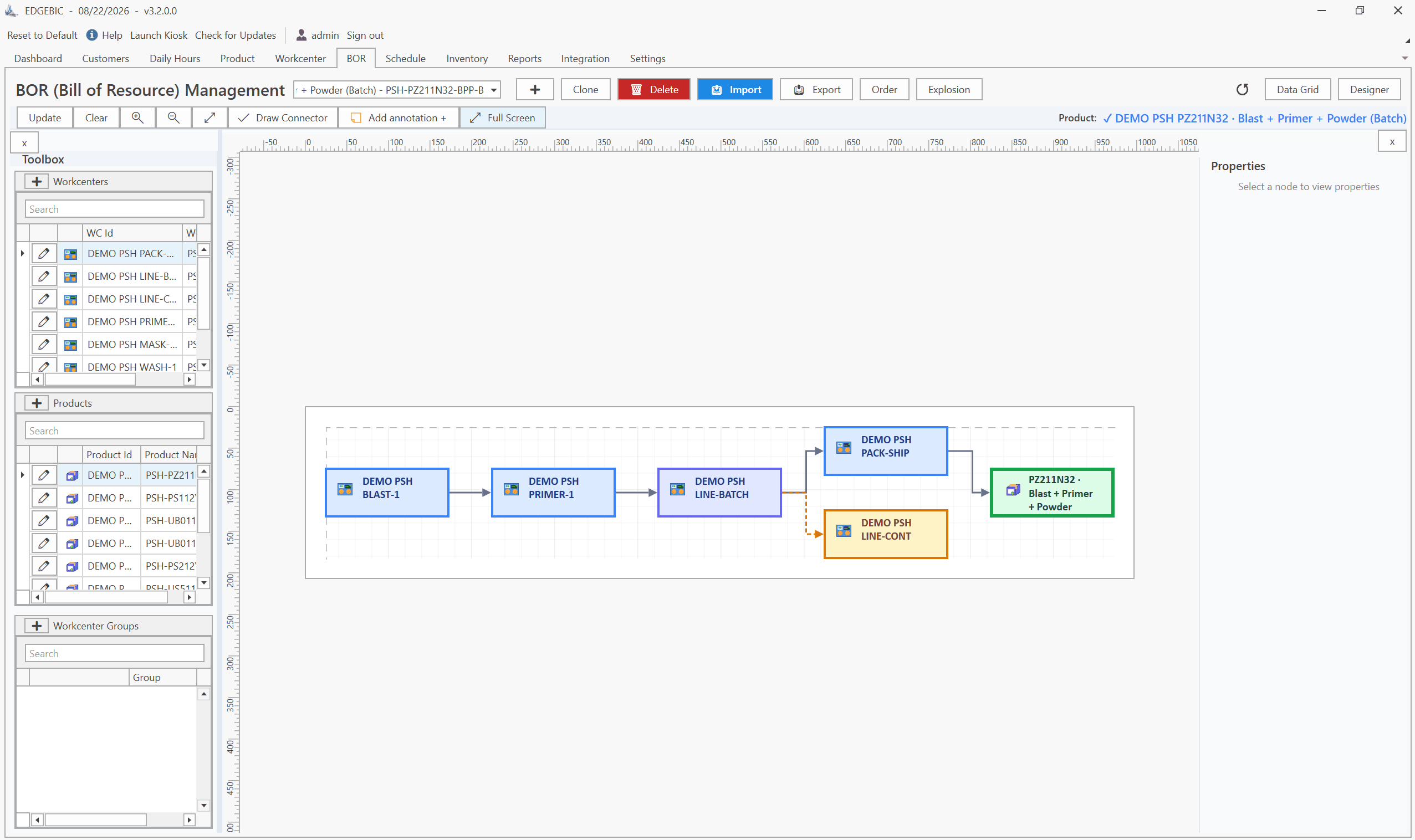
- Bottleneck-first scheduling - schedule the constraint resource first, then subordinate all other resources
- Setup optimization - minimize changeover time on the bottleneck through intelligent job grouping
- Buffer monitoring - track work flowing toward the bottleneck
- What-if analysis - evaluate the impact of adding capacity or changing the bottleneck sequence
- Drag-and-drop rescheduling - manually fine-tune the bottleneck sequence based on scheduler expertise
Combined with EDGEBI's visual interface, bottleneck management becomes a daily practice rather than an occasional fire drill.
Contact User Solutions to see how bottleneck-focused scheduling works with your production data. We will identify your constraint and show you how to schedule around it.
A production bottleneck is a resource (machine, work center, operator, or process) whose capacity is less than the demand placed on it. It is the constraining point that limits the throughput of the entire production system. Every factory has at least one bottleneck.
Look for the resource with the longest queue of waiting work, the highest utilization rate, the most overtime, and the most frequent mention in late delivery root cause analysis. In scheduling software, the bottleneck is the resource with the least available capacity relative to its workload.
Yes. Bottlenecks can shift as product mix changes, as capacity is added or lost, or as demand fluctuates. A resource that is the bottleneck this month may not be next month if orders shift to different products. Regular monitoring is essential.
First, maximize the bottleneck's throughput through better scheduling, reduced setup times, and minimized downtime. Only invest in additional capacity after you have optimized what you have. Many manufacturers find that better scheduling alone resolves the constraint.
Expert Q&A: Deep Dive
Q: We think we have two bottlenecks. Is that possible?
A: It is possible but uncommon. In Theory of Constraints, there is typically one primary constraint at any given time. What often looks like two bottlenecks is actually one true bottleneck plus one resource that is overloaded because of poor scheduling on the first bottleneck. When the primary bottleneck is scheduled optimally, the second resource often becomes unconstrained because work flows through the system more evenly. Start by focusing all scheduling optimization on the resource with the highest utilization and the biggest queue. Then reassess whether the second resource is still a constraint.
Frequently Asked Questions
Ready to Transform Your Production Scheduling?
User Solutions has been helping manufacturers optimize their production schedules for over 35 years. One-time license, 5-day implementation.

User Solutions Team
Manufacturing Software Experts
User Solutions has been developing production planning and scheduling software for manufacturers since 1991. Our team combines 35+ years of manufacturing software expertise with deep industry knowledge to help factories optimize their operations.
Share this article
Related Articles
How to Create a Production Schedule in 7 Steps (Free Template)
How to create a production schedule step by step: horizon, real capacity, work orders, load check, sequence, dates, then publish. Worked example included.
Production Planning and Control (PPC): Functions and Examples
Production planning and control explained: routing, loading, scheduling, sequencing, dispatching and expediting, the types of scheduling, and worked examples.
Sequence-Dependent Setup Times: The Scheduling Problem That Costs You Capacity
When changeover time depends on what ran before, standard scheduling fails. Learn how setup matrices, sequence optimization, and APS software recover 10-25% of hidden capacity in paint lines, food, and coating operations.