
Production Scheduling Methods & Techniques: A Practical Guide
 User Solutions Team
Choosing the right production scheduling methods can mean the difference between a shop that consistently delivers on time and one that lives in perpetual firefighting mode. Every manufacturing environment has unique constraints, but the core scheduling techniques have been refined over decades of industrial practice. Understanding these methods - and knowing which ones apply to your situation - empowers you to build schedules that are realistic, efficient, and resilient.
This guide covers the most widely used production scheduling methods and techniques, from simple dispatch rules to sophisticated optimization approaches. For each method, we explain how it works, when it applies, and what trade-offs to expect. For broader context on production scheduling, see our complete guide to production scheduling software.
Priority Dispatch Rules
Dispatch rules are the simplest scheduling methods. They determine the order in which jobs are processed at a work center based on a single criterion. Despite their simplicity, they form the foundation of many scheduling systems.
First Come, First Served (FCFS)
Jobs are processed in the order they arrive at the work center. This is the default behavior when no other rule is applied.
- Advantage: Simple, perceived as fair
- Disadvantage: Ignores due dates and urgency - late jobs wait in line behind early ones
- Best for: Low-complexity environments with uniform job sizes
Earliest Due Date (EDD)
Jobs are processed in order of their due dates, with the soonest due date running first.
- Advantage: Directly targets on-time delivery
- Disadvantage: Does not consider processing time - a long job with an early due date blocks multiple shorter jobs
- Best for: Make-to-order shops where on-time delivery is the primary KPI
Shortest Processing Time (SPT)
The job with the shortest processing time runs first, regardless of due date.
- Advantage: Maximizes the number of jobs completed per period, reduces average flow time
- Disadvantage: Long jobs get perpetually delayed
- Best for: High-volume environments where throughput count matters more than individual due dates
Critical Ratio (CR)
Critical ratio divides time remaining until the due date by processing time remaining:
CR = (Due Date - Today) / Remaining Processing Time
-
CR < 1.0: Job is behind schedule (prioritize)
-
CR = 1.0: Job is exactly on track
-
CR > 1.0: Job has slack (can wait)
-
Advantage: Dynamic - priorities update automatically as time passes. Balances due date urgency with remaining work
-
Disadvantage: Requires accurate remaining processing time estimates
-
Best for: Environments with varying job sizes and due date urgency. This is one of the most effective general-purpose rules.
Weighted Shortest Job First
A hybrid approach that considers both processing time and due date urgency, applying weights based on management priorities.
- Advantage: Balances multiple objectives
- Disadvantage: Requires tuning the weight factors
- Best for: Shops that need to balance throughput and delivery simultaneously
Scheduling Direction Methods
These methods determine the direction in which the schedule is built. For a detailed comparison, see our forward vs backward scheduling guide.
Forward Scheduling
Starts from today and schedules forward. Shows the earliest possible completion date for each job. Ideal for quoting delivery dates and identifying how far out your capacity extends.
Backward Scheduling
Starts from the due date and schedules backward. Shows when each operation must start to meet the deadline. Ideal for JIT environments that want to minimize work-in-process inventory.
Bidirectional Scheduling
Combines both approaches - forward scheduling for bottleneck resources and backward scheduling for everything else. This advanced technique maximizes bottleneck utilization while minimizing WIP on non-constrained resources.
Capacity-Based Methods
Finite Capacity Scheduling
The most critical method for any manufacturer with real capacity constraints. Finite capacity scheduling respects the reality that a machine can only run one job at a time. It produces executable schedules that do not double-book resources.
This is the foundation of effective production scheduling and is non-negotiable for job shops, make-to-order manufacturers, and any environment with significant setup times or bottleneck resources.
Infinite Capacity Planning
Used for rough-cut capacity analysis at the aggregate level. Useful for identifying which weeks or months are overloaded before drilling into the detailed finite capacity schedule.
Theory of Constraints: Drum-Buffer-Rope (DBR)
Drum-Buffer-Rope is a scheduling method derived from Eli Goldratt's Theory of Constraints. It focuses scheduling effort on the bottleneck resource (the "drum") and manages the rest of the shop around it.
How it works:
- Drum: The bottleneck resource sets the pace. Its schedule is the master schedule.
- Buffer: A time buffer is placed before the drum to ensure it never starves for work. Jobs are released to the shop floor early enough that they arrive at the drum on time.
- Rope: Material release is tied to the drum schedule, preventing excess WIP from flooding the shop.
When to use DBR:
- Your shop has a clear, consistent bottleneck
- Throughput maximization is the primary objective
- You want a simple scheduling philosophy that focuses effort where it matters most
Limitations:
- Less effective when the bottleneck shifts between resources
- Does not optimize non-bottleneck sequences
- Requires clear identification of the constraint
Rate-Based Scheduling
Rate-based scheduling sets a production rate (units per hour or per shift) rather than scheduling individual jobs. It is common in repetitive and process manufacturing.
- Takt time scheduling: Sets the production pace to match customer demand rate
- Line balancing: Distributes work evenly across stations to maintain flow
- Batch scheduling: Groups production into batches with scheduled changeovers between products (see our batch vs discrete scheduling guide)
Rate-based methods work well for high-volume, low-variety environments but break down in high-mix, low-volume settings where job variety makes fixed rates impractical.
Optimization-Based APS Scheduling
Advanced Planning and Scheduling (APS) systems use mathematical optimization to generate schedules that balance multiple objectives simultaneously. Rather than applying a single dispatch rule, APS engines evaluate thousands of possible sequences and select the one that best meets your defined criteria.
Common optimization objectives:
- Minimize total lateness across all orders
- Maximize machine utilization
- Minimize total setup time
- Balance workload across resources
- Minimize work-in-process inventory
How it works: The APS engine takes your jobs, resources, constraints, and objectives, then uses algorithms (heuristic search, genetic algorithms, constraint propagation) to find a near-optimal schedule. The scheduler reviews the result and makes adjustments using drag-and-drop tools.
RMDB from User Solutions combines finite capacity scheduling with optimization logic to produce schedules that are both realistic and efficient. The EDGEBI visual interface then gives schedulers the power to fine-tune the result based on their experience and judgment.
Choosing the Right Method for Your Shop
The best scheduling method depends on your manufacturing environment:
| Manufacturing Type | Recommended Primary Method | Recommended Secondary Method |
|---|---|---|
| Job shop | Finite capacity + EDD or Critical Ratio | What-if analysis, setup grouping |
| Make-to-order | Backward scheduling + finite capacity | Forward scheduling for quoting |
| Repetitive/flow | Rate-based (takt time) | Line balancing |
| Process/batch | Batch scheduling + campaign sequencing | Changeover optimization |
| High-mix low-volume | Finite capacity + Critical Ratio | DBR if clear bottleneck |
| Make-to-stock | Rate-based + safety stock triggers | Demand smoothing |
Most manufacturers use a combination of methods. The key is starting with finite capacity as the foundation and layering priority rules and optimization on top. Modern production scheduling software handles these combinations automatically.
From Method to Practice
Understanding scheduling methods is valuable, but the real impact comes from applying them consistently with the right tools. Manual scheduling - whether on a whiteboard, in Excel, or in someone's head - limits you to the simplest methods. Dedicated scheduling software unlocks the full range of techniques and makes them practical at scale.
User Solutions has been helping manufacturers apply the right scheduling methods for 35+ years. Our 5-day implementation gets you from method selection to working schedules in a single business week.
Contact us for a demo to see how these scheduling methods work with your specific manufacturing challenges.
The main methods include priority dispatch rules (EDD, SPT, FCFS), forward and backward scheduling, finite capacity scheduling, Drum-Buffer-Rope (Theory of Constraints), rate-based scheduling, and optimization-based APS scheduling. Each method suits different manufacturing environments and objectives.
Job shops benefit most from finite capacity scheduling combined with priority dispatch rules like earliest due date (EDD) or critical ratio. The high variety and low volume in job shops makes constraint-based scheduling essential. Tools like RMDB handle this complexity automatically.
Critical ratio divides the time remaining until the due date by the work time remaining. A ratio of 1.0 means the job is exactly on schedule. Below 1.0 means it is behind schedule and needs priority. Above 1.0 means there is slack. It is one of the most effective dynamic priority rules.
Yes, and most manufacturers do. A common approach is to use backward scheduling for the overall direction, finite capacity for constraint management, and EDD or critical ratio for sequencing within a work center queue. Modern APS software handles these combinations automatically.
Expert Q&A: Deep Dive
Q: We currently use first-come-first-served. Should we switch to a different method?
A: FCFS is the simplest rule but rarely the best. It ignores due dates, job urgency, and setup efficiency. If you are experiencing late deliveries or excessive setup times, switching to earliest due date (EDD) as your primary rule and adding setup optimization will likely deliver immediate improvement. The transition does not have to be dramatic. Start by sorting your bottleneck machine's queue by due date instead of arrival order. Just that one change on your most constrained resource can improve on-time delivery measurably. Then expand the approach to other work centers.
Q: How do we handle the trade-off between minimizing setups and meeting due dates?
A: This is the classic scheduling tension. Grouping similar jobs minimizes setup time but may push urgent orders further back. The answer is to use a weighted priority that considers both factors. In practice, most shops batch similar jobs when the due date slack allows it, but break the batch when a job becomes urgent. RMDB lets you set priority rules that balance these competing objectives automatically - and the drag-and-drop Gantt in EDGEBI lets the scheduler make final judgment calls visually.
Frequently Asked Questions
Ready to Transform Your Production Scheduling?
User Solutions has been helping manufacturers optimize their production schedules for over 35 years. One-time license, 5-day implementation.

User Solutions Team
Manufacturing Software Experts
User Solutions has been developing production planning and scheduling software for manufacturers since 1991. Our team combines 35+ years of manufacturing software expertise with deep industry knowledge to help factories optimize their operations.
Share this article
Related Articles
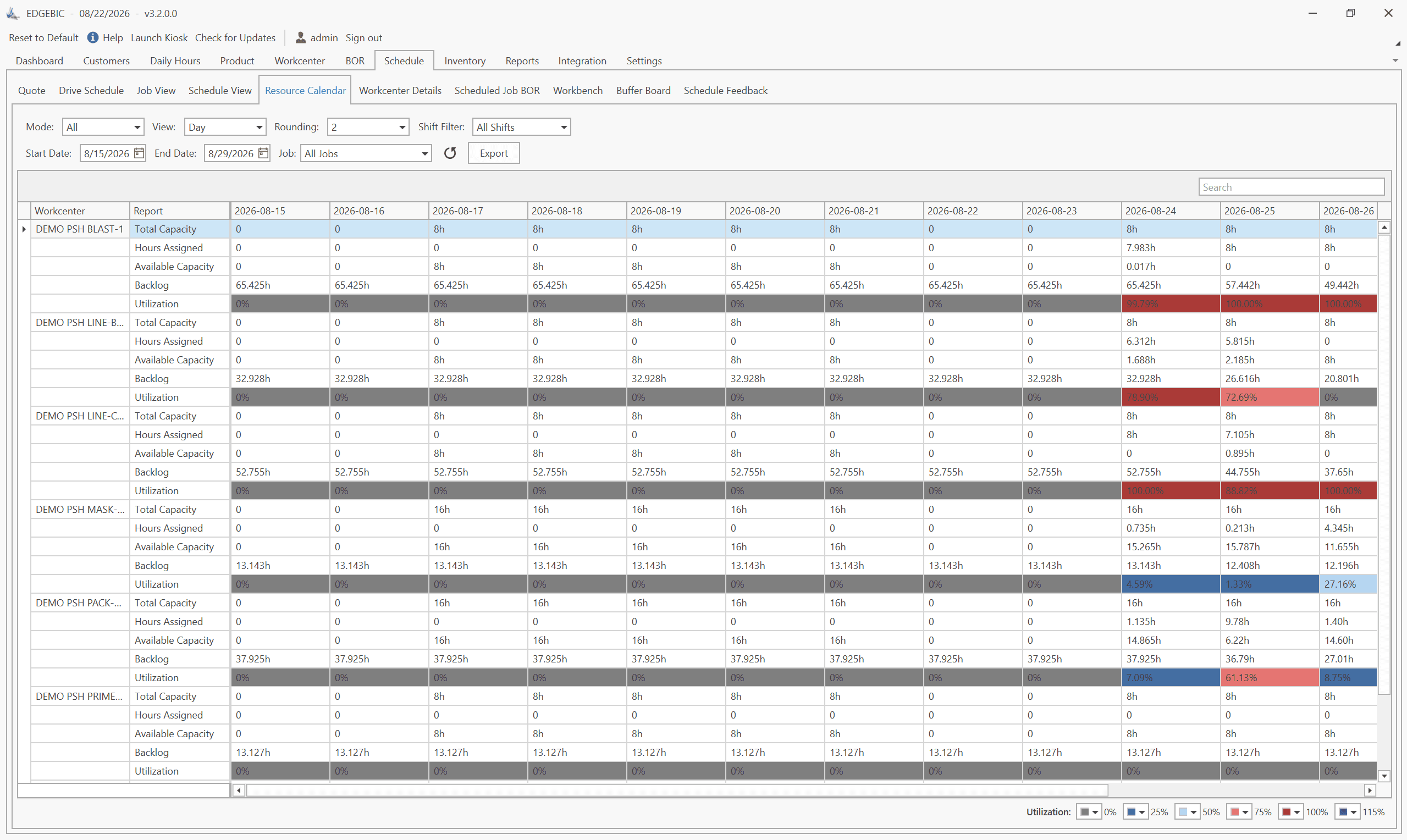
How to Create a Production Schedule in 7 Steps (Free Template)
How to create a production schedule step by step: horizon, real capacity, work orders, load check, sequence, dates, then publish. Worked example included.
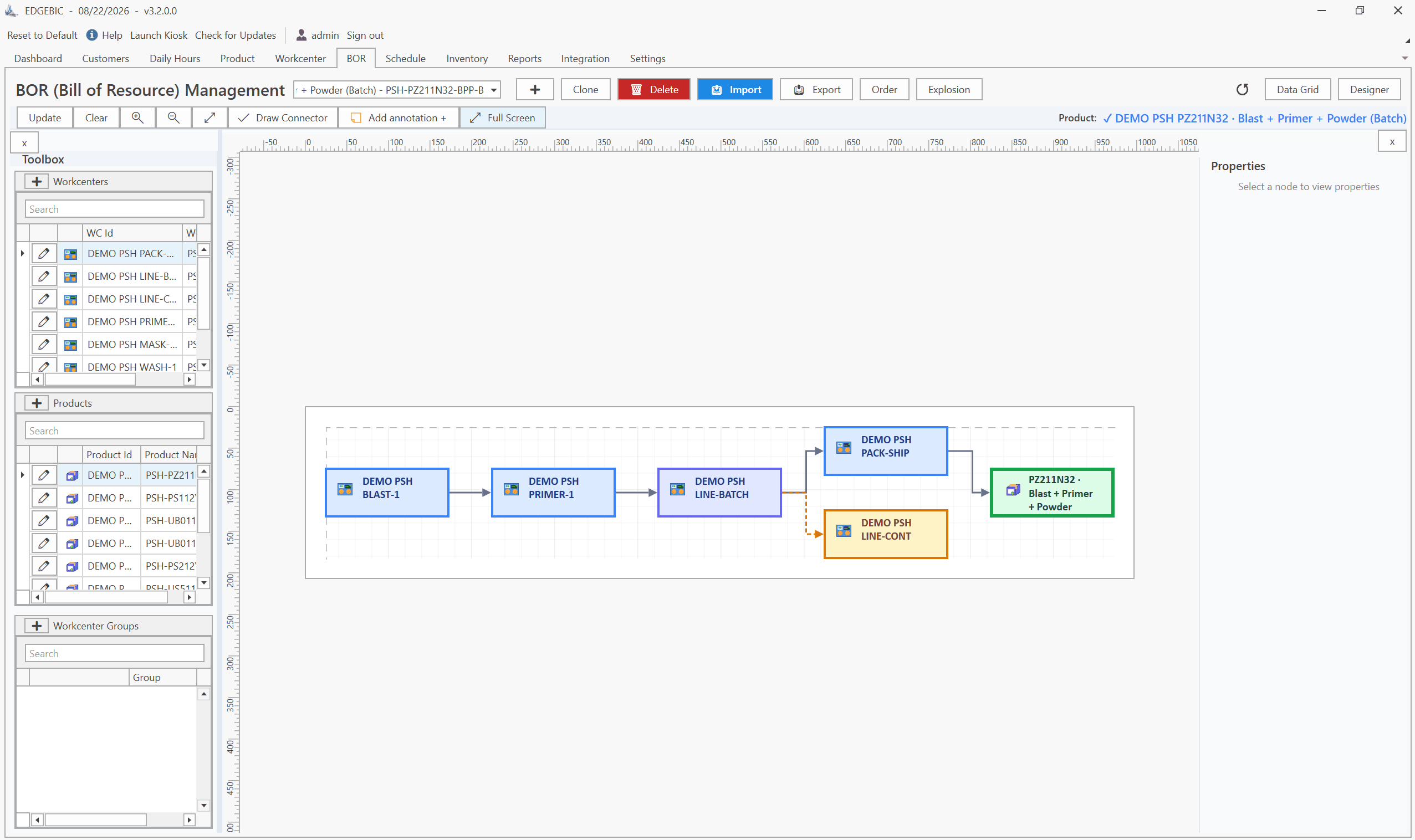
Production Planning and Control (PPC): Functions and Examples
Production planning and control explained: routing, loading, scheduling, sequencing, dispatching and expediting, the types of scheduling, and worked examples.

Sequence-Dependent Setup Times: The Scheduling Problem That Costs You Capacity
When changeover time depends on what ran before, standard scheduling fails. Learn how setup matrices, sequence optimization, and APS software recover 10-25% of hidden capacity in paint lines, food, and coating operations.