


Effective production scheduling KPIs tell you whether your scheduling process is working - and where it needs improvement. Without metrics, scheduling becomes a feel-good exercise. With the right KPIs, it becomes a measurable driver of manufacturing performance.
The challenge is not collecting data - most ERP and scheduling systems generate plenty. The challenge is tracking the right metrics and acting on them. This guide covers the 12 KPIs that matter most for production scheduling effectiveness, with practical guidance on measurement, targets, and improvement strategies. For a broader view of manufacturing metrics, see our production scheduling software guide.
The 12 Essential Production Scheduling KPIs
1. On-Time Delivery Rate (OTD)
What it measures: The percentage of customer orders delivered on or before the promised date.
Formula: (Orders delivered on time / Total orders shipped) x 100
Target: 95-98% for best-in-class; 85-90% for average performers
Why it matters: This is the KPI your customers care about most. Poor on-time delivery erodes customer trust, triggers penalties, and eventually costs you business. It is the ultimate measure of whether your scheduling is working. See our detailed guide on how scheduling improves on-time delivery.
2. Schedule Adherence
What it measures: The percentage of scheduled operations that are executed as planned - right machine, right time, right sequence.
Formula: (Operations completed per schedule / Total scheduled operations) x 100
Target: 85-95%
Why it matters: Schedule adherence tells you whether the shop floor is following the plan. If adherence is low, either the schedule is unrealistic (the planning problem) or the shop floor is ignoring it (the execution problem). Both require different interventions.
Calculate your schedule adherence
Count an operation as on plan only when it ran on the scheduled resource, in the scheduled window and in the scheduled sequence.
Formula
Schedule adherence (%) = (Operations completed as scheduled / Total scheduled operations) x 100
Worked example
Last week the schedule held 212 operations and 188 ran on the right machine, in the right window and sequence: (188 / 212) x 100 = 88.7%. 24 operations moved.
Use the schedule as it was frozen at the start of the period.
Inside the 85-95% target range on this page.
Calculated in your browser. Nothing you enter is stored or sent.
3. Machine Utilization Rate
What it measures: The percentage of available machine time spent on productive work.
Formula: (Actual production time / Available machine time) x 100
Target: 75-85% for most environments; 85-95% for bottleneck resources
Why it matters: Low utilization means idle capacity you are paying for. High utilization (above 90% across the board) means you have no buffer for disruptions and are likely experiencing long queues. The goal is optimal utilization - high on bottleneck machines, moderate on non-bottlenecks.
Calculate machine utilization
Works for one machine, a work center or a whole department. Use the same period (a shift, a day, a week) for both numbers.
Formula
Utilization (%) = (Actual production hours / Available production hours) x 100. Output-based version: (Actual output / Maximum possible output) x 100.
Worked example
A work center is available 40 hours this week and runs production for 34 of them: (34 / 40) x 100 = 85%, leaving 6 hours of idle, changeover or downtime.
Time the resource spent making good or bad parts, not idle or waiting.
Scheduled hours after planned maintenance, not 24/7 theory.
Not sure of your available hours?
Available capacity = resources x hours per shift x shifts per day x operating days x planned uptime factor.
Available capacity: 144 hours
Calculated in your browser. Nothing you enter is stored or sent.
4. Manufacturing Lead Time
What it measures: The total elapsed time from job release to completion, including queue time, setup time, run time, and move/wait time.
Target: Continuously decreasing. Compare to quoted lead times and customer expectations.
Why it matters: Long lead times reduce competitiveness and tie up working capital in WIP. Scheduling directly impacts lead time by minimizing queue time and optimizing job sequences. A 15-25% lead time reduction is typical when manufacturers move from manual to automated scheduling.
5. Throughput
What it measures: The number of units, jobs, or operations completed per time period.
Target: Increasing or stable at capacity, depending on demand.
Why it matters: Throughput measures the productive output of your operation. Effective scheduling maximizes throughput by reducing idle time, minimizing setups, and keeping bottleneck resources fully loaded.
6. Setup Time Ratio
What it measures: The percentage of total machine time consumed by setups and changeovers.
Formula: (Total setup time / Total machine time) x 100
Target: Below 15-20% for most environments; below 10% for high-efficiency operations
Why it matters: Setup time is non-productive time. Scheduling methods that group similar jobs together (setup optimization) can reduce setup time by 20-40%. This directly increases capacity without buying new equipment. The right scheduling methods make a significant impact here.
7. Work-in-Process (WIP) Levels
What it measures: The number of jobs or dollar value of partially completed work on the shop floor at any point in time.
Target: As low as possible while maintaining throughput. Track the trend.
Why it matters: Excessive WIP consumes floor space, ties up capital, increases lead times, and creates confusion. Backward scheduling and pull-based methods help control WIP by starting jobs at the latest responsible moment.
8. Queue Time Ratio
What it measures: The percentage of total lead time spent waiting in queue (not being processed).
Formula: (Total queue time / Total lead time) x 100
Target: Below 60%. In many shops, queue time exceeds 80% of total lead time.
Why it matters: In most manufacturing environments, parts spend more time waiting than being processed. Reducing queue time through better sequencing and finite capacity scheduling is often the fastest path to lead time reduction.
9. Schedule Stability
What it measures: The percentage of scheduled jobs that do not change position or timing within a defined frozen period (typically 1-3 days out).
Formula: (Jobs unchanged in frozen period / Total jobs in frozen period) x 100
Target: 80-90% stability within the frozen window
Why it matters: Constant rescheduling creates chaos on the shop floor. Materials get staged and then un-staged. Operators start setups and then switch. A stable near-term schedule (even if the further-out schedule changes) reduces wasted effort and improves execution.
10. Overtime Percentage
What it measures: Overtime hours as a percentage of total labor hours.
Formula: (Overtime hours / Total labor hours) x 100
Target: Below 5-10% for planned operations; higher during peak periods is acceptable if planned
Why it matters: Excessive overtime signals capacity problems that scheduling should address. If overtime is chronically above 10%, the schedule may be overloaded, or the shop may need additional capacity (equipment or labor). Scheduling software that provides capacity visibility helps reduce unplanned overtime.
11. Schedule Change Frequency
What it measures: The number of schedule changes per day or week, broken down by cause (rush orders, machine breakdowns, material delays, etc.).
Target: Decreasing trend. Track the root causes.
Why it matters: Every schedule change has a cost - rework of setups, communication overhead, operator confusion. Tracking the frequency and root causes of changes reveals systemic problems. If rush orders are the primary driver, the quoting process may need attention. If machine breakdowns dominate, the maintenance program needs improvement.
12. Capacity Utilization Balance
What it measures: The variance in utilization rates across resources. Are some machines at 95% while others sit at 40%?
Formula: Standard deviation of utilization rates across resources
Target: Low variance across non-bottleneck resources; bottleneck resources should be highest
Why it matters: Extreme imbalance indicates scheduling or routing issues. If one machine is consistently overloaded while a capable alternate sits idle, the schedule should be redistributing work. Multi-constraint scheduling with alternate routing support addresses this directly.
How to Build a Scheduling KPI Dashboard
Step 1: Start with Three KPIs
Do not try to track all 12 from day one. Start with the three that matter most to your operation:
- On-time delivery - the customer-facing metric
- Schedule adherence - the execution metric
- Machine utilization - the capacity metric
Step 2: Establish Baselines
Measure your current performance before making changes. You cannot demonstrate improvement without a baseline. Run two weeks of measurement to establish starting points.
Step 3: Set Targets
Set realistic improvement targets for the next 90 days. Typical first-quarter targets after implementing scheduling software:
- On-time delivery: improve by 10-15 percentage points
- Schedule adherence: reach 85%+
- Machine utilization: improve by 5-10 percentage points on bottleneck resources
Step 4: Review Regularly
Review operational KPIs (adherence, utilization) at daily or weekly production meetings. Review strategic KPIs (on-time delivery trends, lead time trends) monthly with management.
Step 5: Expand Over Time
Add additional KPIs as your scheduling maturity grows. After mastering the core three, add setup time ratio, WIP levels, and queue time ratio.
How Scheduling Software Enables KPI Tracking
Manual KPI tracking from spreadsheets is tedious and error-prone. Dedicated production scheduling software automates much of the data collection and calculation.
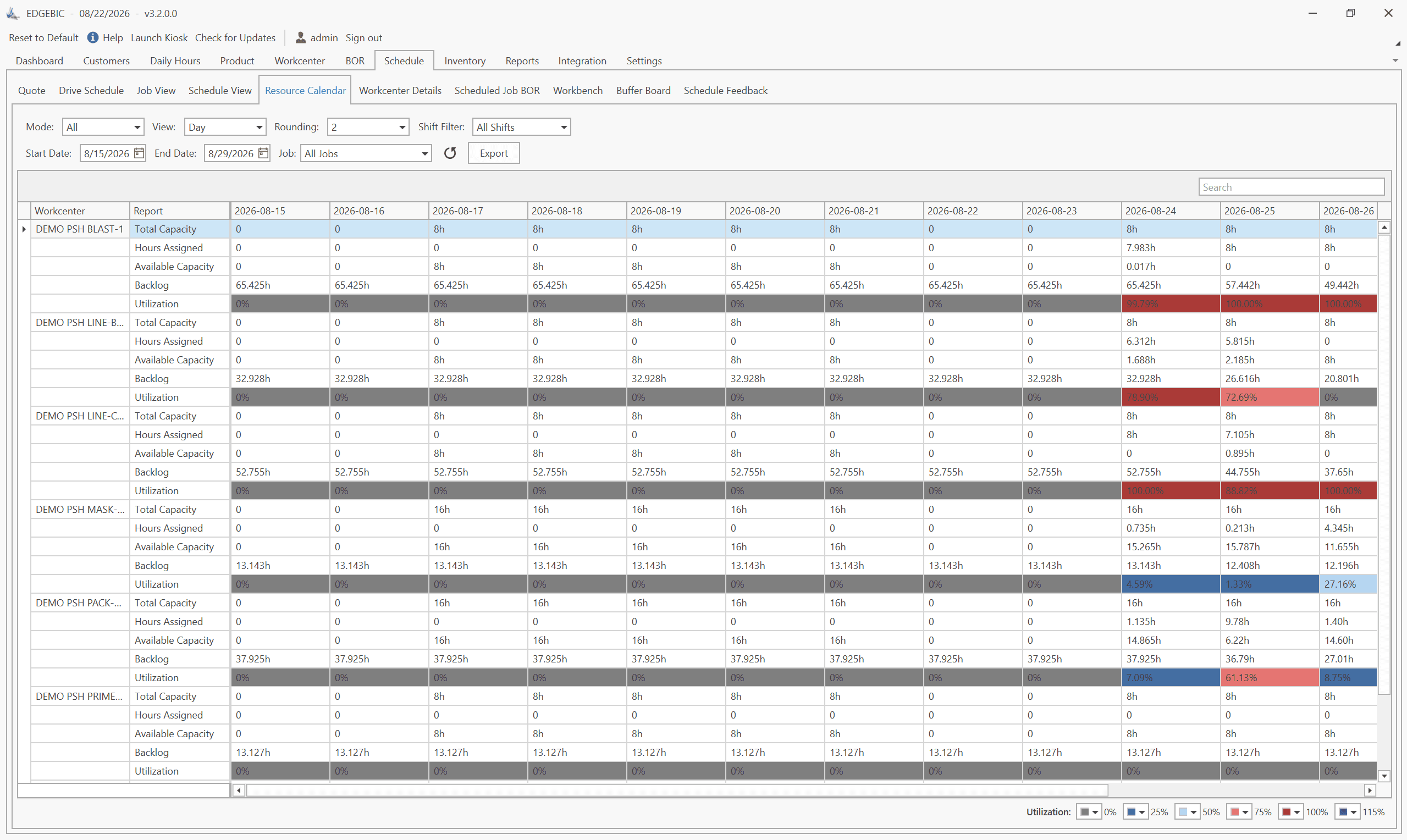
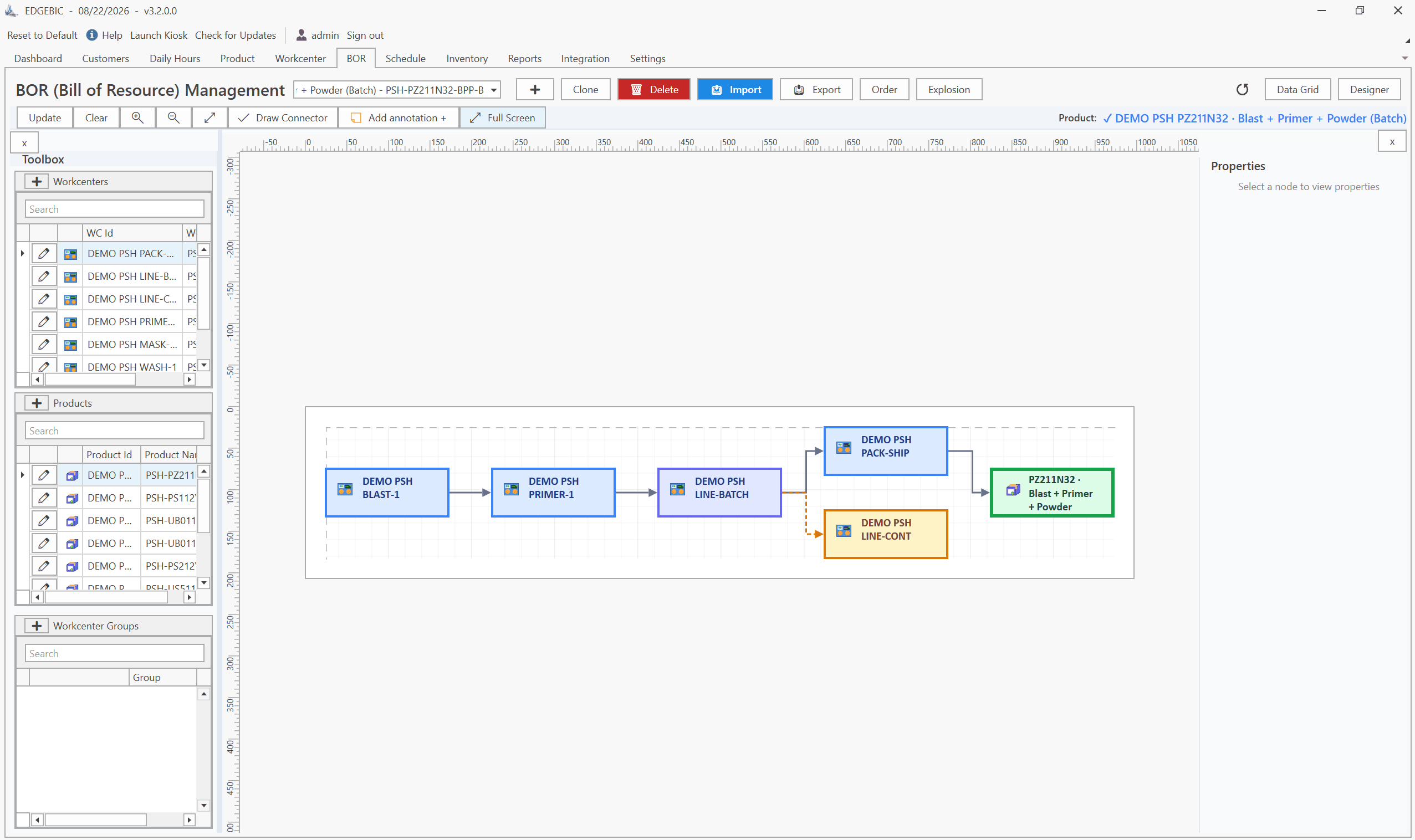
RMDB from User Solutions tracks scheduled versus actual performance across resources and jobs, providing the data foundation for KPI calculation. Combined with EDGEBI's visual interface, schedulers can see utilization, adherence, and delivery status at a glance - and take action when KPIs drift from target.
Over 35 years of helping manufacturers implement scheduling, we have found that the act of measuring these KPIs drives improvement even before the scheduling process is fully optimized. Visibility creates accountability, and accountability drives results.
Ready to start measuring what matters? Contact us for a demo and we will show you how RMDB makes KPI tracking a natural part of the scheduling workflow.
The most critical KPIs are on-time delivery rate, schedule adherence, machine utilization, manufacturing lead time, and throughput. These five metrics give you a comprehensive view of scheduling effectiveness across delivery, execution, capacity, and efficiency dimensions.
Schedule adherence measures the percentage of operations that are completed as scheduled - on the right machine, in the right sequence, at the right time. Calculate it as: (Operations completed per schedule / Total scheduled operations) x 100. A target of 85-95% is realistic for most manufacturers.
Best-in-class manufacturers achieve 95-98% on-time delivery. Average manufacturers hover around 80-85%. If your rate is below 80%, there is significant room for improvement through better scheduling practices and tools.
Review operational KPIs (schedule adherence, utilization) daily or weekly. Review strategic KPIs (on-time delivery trends, lead time trends, throughput) monthly. The key is acting on the data, not just collecting it.
Expert Q&A: Deep Dive
Q: We track on-time delivery but nothing else. What should we add first?
A: Add schedule adherence and machine utilization. Together with on-time delivery, these three KPIs give you a complete picture. On-time delivery tells you how the customer experiences your performance. Schedule adherence tells you whether the shop floor is following the plan. Machine utilization tells you whether you have capacity headroom or are running at the limit. If on-time delivery is poor but schedule adherence is high, the schedule itself is the problem - it contains unrealistic promises. If schedule adherence is low, the execution is the problem - the schedule may be fine, but the shop is not following it. This diagnostic power is why tracking multiple KPIs matters.
Frequently Asked Questions
Ready to Transform Your Production Scheduling?
User Solutions has been helping manufacturers optimize their production schedules for over 35 years. One-time license, 5-day implementation.

User Solutions Team
Manufacturing Software Experts
User Solutions has been developing production planning and scheduling software for manufacturers since 1991. Our team combines 35+ years of manufacturing software expertise with deep industry knowledge to help factories optimize their operations.
Share this article
Related Articles
How to Create a Production Schedule in 7 Steps (Free Template)
How to create a production schedule step by step: horizon, real capacity, work orders, load check, sequence, dates, then publish. Worked example included.
Production Planning and Control (PPC): Functions and Examples
Production planning and control explained: routing, loading, scheduling, sequencing, dispatching and expediting, the types of scheduling, and worked examples.

Sequence-Dependent Setup Times: The Scheduling Problem That Costs You Capacity
When changeover time depends on what ran before, standard scheduling fails. Learn how setup matrices, sequence optimization, and APS software recover 10-25% of hidden capacity in paint lines, food, and coating operations.