
RMDB vs PlanetTogether: APS Software Comparison (2026)
 User Solutions Team
RMDB vs PlanetTogether is a comparison that often surfaces when manufacturers are evaluating dedicated Advanced Planning and Scheduling (APS) software. Both tools are purpose-built for production scheduling - unlike ERP systems with bolt-on scheduling modules - but they target different segments of the manufacturing market. PlanetTogether focuses on mid-to-large enterprises with complex supply chains. RMDB serves small to mid-size manufacturers who need deep scheduling capability without enterprise-grade complexity and cost. This guide provides an honest, feature-by-feature comparison to help you determine which tool fits your operation.
For context on how both tools compare within the broader scheduling market, see our production scheduling software comparison guide.
Company Background
PlanetTogether
PlanetTogether is an APS vendor founded in 2002 with headquarters in Walnut Creek, California. The company has built a reputation in the mid-market and enterprise APS space, serving manufacturers in automotive, aerospace, food and beverage, pharmaceutical, and consumer goods industries. PlanetTogether's Galaxy APS platform emphasizes visual scheduling, supply chain integration, and AI-assisted optimization. The company has grown through ERP partnerships and positions itself as an ERP-agnostic scheduling layer.
RMDB by User Solutions
RMDB is developed by User Solutions, founded in 1991 with 35+ years in manufacturing scheduling software. RMDB is a finite capacity scheduling and planning system built specifically for small to mid-size manufacturers. The software is deployed across hundreds of facilities in industries including aerospace, defense, automotive, electronics, heavy equipment, and job shop machining. User Solutions takes a no-subscription, perpetual license approach.
Feature Comparison
| Feature | RMDB | PlanetTogether |
|---|---|---|
| Finite capacity scheduling | Advanced multi-constraint | Advanced multi-constraint |
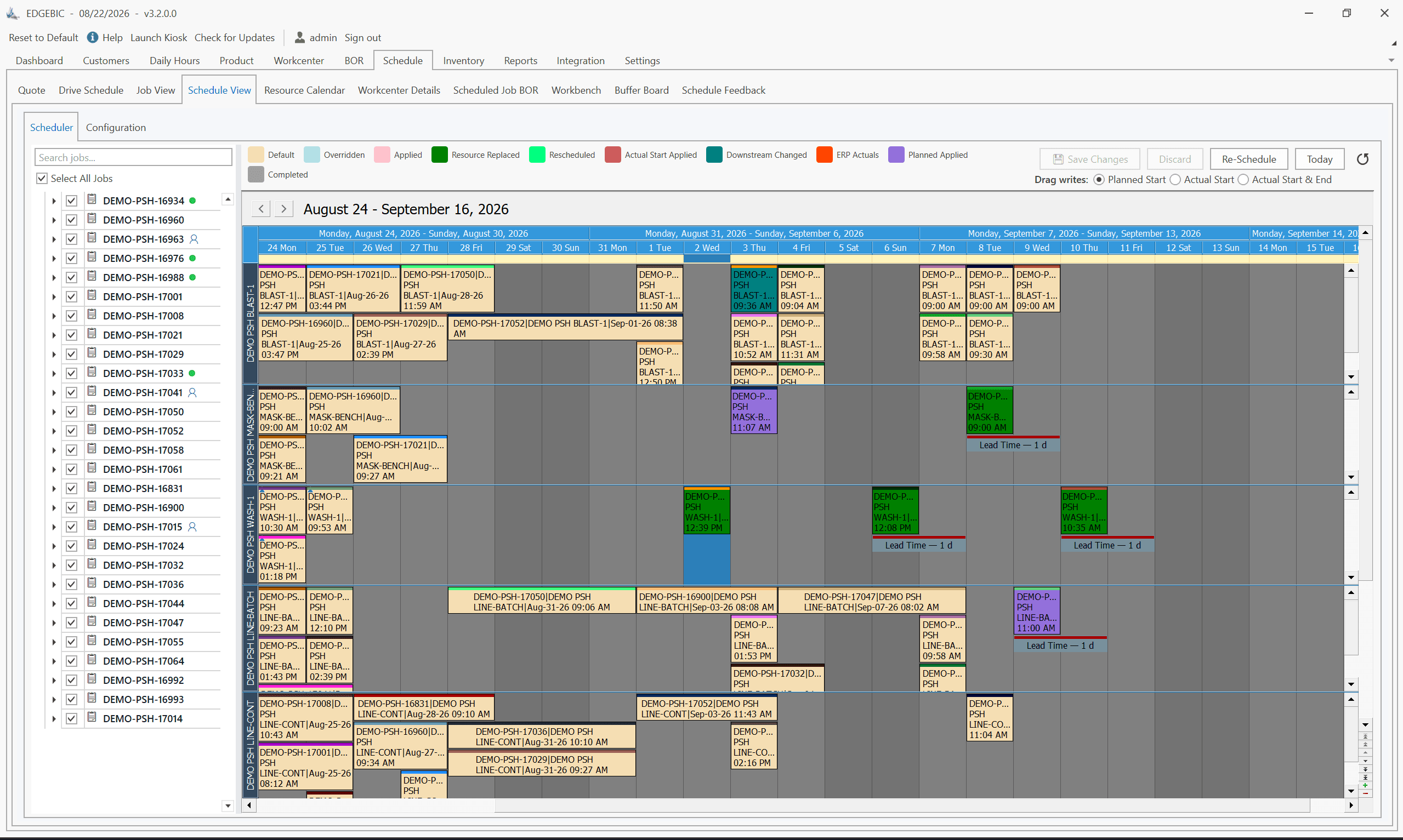
| Gantt chart visualization | EDGEBI interactive Gantt | Galaxy visual scheduling |
| What-if scenario analysis | Yes, multiple scenarios | Yes, sandbox mode |
| Drag-and-drop rescheduling | Yes | Yes |
| Multi-plant scheduling | Single plant focus | Multi-plant capable |
| Supply chain synchronization | Via ERP integration | Native supply chain planning |
| AI/ML optimization | Rule-based optimization | AI-assisted scheduling |
| Sequence-dependent setups | Yes | Yes |
| Alternate routings | Yes | Yes |
| ERP integration | Any ERP system | Pre-built ERP connectors |
| Deployment | On-premise | Cloud and on-premise |
| Pricing model | One-time perpetual license | Annual subscription/license |
| Implementation time | 5 business days | 3-6 months typical |
| Target company size | 10-500 employees | 100-5,000+ employees |
Scheduling Capabilities: Both Go Deep
Unlike comparisons between RMDB and ERP-based tools, the scheduling depth of RMDB and PlanetTogether is more comparable. Both are true finite capacity scheduling systems built to handle real manufacturing complexity.
Where Both Excel
Both RMDB and PlanetTogether handle the core APS capabilities that differentiate dedicated scheduling tools from ERP add-ons:
- True finite capacity logic: Both model resource constraints accurately, preventing the overloading that plagues infinite capacity MRP systems.
- Multi-constraint optimization: Machine capacity, labor availability, tooling, and material constraints are all considered simultaneously.
- Visual Gantt scheduling: Both provide interactive Gantt charts where planners can visualize the schedule and make manual adjustments.
- What-if analysis: Both allow planners to test schedule scenarios before committing changes to production.
- Sequence-dependent setups: Both handle setup times that vary based on the sequence of jobs running on a machine - critical for reducing changeover waste.
Where PlanetTogether Has an Edge
PlanetTogether offers capabilities that primarily benefit larger, more complex operations:
- Multi-plant synchronization: PlanetTogether can schedule across multiple facilities with inter-plant transfer dependencies. RMDB focuses on single-plant scheduling.
- Supply chain planning integration: PlanetTogether's Galaxy platform connects scheduling with procurement and supplier lead times more natively.
- AI-assisted optimization: PlanetTogether has invested in machine learning algorithms that learn from historical patterns to improve scheduling recommendations over time.
- Industry-specific modules: PlanetTogether offers tailored configurations for food and beverage, pharmaceutical, and other regulated industries.
Where RMDB Has an Edge
RMDB delivers advantages that matter most to small and mid-size manufacturers:
- Implementation speed: RMDB's 5-day implementation gets manufacturers live in a single business week. PlanetTogether implementations typically span 3-6 months.
- Total cost of ownership: RMDB's one-time license model costs 80-90% less than PlanetTogether over five years for a typical small manufacturer.
- Simplicity without sacrificing power: RMDB provides sophisticated scheduling without requiring a dedicated IT team or months of training. The interface is designed for production planners, not software engineers.
- No subscription dependency: RMDB's perpetual license means you own the software outright. No recurring fees, no price escalation, no risk of access loss.
- 35+ years of scheduling expertise: Every implementation includes direct access to User Solutions' deep manufacturing scheduling knowledge - not just software training, but scheduling methodology.
Pricing: Dramatically Different Models
The cost difference between RMDB and PlanetTogether is one of the most significant factors for small to mid-size manufacturers.
PlanetTogether Pricing
PlanetTogether does not publish pricing publicly, which is common among enterprise APS vendors. Based on industry data and customer reports, typical costs include:
- License/subscription: $50,000-$200,000+ depending on modules, users, and plant count
- Implementation services: $30,000-$100,000+
- Annual maintenance/support: 18-22% of license cost
- Total first-year cost: $80,000-$300,000+ for a mid-size deployment
RMDB Pricing
- One-time license: $25,000 (EDGEBIC APS) or $35,000 (EDGEBIC Complete), sold today as EDGEBIC (RMDB 2.0) by User Solutions
- Implementation: typically 5 days
- Updates: Included, with no per-seat annual fee
- Total first-year cost: $25,000-$35,000
5-Year Cost Comparison
| Cost Element | RMDB | PlanetTogether (Mid-Range) |
|---|---|---|
| Year 1 (license) | $25,000-$35,000 | $100,000-$200,000 |
| Years 2-5 (maintenance) | $0 (updates included) | $40,000-$80,000 |
| 5-Year Total | $25,000-$35,000 | $140,000-$280,000 |
For a manufacturer with 50 employees and 20 machines, the question is whether PlanetTogether's additional capabilities justify a cost premium of 6-12x over RMDB.
Implementation: One Week vs Several Months
Implementation speed is where the practical difference between RMDB and PlanetTogether is most visible.
RMDB: 5 Business Days
User Solutions' structured implementation program loads your actual production data - jobs, routings, resources, and orders - into RMDB and has planners running real schedules by end of week one. This is possible because RMDB is focused specifically on scheduling and integrates with your existing ERP rather than replacing any part of your technology stack. The compressed timeline means minimal disruption and immediate value generation.
PlanetTogether: 3-6+ Months
PlanetTogether implementations follow a more traditional enterprise software rollout: discovery and scoping (2-4 weeks), data mapping and integration setup (4-8 weeks), configuration and testing (4-8 weeks), user training and go-live (2-4 weeks). For complex deployments with multiple plants or extensive ERP integration, timelines can extend to 12 months or more.
The longer timeline reflects PlanetTogether's broader scope and deeper integration requirements. It is not a criticism of PlanetTogether's implementation quality - enterprise APS deployments inherently require more time. The question is whether your operation needs that level of complexity.
When PlanetTogether Is the Better Choice
PlanetTogether makes sense when:
- You operate multiple plants that need synchronized scheduling with inter-plant dependencies.
- Your company has 200+ employees and the budget, IT resources, and organizational patience for a multi-month implementation.
- Supply chain integration is critical and you need native connections between scheduling, procurement, and supplier management.
- You need AI-driven optimization that learns from historical patterns across large datasets.
- You are in a regulated industry (pharmaceutical, food safety) where PlanetTogether's industry-specific modules add value.
When RMDB Is the Better Choice
RMDB is the stronger fit when:
- You are a small to mid-size manufacturer (10-500 employees) who needs powerful scheduling without enterprise costs and complexity.
- Scheduling is your primary problem. If you already have an ERP handling inventory, procurement, and financials, you do not need another enterprise platform. You need better scheduling.
- Budget matters. At 80-90% less than PlanetTogether over five years, RMDB delivers the scheduling depth most small manufacturers need at a price that makes financial sense.
- Speed matters. A 5-day implementation vs 3-6 months is a significant difference when late deliveries are costing you customers right now.
- You want to own your software. The perpetual license means no subscription treadmill and complete data control.
- You run a job shop or make-to-order operation where scheduling complexity is high but plant count is one.
Honest Assessment: It Is About Fit, Not Better or Worse
PlanetTogether is a capable, well-established APS platform that has earned its reputation among mid-to-large manufacturers. For operations that need multi-plant synchronization, supply chain integration, and AI-driven optimization, PlanetTogether delivers genuine value.
RMDB is a purpose-built scheduling solution that delivers comparable scheduling depth for single-plant operations at a fraction of the cost and implementation time. For the thousands of small to mid-size manufacturers who need finite capacity scheduling, visual planning, and what-if analysis without a six-figure investment, RMDB is the more practical choice.
The right tool depends on your size, complexity, budget, and timeline. We encourage you to evaluate both.
Frequently Asked Questions
PlanetTogether is designed for mid-to-large manufacturers and offers strong multi-plant capabilities. For large enterprises with complex supply chain integration needs, PlanetTogether may be the better fit. For small to mid-size manufacturers who need powerful scheduling without enterprise complexity and cost, RMDB delivers equivalent scheduling depth at a fraction of the price.
PlanetTogether pricing varies by configuration but typically ranges from $50,000 to $200,000+ for mid-size deployments, plus annual maintenance fees. RMDB, now EDGEBIC (RMDB 2.0) by User Solutions, is a one-time perpetual license at $25,000 (APS) or $35,000 (Complete). For small to mid-size manufacturers, it can cost roughly 75-90% less than PlanetTogether over five years.
For the scheduling scenarios most small and mid-size manufacturers face - finite capacity, multi-constraint optimization, sequence-dependent setups, what-if analysis - RMDB handles the same complexity. PlanetTogether adds capabilities around multi-plant supply chain synchronization and advanced AI-driven optimization that matter primarily for very large operations.
PlanetTogether implementations typically take 3-6 months depending on complexity, with some enterprise deployments extending to 12+ months. RMDB's structured 5-day implementation program gets manufacturers live with real production data in a single business week.
Yes, PlanetTogether offers pre-built integrations with major ERP systems including SAP, Oracle, Microsoft Dynamics, Epicor, and Infor. RMDB, now EDGEBIC (RMDB 2.0) by User Solutions, integrates with all major ERPs through flexible Excel, CSV and database import-export, with no custom API project required.
See How RMDB Compares With Your Data
The most meaningful comparison uses your own production data. Contact User Solutions to schedule a demo with your actual jobs, routings, and constraints. With our 5-day implementation, you can be running real schedules before a typical PlanetTogether implementation finishes its discovery phase. Request a demo today.
Frequently Asked Questions
Ready to Transform Your Production Scheduling?
User Solutions has been helping manufacturers optimize their production schedules for over 35 years. One-time license, 5-day implementation.

User Solutions Team
Manufacturing Software Experts
User Solutions has been developing production planning and scheduling software for manufacturers since 1991. Our team combines 35+ years of manufacturing software expertise with deep industry knowledge to help factories optimize their operations.
Share this article
Related Articles
10 Best APS Software for Manufacturers in 2026
Compare the 10 best Advanced Planning and Scheduling (APS) software solutions, from EDGEBIC (RMDB 2.0) to PlanetTogether, Siemens Opcenter and SAP. Features, pricing, implementation timelines, and recommendations by manufacturer size.

Free vs Paid Production Scheduling Software: What Manufacturers Need to Know
Compare free and paid production scheduling software for manufacturers. Real costs, hidden limitations, and when to invest in a paid scheduling solution.

One-Time License vs SaaS Scheduling Software: Total Cost Comparison
Compare perpetual license and SaaS subscription pricing for manufacturing scheduling software. 5-year TCO analysis, pros, cons, and which model fits your shop.