
RMDB vs MRPeasy: Honest Comparison for Manufacturers (2026)
 User Solutions Team
Choosing between RMDB and MRPeasy is a decision many small to mid-size manufacturers face when they outgrow spreadsheets and need proper production scheduling. Both tools serve manufacturers, but they approach the problem from fundamentally different angles. MRPeasy is a cloud-based ERP system with scheduling features built in. RMDB is a dedicated finite capacity scheduling tool designed to work alongside any ERP. This comparison will help you understand which approach fits your operation.
This is not a marketing exercise. We will cover genuine strengths and limitations for both platforms so you can make an informed decision. For a broader look at how different scheduling tools stack up, see our production scheduling software comparison guide.
Company Background
MRPeasy
MRPeasy launched in 2014 as a cloud-based manufacturing ERP designed specifically for small manufacturers. Based in Estonia, the company has built a strong presence among manufacturers with 10-200 employees who want an all-in-one system covering production, inventory, procurement, CRM, and basic accounting. MRPeasy has grown significantly through content marketing and offers a free trial that makes it easy to evaluate.
RMDB by User Solutions
RMDB (Resource Manager DB) was developed by User Solutions, a company founded in 1991 with over 35 years of experience in manufacturing scheduling software. RMDB focuses exclusively on finite capacity scheduling and planning, designed to work as an add-on to virtually any existing ERP system. The software has been deployed across hundreds of manufacturers in industries including aerospace, defense, automotive, electronics, and job shop machining.
Feature Comparison
The table below compares core capabilities across both platforms:
| Feature | RMDB | MRPeasy |
|---|---|---|
| Finite capacity scheduling | Advanced multi-constraint | Basic capacity planning |
| Gantt chart visualization | Full interactive Gantt via EDGEBI | Basic production timeline |
| What-if scenario analysis | Yes, multiple scenarios | No |
| Drag-and-drop rescheduling | Yes | Limited |
| MRP/material planning | Integrates with ERP's MRP | Built-in MRP |
| CRM | No (uses your ERP) | Built-in |
| Procurement | No (uses your ERP) | Built-in |
| Inventory management | No (uses your ERP) | Built-in |
| ERP integration | Any ERP system | Standalone ERP |
| Multi-constraint optimization | Yes | No |
| Sequence-dependent setups | Yes | No |
| Deployment | On-premise | Cloud |
| Pricing model | One-time perpetual license | Monthly subscription |
| Implementation time | 5 business days | 2-6 weeks |
Scheduling Depth: Where the Differences Matter
The most significant difference between RMDB and MRPeasy lies in scheduling sophistication. This matters because scheduling is where most small manufacturers feel the most pain.
RMDB Scheduling Capabilities
RMDB was built from the ground up as a finite capacity scheduling system. It models every resource constraint - machines, labor, tooling, materials - simultaneously. When you load jobs into RMDB, the scheduler considers:
- Machine availability and capacity limits
- Labor skills and shift patterns
- Tooling and fixture availability
- Material availability dates from your ERP
- Setup time dependencies between job sequences
- Customer priority and due date requirements
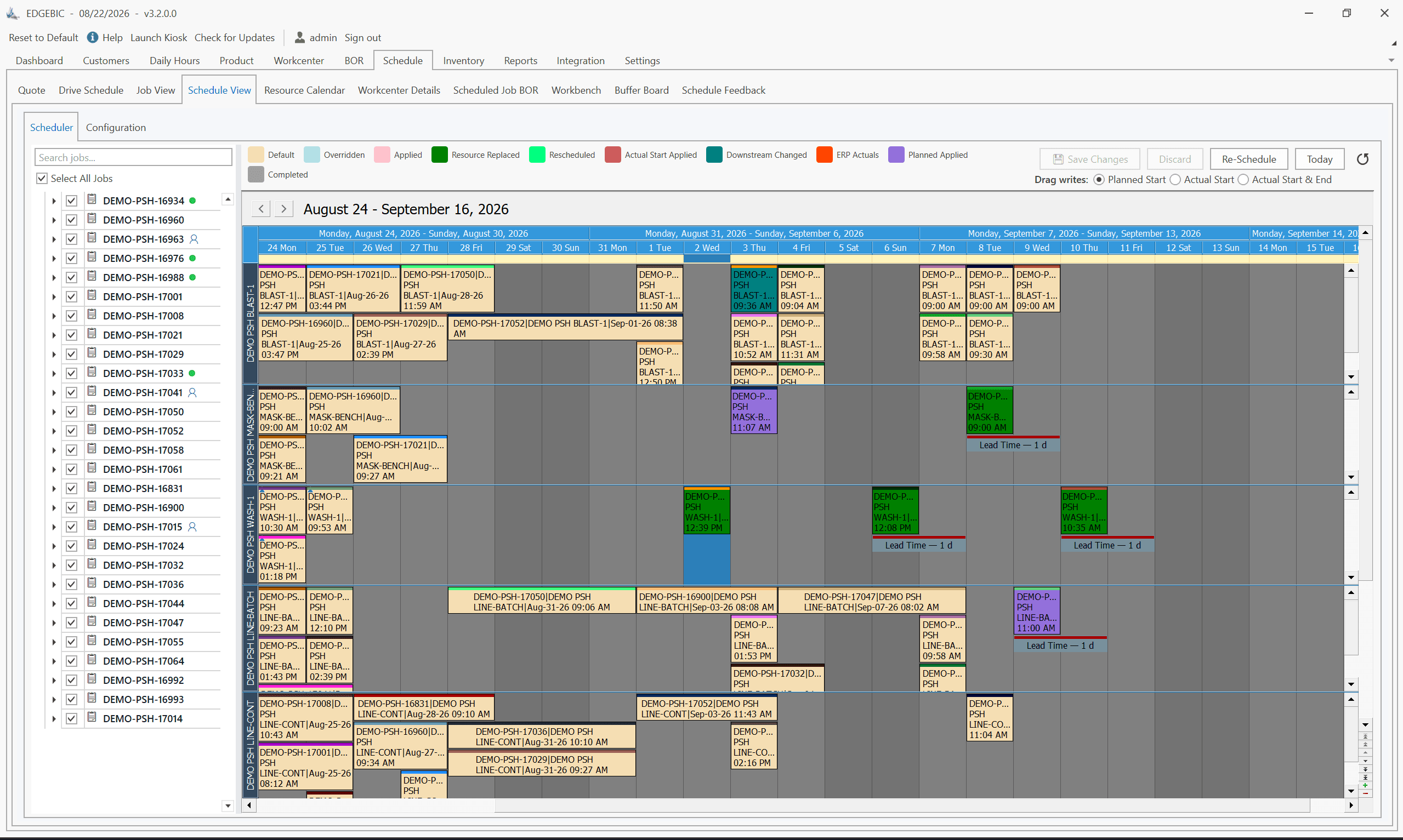
The EDGEBI visual interface provides interactive Gantt charts where planners can drag and drop operations, see the ripple effects of changes instantly, and compare multiple what-if scenarios before committing to a schedule. This level of scheduling intelligence is what separates dedicated APS tools from ERP modules with basic scheduling features.
MRPeasy Scheduling Capabilities
MRPeasy provides solid production planning with workstation loading views, basic forward scheduling, and automatic work order generation from sales orders. The system handles production routing definitions, workstation management, and capacity utilization tracking. For many small manufacturers with straightforward production flows, this level of scheduling is sufficient.
Where MRPeasy falls short is in handling complexity. If your shop deals with sequence-dependent setups, alternate routings, competing priorities across multiple work centers, or needs to run scenario analysis before committing schedule changes, MRPeasy's scheduling engine will feel limiting.
Pricing and Total Cost of Ownership
Pricing is where RMDB and MRPeasy diverge dramatically, and the difference compounds over time.
MRPeasy Pricing
MRPeasy offers tiered per-user subscription pricing (published prices as of September 2026; see mrpeasy.com for current prices and what each tier includes):
- Starter: $49/user/month
- Professional: $69/user/month
- Enterprise: $99/user/month
- Unlimited: $149/user/month (2-user minimum)
Unlike the one-time RMDB license, every MRPeasy tier is billed per user for as long as you use the software.
For a typical small manufacturer with 5 users on the Professional plan, that is $345/month or $4,140/year. Over five years, the total reaches $20,700 - and you never own the software.
RMDB Pricing
RMDB uses a one-time perpetual license model. Today it is sold as EDGEBIC (RMDB 2.0) by User Solutions: $25,000 for EDGEBIC APS or $35,000 for EDGEBIC Complete, as a one-time purchase with updates included and no per-seat annual fee.
Over five years, a 5-user MRPeasy Professional subscription ($20,700) costs less than the EDGEBIC license, which carries the RMDB engine forward. The comparison turns with team size and time: 10 users on Professional reach $41,400 over five years, and the one-time license keeps paying back after that. RMDB also does not hold your data hostage: there is no subscription to keep paying for the software to keep working.
5-Year Cost Comparison
| Cost Element | RMDB | MRPeasy (Professional, 5 users) |
|---|---|---|
| Year 1 | $25,000-$35,000 (license) | $4,140 |
| Year 2 | $0 (updates included) | $4,140 |
| Year 3 | $0 | $4,140 |
| Year 4 | $0 | $4,140 |
| Year 5 | $0 | $4,140 |
| 5-Year Total | $25,000-$35,000 | $20,700 |
At 5 users on Professional, breakeven takes about six years; at 10 users it takes about three. After breakeven, the one-time license's advantage grows every year.
Implementation and Onboarding
RMDB: 5-Day Implementation
User Solutions offers a structured 5-day implementation program where your actual production data - jobs, routings, work centers, and orders - is loaded into RMDB. By the end of the week, planners are running real schedules. This rapid deployment minimizes disruption and gets you generating value immediately.
MRPeasy: 2-6 Week Setup
MRPeasy is a cloud application that you can start using immediately after signup. However, meaningful production use typically requires 2-6 weeks of data entry and configuration - setting up BOMs, routings, workstations, inventory items, and suppliers. MRPeasy provides onboarding resources and tutorials, but the setup effort falls primarily on your team.
Both timelines are fast compared to enterprise systems that can take 6-18 months. The key difference is that RMDB's implementation is guided by experienced scheduling consultants, while MRPeasy's onboarding is largely self-service.
Integration Approach
RMDB: ERP Add-On Philosophy
RMDB was designed to complement your existing ERP, not replace it. It integrates with virtually any ERP system - including SAP, Oracle, Epicor, JobBOSS, Sage, and many others - through flexible data import/export and API connections. This means you keep your existing ERP for financials, inventory, procurement, and order management while adding RMDB's scheduling intelligence on top.
MRPeasy: All-in-One Philosophy
MRPeasy aims to be your complete manufacturing ERP. For manufacturers who do not have an existing ERP and want a single system for everything, this all-in-one approach is appealing. However, if you already have an ERP you are invested in, MRPeasy creates a replace-or-duplicate dilemma.
When MRPeasy Is the Better Choice
MRPeasy makes sense when:
- You need a full ERP, not just scheduling. If you are starting from scratch with no ERP and want inventory, procurement, CRM, and basic scheduling in one tool, MRPeasy covers a lot of ground.
- Your scheduling needs are straightforward. If your production flow is linear with minimal setup variability and you do not need scenario analysis, MRPeasy's built-in scheduling may be sufficient.
- You prefer cloud-based access. MRPeasy runs in a browser and is accessible from anywhere. For manufacturers with distributed teams or limited IT infrastructure, this is a genuine advantage.
- You want low upfront investment. The monthly subscription means lower initial cash outlay, which can matter for very new or cash-constrained businesses.
When RMDB Is the Better Choice
RMDB is the stronger fit when:
- Scheduling is your primary pain point. If missed due dates, bottleneck confusion, and reactive firefighting are what keep you up at night, RMDB's scheduling depth addresses these directly.
- You already have an ERP. RMDB enhances your existing system instead of replacing it. No data migration, no retraining on procurement and inventory - just better scheduling.
- You deal with scheduling complexity. Sequence-dependent setups, alternate routings, multi-constraint resources, and competing priorities are where RMDB excels and where MRPeasy struggles.
- You want to own your software. The one-time license means no subscription fees, no price increases, and no risk of losing access to your scheduling tool if you pause payments.
- You value implementation expertise. The 5-day guided implementation with User Solutions' 35+ years of manufacturing scheduling experience compresses what could be months of trial and error into a single productive week.
Real-World Scenario: Job Shop with 30 Employees
Consider a typical job shop running 15 machines across two shifts, with 200+ active jobs at any time. Here is how each tool handles common challenges:
Challenge: Rush order arrives and needs to be inserted into the schedule.
- RMDB: Load the rush order, run what-if scenarios to see the impact on existing commitments, drag-and-drop to find the best insertion point, and immediately see which other jobs are affected.
- MRPeasy: Create the work order and manually adjust the production plan. Limited visibility into cascading effects on other orders.
Challenge: Key machine goes down for unplanned maintenance.
- RMDB: Remove machine availability for the downtime period, reschedule affected operations to alternate machines or time slots, and instantly see the new projected completion dates.
- MRPeasy: Manually reassign work orders and adjust production timelines. Less automated cascade recalculation.
Challenge: Customer calls asking for an accurate delivery date on a new quote.
- RMDB: Load the prospective job as a what-if scenario, see where it fits in the current schedule without committing, and provide a realistic delivery date based on actual capacity.
- MRPeasy: Estimate based on workstation loading data. Less precise because of limited finite capacity modeling.
The Bottom Line
MRPeasy is a capable, affordable cloud ERP for small manufacturers who need an all-in-one system and have relatively straightforward scheduling needs. It does many things adequately and is a significant step up from spreadsheets and manual processes.
RMDB is a specialized scheduling tool that goes significantly deeper on the production planning and scheduling problem. If scheduling accuracy, visibility, and responsiveness are critical to your business - and for most job shops they are - RMDB delivers capabilities that MRPeasy's built-in scheduler simply does not match.
The two tools are not mutually exclusive. Some manufacturers use MRPeasy for ERP functions and RMDB for scheduling. The right choice depends on whether your primary need is a broad ERP system or a deep scheduling solution.
Frequently Asked Questions
It depends on what you prioritize. MRPeasy offers a broader ERP feature set including CRM and procurement. RMDB delivers deeper scheduling capability with finite capacity logic, what-if analysis, and visual Gantt charts. For manufacturers whose primary pain point is scheduling, RMDB is typically the stronger fit.
MRPeasy charges $49-$149 per user per month depending on the plan. Over 5 years with 5 users, that totals $14,700-$44,700. RMDB, now EDGEBIC (RMDB 2.0) by User Solutions, is a one-time perpetual license at $25,000 (APS) or $35,000 (Complete) with updates included and no per-seat annual fee. For a small team on a lower MRPeasy plan, MRPeasy costs less over five years; the one-time license pulls ahead as users grow, as the years run past five, or when finite-capacity scheduling depth is the real need.
RMDB is not a full ERP system, so it would not replace MRPeasy's CRM, procurement, or accounting functions. However, RMDB can work alongside your existing ERP (including MRPeasy) as a scheduling add-on that provides significantly deeper finite capacity scheduling, Gantt visualization, and what-if analysis.
Both are relatively quick to implement compared to enterprise systems. MRPeasy is cloud-based and can be set up in 2-6 weeks. RMDB offers a structured 5-day implementation program that gets manufacturers live with real production data in a single business week.
MRPeasy includes basic capacity planning features that show workstation loading and highlight overloads. However, it does not offer the same depth of finite capacity scheduling as dedicated APS tools like RMDB, which provides multi-constraint scheduling, what-if scenario analysis, and advanced sequencing algorithms.
Ready to See RMDB in Action?
The best way to evaluate scheduling software is with your own data. Contact User Solutions to schedule a demo using your actual jobs, routings, and work centers. With our 5-day implementation, you can be running real schedules in a single business week - no lengthy pilots, no months of configuration. Request a demo today.
Frequently Asked Questions
Ready to Transform Your Production Scheduling?
User Solutions has been helping manufacturers optimize their production schedules for over 35 years. One-time license, 5-day implementation.

User Solutions Team
Manufacturing Software Experts
User Solutions has been developing production planning and scheduling software for manufacturers since 1991. Our team combines 35+ years of manufacturing software expertise with deep industry knowledge to help factories optimize their operations.
Share this article
Related Articles
10 Best APS Software for Manufacturers in 2026
Compare the 10 best Advanced Planning and Scheduling (APS) software solutions, from EDGEBIC (RMDB 2.0) to PlanetTogether, Siemens Opcenter and SAP. Features, pricing, implementation timelines, and recommendations by manufacturer size.

Free vs Paid Production Scheduling Software: What Manufacturers Need to Know
Compare free and paid production scheduling software for manufacturers. Real costs, hidden limitations, and when to invest in a paid scheduling solution.

One-Time License vs SaaS Scheduling Software: Total Cost Comparison
Compare perpetual license and SaaS subscription pricing for manufacturing scheduling software. 5-year TCO analysis, pros, cons, and which model fits your shop.