
Production Scheduling vs Production Planning: Key Differences
 User Solutions Team
The terms production scheduling vs production planning are often used interchangeably on the shop floor, but they refer to fundamentally different activities. Confusing the two leads to unrealistic delivery promises, overloaded work centers, and chronic firefighting. Understanding where planning ends and scheduling begins is essential for any manufacturer who wants to move from reactive chaos to proactive control.
At User Solutions, we have spent 35+ years implementing production scheduling software for manufacturers, and the planning-scheduling distinction is one of the first concepts we clarify with every new customer. This article breaks down the differences, explains how the two disciplines complement each other, and shows how the right tools make both more effective.
What Is Production Planning?
Production planning is the strategic process of determining what to produce, how much, and by when. It operates at a higher level than scheduling and typically covers weeks, months, or even quarters.
Key activities within production planning include:
- Demand forecasting - estimating future customer demand based on historical data, sales pipeline, and market trends
- Material requirements planning (MRP) - calculating raw material needs based on bills of material and open orders
- Aggregate capacity planning - ensuring overall capacity (labor hours, machine hours) is sufficient to meet planned volumes
- Master production scheduling (MPS) - defining the high-level timeline for finished goods production (see our MPS guide)
- Procurement coordination - aligning material purchases with production timelines
Production planning answers the question: Can we fulfill this demand with the resources and materials we have or can acquire?
What Is Production Scheduling?
Production scheduling is the tactical process of determining the exact sequence of operations across specific machines, work centers, and labor resources. It operates at the shift, day, or hour level. For a full definition with a worked example, see what is production scheduling.
Key activities within production scheduling include:
- Job sequencing - determining the order in which jobs run on each machine
- Resource assignment - assigning specific machines, operators, and tooling to each operation
- Setup optimization - grouping similar jobs to minimize changeover time
- Constraint management - respecting finite capacity, material availability, and labor skills
- Rescheduling - adjusting the schedule in response to disruptions like machine breakdowns, rush orders, or material delays
Production scheduling answers the question: What should run where, when, and in what order to meet our planned targets?
Side-by-Side Comparison
The differences become clearer in a direct comparison:
| Dimension | Production Planning | Production Scheduling |
|---|---|---|
| Time horizon | Weeks to months | Hours to days |
| Level of detail | Aggregate (product families, weekly buckets) | Granular (individual operations, specific machines) |
| Primary question | What and how much? | Where, when, and in what order? |
| Capacity view | Rough-cut (infinite capacity is common) | Finite capacity (respects real constraints) |
| Key output | Master production schedule, MRP plan | Gantt chart, dispatch list, work center queue |
| Primary tool | ERP/MRP system | Scheduling software (APS) |
| Who owns it | Production planner, materials manager | Production scheduler, shop floor supervisor |
| Update frequency | Weekly or monthly | Daily or per-shift |
| Handles disruptions | Rarely (re-plans on a longer cycle) | Constantly (reschedules in real time) |
How Planning and Scheduling Work Together
Think of planning and scheduling as two halves of the same process. Planning sets the targets; scheduling figures out how to hit them.
Here is how they connect in a typical manufacturing workflow:
1. Planning generates demand. The planner reviews open orders and forecasts, runs MRP, and produces a master production schedule that says "We need 500 units of Part A by April 30 and 200 units of Part B by May 7."
2. Scheduling creates the execution plan. The scheduler takes those requirements and loads them against available machines and labor. Using production scheduling methods like forward scheduling or backward scheduling, the software generates a detailed, time-phased plan for every work center.
3. Scheduling validates the plan. This is the critical handoff. If scheduling reveals that the plan is infeasible - a bottleneck machine is overloaded, or material will not arrive in time - that feedback loops back to planning. The planner adjusts quantities, shifts dates, or authorizes overtime.
4. Execution happens. The shop floor follows the schedule. Operators see their queue of jobs, know the sequence, and understand priorities.
5. Both update continuously. Planning updates weekly as demand changes. Scheduling updates daily or more frequently as shop floor conditions shift.
Without planning, scheduling has no target. Without scheduling, planning has no reality check. Manufacturers who excel at both outperform those who focus on only one.
Where Most Manufacturers Go Wrong
In our experience across hundreds of implementations, the most common mistakes fall into predictable patterns:
Planning without finite capacity. Many ERP systems run MRP with infinite capacity assumptions - meaning they assume unlimited machine availability. The result is a plan that looks great on paper but cannot be executed. Jobs stack up on bottleneck machines, and the shop floor loses faith in the schedule. This is precisely why finite capacity scheduling matters.
Scheduling without a plan. Some manufacturers skip formal planning entirely. The scheduler works directly from the sales order backlog, sequencing jobs as they come in. This reactive approach misses the opportunity to anticipate material shortages, balance workloads across periods, and make proactive staffing decisions.
Using the same tool for both. Excel is a common culprit here. A spreadsheet can hold a rough production plan, but it cannot perform finite capacity scheduling. When manufacturers try to force Excel into both roles, they end up with a tool that does neither well.
No feedback loop. Planning and scheduling must communicate. When the schedule reveals a capacity problem, that information needs to flow back to the planner quickly. In organizations where the planner and scheduler do not talk regularly - or where there is no shared system - problems get discovered too late.
The Right Tools for Each Job
The best manufacturing operations use purpose-built tools for planning and scheduling:
For planning: Your ERP system's MRP module handles material requirements planning, purchase order generation, and aggregate capacity checks. Systems like SAP, Oracle, Epicor, JobBOSS, and Sage all include these capabilities.
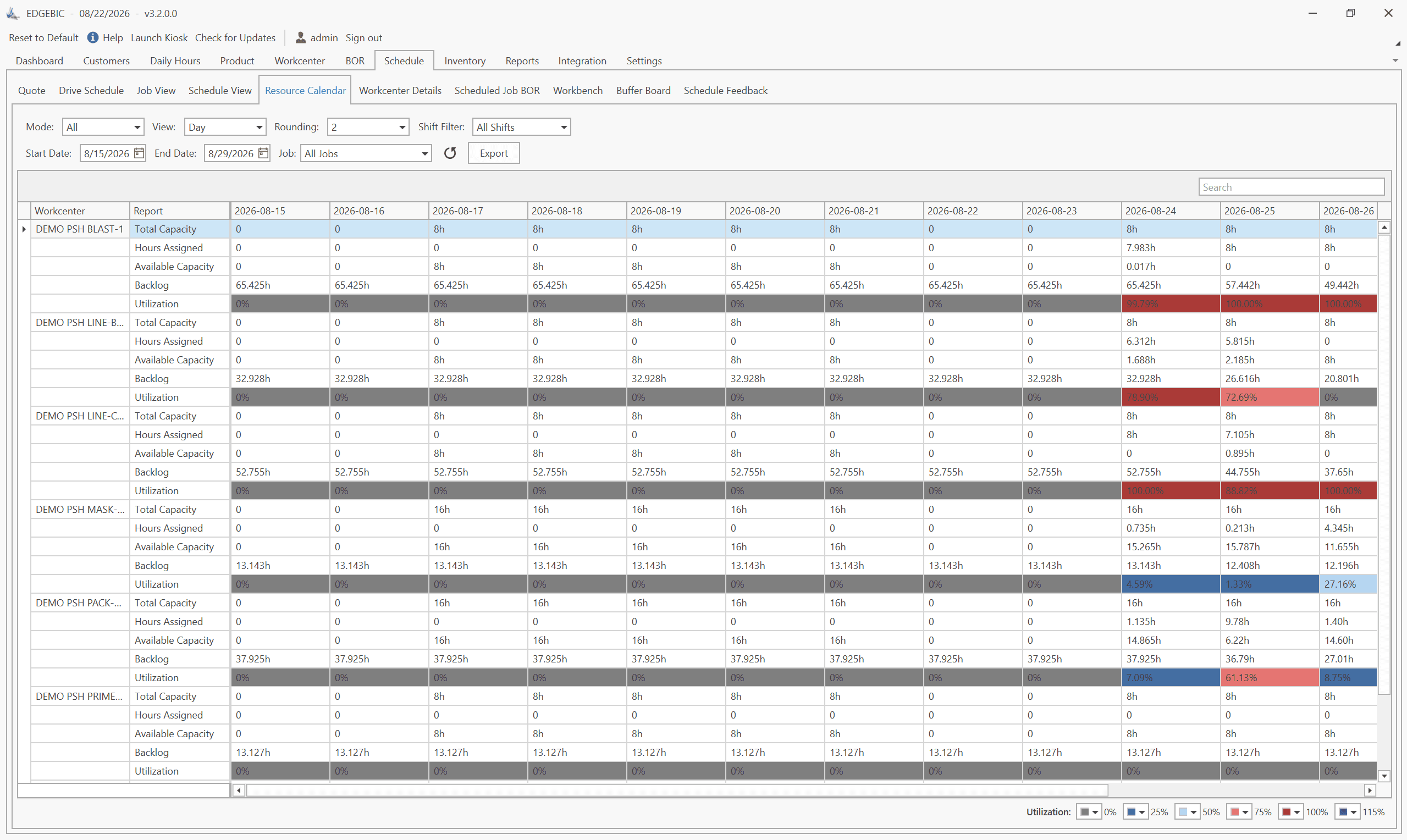
For scheduling: A dedicated scheduling tool like RMDB from User Solutions provides finite capacity scheduling, constraint management, and what-if analysis. Now sold as EDGEBIC, its drag-and-drop Gantt chart gives schedulers drag-and-drop control over job sequences with instant visibility into the impact of every change.
The two systems connect through data integration. RMDB imports orders and routings from your ERP, generates the optimized schedule, and can feed completion data back. This integration means you get the best of both worlds: your ERP's planning strength and RMDB's scheduling precision.
User Solutions' approach to integration is intentionally flexible - RMDB works as an add-on to virtually any ERP system, avoiding the need for a costly full-system replacement.
Making the Distinction Work for Your Shop
If you are trying to improve your manufacturing operations, start by asking a simple question: Where are we losing control - at the planning level or the scheduling level?
- If you are frequently surprised by material shortages, your planning needs work.
- If you miss delivery dates despite having materials on hand, your scheduling needs work.
- If both happen regularly, you need to strengthen both - and the connection between them.
For most small to mid-size manufacturers, the highest-impact move is improving scheduling. Planning systems (ERP/MRP) are usually already in place. What is missing is the finite capacity scheduling layer that turns a rough plan into an executable shop floor reality.
User Solutions offers a 5-day implementation that gets your scheduling system live within a single business week. Over 35 years, we have helped manufacturers across every industry bridge the gap between planning and scheduling - and the results consistently speak for themselves.
Contact us for a demo to see how RMDB, now EDGEBIC, can bring planning and scheduling together for your operation.
Production planning determines what to produce, how much, and by when at a strategic level. Production scheduling determines the exact sequence of operations - which machine runs which job at which specific time. Planning is about volume and timing; scheduling is about sequence and resource assignment.
Yes. Planning without scheduling results in unrealistic promises because capacity constraints are ignored. Scheduling without planning means you are sequencing jobs without understanding overall demand and material requirements. The two disciplines work together to bridge strategy and execution.
Planning comes first. You must determine what to make and when it is needed before you can sequence the detailed operations on the shop floor. In practice, planning and scheduling overlap - planners set the targets, and schedulers figure out how to hit them.
Some ERP systems include both MRP (planning) and finite capacity scheduling modules, but the scheduling component is often basic. Dedicated scheduling tools like RMDB from User Solutions layer on top of your ERP to provide the detailed, constraint-aware scheduling that built-in modules cannot match.
Expert Q&A: Deep Dive
Q: We have a planner and a scheduler - should they be the same person?
A: In smaller shops (under 50 people), the planner and scheduler are often the same person. That can work, but the risk is that planning tasks - reviewing forecasts, managing materials, coordinating with purchasing - consume so much time that scheduling becomes reactive rather than proactive. As shops grow, separating the roles pays dividends. The planner focuses on what and when; the scheduler focuses on how and where. If you can't justify two full-time roles, consider making scheduling a dedicated part of someone's day - even 2 hours of focused scheduling time each morning dramatically improves shop floor performance.
Q: Our ERP does MRP planning. Do we still need separate scheduling software?
A: Almost certainly yes. MRP tells you when materials need to arrive and when jobs should start based on lead time offsets - but it uses infinite capacity assumptions. It does not know that Machine A is already fully loaded next Tuesday. Layering finite capacity scheduling software like RMDB on top of your ERP gives you realistic, executable schedules that reflect actual shop floor constraints. The two systems complement each other perfectly.
Frequently Asked Questions
Ready to Transform Your Production Scheduling?
User Solutions has been helping manufacturers optimize their production schedules for over 35 years. One-time license, 5-day implementation.

User Solutions Team
Manufacturing Software Experts
User Solutions has been developing production planning and scheduling software for manufacturers since 1991. Our team combines 35+ years of manufacturing software expertise with deep industry knowledge to help factories optimize their operations.
Share this article
Related Articles
How to Create a Production Schedule in 7 Steps (Free Template)
How to create a production schedule step by step: horizon, real capacity, work orders, load check, sequence, dates, then publish. Worked example included.
Production Planning and Control (PPC): Functions and Examples
Production planning and control explained: routing, loading, scheduling, sequencing, dispatching and expediting, the types of scheduling, and worked examples.

Sequence-Dependent Setup Times: The Scheduling Problem That Costs You Capacity
When changeover time depends on what ran before, standard scheduling fails. Learn how setup matrices, sequence optimization, and APS software recover 10-25% of hidden capacity in paint lines, food, and coating operations.