
Scheduling for High-Mix Low-Volume Manufacturing
 User Solutions Team
High-mix low-volume (HMLV) manufacturing represents the most challenging scheduling environment in discrete manufacturing. When every job is different, setups consume a significant portion of capacity, and demand patterns are unpredictable, traditional scheduling approaches break down. The scheduler faces a constant stream of unique jobs competing for the same resources, each with different routings, different setup requirements, and different due dates.
At User Solutions, HMLV manufacturers - job shops, custom fabricators, aerospace suppliers, medical device makers - represent the majority of our customer base. Over 35+ years, we have developed scheduling strategies specifically for environments where variety is the norm and repetition is the exception. This guide shares those strategies.
What Makes HMLV Scheduling Different
HMLV scheduling differs from high-volume, low-variety environments in fundamental ways:
| Factor | High-Volume Low-Variety | High-Mix Low-Volume |
|---|---|---|
| Product variety | Few products, large quantities | Many products, small quantities |
| Routings | Standardized, repetitive | Unique or semi-unique per job |
| Setup times | Minimized through dedicated lines | Significant and variable |
| Demand pattern | Predictable, forecastable | Irregular, order-driven |
| Scheduling complexity | Low (repetitive sequences) | Very high (unique sequences) |
| Learning curve | Operators learn through repetition | Limited repetition, more variation |
| WIP visibility | Straightforward tracking | Complex, many parts in different stages |
The scheduling challenges are intensified because:
- Each job may require different scheduling logic - some jobs are rush orders, some are standard, some have complex multi-step routings, others are simple
- Setup sequences matter enormously - the order in which jobs run on a machine can double or halve the total setup time
- Demand is order-driven - there is no stable forecast to plan around; new orders arrive continuously and change the picture
- Operator skill variation - not every operator can run every job on every machine, creating labor constraints that compound machine constraints
Strategy 1: Focus on the Bottleneck
In an HMLV environment, you cannot optimize everything simultaneously. The most impactful strategy is to focus your scheduling effort on the bottleneck resources - the machines or work centers that constrain your overall throughput.
Why it works: The bottleneck determines your maximum output. An hour lost at the bottleneck is an hour lost for the entire factory. An hour saved at a non-bottleneck is meaningless - it just creates idle time.
How to implement:
- Identify your 3-5 most loaded resources (typically > 80% utilization)
- Schedule these resources with finite capacity scheduling and setup optimization
- Protect the bottleneck with a time buffer - ensure work arrives early enough that the bottleneck never starves
- For non-bottleneck resources, simpler scheduling rules (FIFO or EDD) suffice
This focused approach delivers 80% of the scheduling benefit with 20% of the effort.
Strategy 2: Setup Optimization
In HMLV environments, setup time can consume 20-40% of total machine time. Reducing this percentage directly increases capacity without capital investment.
Grouping similar jobs: Sequence jobs with similar characteristics together on the same machine. If switching from aluminum to steel requires a 45-minute changeover, but switching between aluminum jobs requires only 10 minutes, running aluminum jobs consecutively saves significant time.
Sequence-dependent setup matrices: Advanced scheduling tools like RMDB support setup matrices that define the changeover time between any two job types. The scheduling engine uses this matrix to find sequences that minimize total setup time while respecting due dates.
The trade-off: Setup optimization sometimes conflicts with due date priority. A perfect setup sequence may delay an urgent order. The best schedulers balance both objectives, grouping when due date slack allows and breaking groups when urgency demands it. What-if analysis helps evaluate these trade-offs.
Strategy 3: Dynamic Priority Rules
Static priority rules (always run the earliest due date first) work poorly in HMLV because the situation changes constantly. Dynamic rules that recalculate priorities as conditions change are more effective:
Critical Ratio (CR) is the most effective general-purpose rule for HMLV:
CR = (Due Date - Today) / Remaining Processing Time
Jobs with CR below 1.0 are behind schedule and get priority. Jobs with CR above 1.0 have slack. The beauty of CR is that it automatically adjusts as time passes - a job that was comfortable yesterday may become urgent today.
Weighted priority combines multiple factors: due date urgency, customer importance, job value, and setup compatibility. RMDB's scheduling methods support weighted priority rules that balance these competing factors automatically.
Strategy 4: Capacity Buffers
HMLV environments are inherently variable. Scheduling every machine to 100% utilization guarantees missed deliveries because there is no room for the inevitable disruptions.
Best practice: Schedule bottleneck resources to 85-90% utilization and non-bottlenecks to 70-80%. The remaining capacity serves as a buffer for:
- Rush orders that cannot be anticipated
- Jobs that take longer than estimated
- Machine breakdowns and maintenance
- Quality issues requiring rework
This seems counterintuitive - why leave capacity unused? Because the cost of the buffer (slightly lower utilization) is far less than the cost of chronic overtime, missed deliveries, and customer dissatisfaction.
Strategy 5: Visual Scheduling with Drag-and-Drop
HMLV scheduling requires continuous human judgment that algorithms alone cannot provide. Visual scheduling tools give the scheduler the ability to:
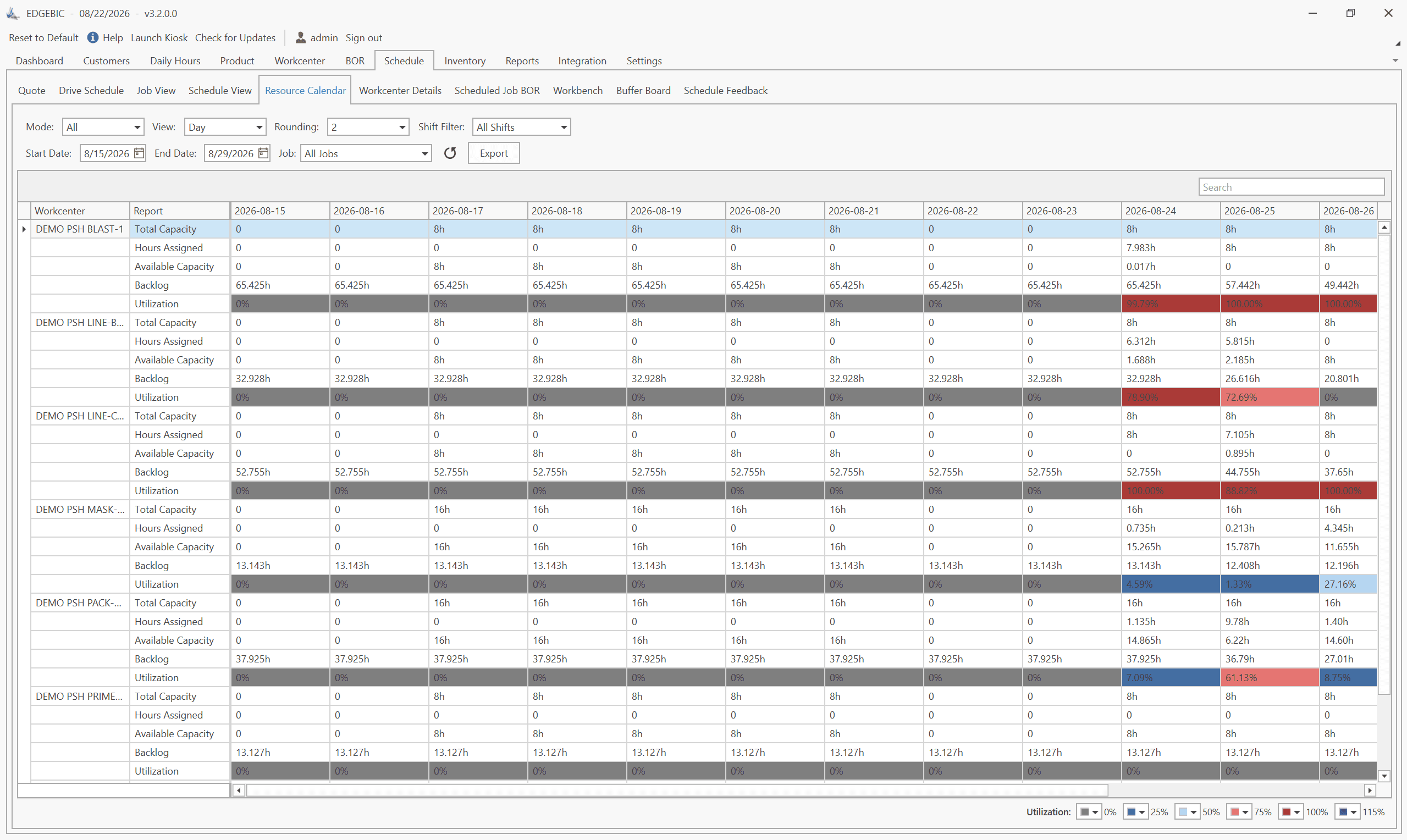
- See the entire shop floor schedule at a glance
- Identify gaps and overloads quickly
- Drag and drop jobs to test sequences
- Respond to disruptions in minutes
EDGEBI from User Solutions provides this visual layer on top of RMDB's finite capacity scheduling engine, giving HMLV schedulers the combination of algorithmic optimization and human intuition that complex environments require.
Strategy 6: Realistic Lead Time Quoting
HMLV manufacturers often lose delivery credibility by quoting lead times that do not account for current shop load. The quote is based on routing time alone, ignoring the queue of jobs ahead of the new order.
Fix: Use forward scheduling to generate realistic delivery dates. Load the new order into the scheduling system against current capacity and let the finite capacity engine show the earliest feasible completion date. This may result in longer quoted lead times, but those quotes will be achievable - building customer trust rather than eroding it.
Technology Requirements for HMLV Scheduling
Not all scheduling software handles HMLV well. Look for:
- Finite capacity scheduling - non-negotiable in high-variety environments
- Multi-constraint scheduling - labor and tooling constraints compound machine constraints in HMLV
- Setup optimization - sequence-dependent setup logic that minimizes changeover
- Flexible priority rules - support for EDD, critical ratio, weighted priorities, and custom rules
- Visual Gantt charts - essential for managing the complexity visually
- Fast rescheduling - HMLV schedules change frequently; the tool must recalculate in seconds
- What-if analysis - testing the impact of rush orders and disruptions before committing
RMDB from User Solutions was built for exactly this environment. The majority of our 100+ customer implementations are HMLV manufacturers, and our 5-day implementation is designed to get complex shops scheduling quickly.
Contact us for a demo with your specific HMLV scheduling challenges. We have seen them all - and we have solutions that work.
High-mix low-volume manufacturing produces a wide variety of different products in small quantities - often one-off or small-batch custom orders. Examples include aerospace job shops, medical device manufacturers, and custom metal fabricators. HMLV environments are the most challenging to schedule due to high variety and unpredictable demand.
HMLV scheduling is harder because every job may have a unique routing, setup times vary significantly between jobs, demand is unpredictable, and there is limited opportunity for repetition and optimization. The scheduler must manage hundreds of unique jobs competing for the same resources.
Finite capacity scheduling with critical ratio or earliest due date priority rules works best for HMLV. The combination ensures realistic capacity allocation while prioritizing jobs that are most at risk of missing their due dates. Tools like RMDB are specifically designed for this environment.
Group similar jobs together when due dates allow, use quick-change tooling and fixtures, standardize setups where possible, and use scheduling software that optimizes setup sequences automatically. Even modest setup reduction (20-30%) can significantly improve throughput in HMLV environments.
Expert Q&A: Deep Dive
Q: We run 200+ unique part numbers through 15 machines. Our scheduler is overwhelmed. What should we change first?
A: The first change is to stop trying to schedule every machine with equal detail. Identify your 3-5 bottleneck machines - the ones that are most loaded and most often cause delivery delays. Focus your scheduling effort there. For the bottleneck machines, use finite capacity scheduling to build a detailed, optimized sequence. For non-bottleneck machines, simpler rules (FIFO or earliest due date) may suffice because these resources have excess capacity by definition. This focused approach with RMDB typically takes your scheduler from being overwhelmed to being in control within a few weeks. Once the bottleneck machines are managed, you can expand to detailed scheduling of other resources.
Frequently Asked Questions
Ready to Transform Your Production Scheduling?
User Solutions has been helping manufacturers optimize their production schedules for over 35 years. One-time license, 5-day implementation.

User Solutions Team
Manufacturing Software Experts
User Solutions has been developing production planning and scheduling software for manufacturers since 1991. Our team combines 35+ years of manufacturing software expertise with deep industry knowledge to help factories optimize their operations.
Share this article
Related Articles
How to Create a Production Schedule in 7 Steps (Free Template)
How to create a production schedule step by step: horizon, real capacity, work orders, load check, sequence, dates, then publish. Worked example included.
Production Planning and Control (PPC): Functions and Examples
Production planning and control explained: routing, loading, scheduling, sequencing, dispatching and expediting, the types of scheduling, and worked examples.

Sequence-Dependent Setup Times: The Scheduling Problem That Costs You Capacity
When changeover time depends on what ran before, standard scheduling fails. Learn how setup matrices, sequence optimization, and APS software recover 10-25% of hidden capacity in paint lines, food, and coating operations.