

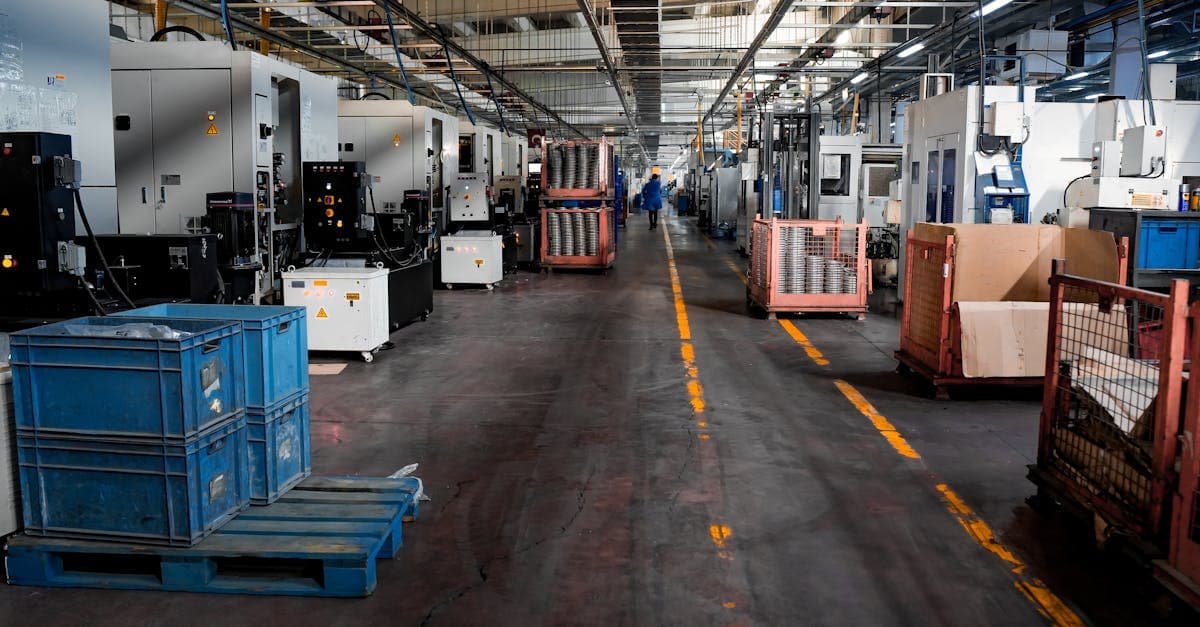
What is an Assembly Line?
An assembly line is a production arrangement in which a product moves through a fixed sequence of workstations, and each station performs one specific task until the finished product comes off the end. Assembly lines break a long build into short repeated steps, so a plant can turn out high volumes at consistent quality and a low cost per unit.
Each station adds a component, fastens, tests or inspects, then passes the partly built product on. The pace is shared: takt time sets the rhythm demand requires, and the line can only run as fast as its slowest station. That one fact is why line balancing and planning against real resource limits decide whether an assembly line hits its number.
What Are Assembly Lines?
Assembly lines are production arrangements in which a product moves through a fixed sequence of workstations, and each station performs one specific task until the finished product comes off the end. The plural is how most plants actually talk, because almost nobody runs just one: a typical factory keeps a single-model line for its highest runner and a mixed-model line for everything else, and the two are scheduled very differently.
The distinction worth holding on to is that assembly lines are not simply groups of machines. A cell of five machines arranged by function is a job shop. The same five machines arranged in build order, sharing one pace, are an assembly line. The layout is the visible difference; the shared pace is the real one.
How Assembly Lines Work
An assembly line divides the total work content of building a product into discrete tasks, then assigns those tasks to sequential stations. The product - or a carrier holding it - moves from station to station at a fixed pace called the takt time, which is determined by customer demand. If customers require 480 units per eight-hour shift, takt time is one minute per unit.
Each station must complete its assigned tasks within one takt time. If a station takes longer, it becomes a bottleneck and limits the entire line. Line balancing is the engineering discipline of distributing tasks across stations so that the work content at each station is as close to takt time as possible. A well-balanced line has high utilization and minimal idle time.
Assembly lines can be manual, automated, or a hybrid. Manual lines use human operators at each station with hand tools and fixtures. Automated lines use robots, conveyors, and programmable logic controllers. Most modern lines are mixed - robots handle repetitive or ergonomically difficult tasks while humans perform complex assembly, quality checks, and exception handling.
Material delivery to the line is critical. Stations must have the right parts at the right time. Kitting, line-side delivery, and kanban replenishment systems prevent line stoppages caused by part shortages. Even a few minutes of downtime on a high-volume assembly line translates to significant lost output.
Types of Assembly Line
Three arrangements cover almost every real line, and each hands the planner a different job.
| Line type | What runs on it | Best fit | The scheduling job |
|---|---|---|---|
| Single-model | one product, continuously | high, stable volume | protect takt time, fit maintenance into breaks |
| Batch-model | one model at a time, changeover between runs | a handful of related models | sequence runs so changeover time is paid once, not repeatedly |
| Mixed-model | several models interleaved unit by unit | many variants on level demand | sequence variants so option content and operator load stay level |
Mixed-model is the hardest of the three, because the sequence itself decides whether operators are overloaded. Two high-option units back to back can stall a station that handles either one comfortably on its own.
Assembly Line Example, with the Arithmetic
An appliance manufacturer produces dishwashers on an assembly line with 24 stations. An eight-hour shift gives 28,800 seconds of running time and the target is 400 units, so takt time is 28,800 / 400 = 72 seconds. At station 1 the base frame is loaded onto the conveyor. Stations 2 through 8 install the tub, pumps and plumbing. Stations 9 through 14 handle electrical wiring and the control board. Stations 15 through 20 attach the door, racks and spray arms. Stations 21 through 23 run functional tests, and station 24 packages the unit for shipping.
Total work content across the 24 stations is 1,600 seconds. Before balancing, the longest station ran 85 seconds and the shortest 50 seconds. A line produces one unit per slowest-station cycle, so output was 28,800 / 85 = 338 units per shift, well short of the 400 the plant had promised. Rebalancing moved tasks until every station ran between 65 and 72 seconds. Nothing was bought and nobody was added.
| Measure | Before balancing | After balancing |
|---|---|---|
| Total work content | 1,600 seconds | 1,600 seconds |
| Slowest station | 85 seconds | 72 seconds |
| Fastest station | 50 seconds | 65 seconds |
| Units per shift (28,800 / slowest station) | 338 | 400 |
| Balance efficiency (work content / 24 x slowest) | 78 percent | 93 percent |
| Labor added | none | none |
The gain is 62 units per shift, 18 percent more output, purely from how the work was divided. That is the argument for treating an assembly line as a capacity problem and not a layout problem.
Advantages of Assembly Line Production
Assembly lines increase throughput, reduce per-unit labor cost through specialization, hold quality steady through standardized work, cut material handling between operations, and let a plant reach high volume with lower skill requirements at each individual station than craft production needs.
The cost of all that is rigidity. A line is tuned to one takt time and one product family, so demand that moves outside its design point is expensive to serve, and a stoppage anywhere stops everything. The trade is volume and consistency in exchange for flexibility, which is exactly the trade a job shop makes in reverse.
Why Assembly Lines Matter for Production Scheduling
Assembly lines require precise scheduling because every station depends on the one before it. A disruption at any point, a missing component, a quality defect, an equipment failure, stops the entire line. Production schedulers must coordinate material availability, staffing and maintenance windows to keep the line running.
Scheduling software like Resource Manager DB (RMDB) and its successor EDGEBIC (RMDB 2.0) helps planners sequence product variants on mixed-model assembly lines, schedule changeovers between product families, and plan maintenance during shift breaks to maximize uptime. Finite capacity scheduling ensures that upstream feeder operations deliver subassemblies to the line on time, so no station is left starving. Enevate schedules sub-assemblies ten levels deep this way, which is what a line fed by its own tree of components actually requires.
Most line stoppages are born on the feeder side, so it pays to load the cells that feed the line against their real available hours instead of against the line due dates alone. When the line and its feeders have to be planned in one pass, planners use one model that covers the line and the plant around it. Across several lines sharing labor and tooling, the same engine sequences variants and changeovers on every line at once.
For mixed-model lines, scheduling determines the order in which models are built. Proper sequencing levels the demand for individual components and keeps operators off the edge when complex variants would otherwise cluster together. The payoff is ordinary and measurable: Homestead Furniture moved its basic weekly schedule from a 40-hour scheduler task to a 2-hour clerk task, and Technical Glass Products took on 4 percent more business with the same workforce. Neither added a station, and both changed how the work was sequenced.
Related Terms
- Production Line - A broader term that includes assembly lines and other sequential production arrangements
- Takt Time - The pace at which the assembly line must produce to meet customer demand
- Subassembly - A partially completed component that feeds into the assembly line
Common Questions About Assembly Lines
How do you define an assembly line?
An assembly line is defined by three things together: a fixed station sequence, a transfer mechanism that moves the product from station to station, and a shared pace called takt time. Remove any one of them and the arrangement is something else. Without a fixed sequence it is a job shop, and without a shared pace it is a batch-and-queue process.
How does line balancing affect assembly line efficiency?
A line produces one unit per slowest-station cycle, so the slowest station sets the output of every other station. Balancing moves work until station times sit close to takt time. In the dishwasher example above, cutting the slowest station from 85 to 72 seconds lifted output from 338 to 400 units per shift with no extra labor.
Learn more in our complete manufacturing glossary or production scheduling guide.
Frequently Asked Questions
Ready to Transform Your Production Scheduling?
User Solutions has been helping manufacturers optimize their production schedules for over 35 years. One-time license, 5-day implementation.

User Solutions Team
Manufacturing Software Experts
User Solutions has been developing production planning and scheduling software for manufacturers since 1991. Our team combines 35+ years of manufacturing software expertise with deep industry knowledge to help factories optimize their operations.
Share this article
Related Articles
What Is FMEA (Failure Mode and Effects Analysis)? Manufacturing Guide
FMEA (Failure Mode and Effects Analysis) is a systematic risk method that scores failure modes by severity, occurrence, and detection to prioritize corrective actions.
What Is RCA (Root Cause Analysis)? Definition, Methods, and Manufacturing Examples
RCA (Root Cause Analysis) is a systematic process that identifies the fundamental cause of a problem so corrective actions prevent recurrence, not just fix symptoms.
What Is SCM (Supply Chain Management)? Definition and Manufacturing Guide
SCM (Supply Chain Management) is the active coordination of planning, sourcing, production, delivery, and returns to maximize customer value and competitive advantage.