
SKU Rationalization: How to Cut Product Complexity Without Hurting Sales
 User Solutions Team
Most manufacturers do not set out to build an unmanageable product portfolio. Complexity accumulates one customer request at a time - a custom color here, a non-standard length there, a one-off configuration for a large account that eventually becomes a permanent catalog item. After a few years of this pattern, a plant that once ran 150 SKUs efficiently is now wrestling with 600, and schedulers are spending more time managing exceptions than running the floor. SKU rationalization is the disciplined process of reversing that drift by evaluating every item in the portfolio against clear financial and operational criteria, then eliminating or consolidating the items that fail to clear the bar.
Why SKU Proliferation Happens
SKU count grows because the incentives that drive growth run in one direction. Sales teams earn commission on new business, and the easiest way to close a deal is to say yes to customization. Product managers build careers on launches, not consolidations. Operations absorbs the complexity without an explicit budget for it, so the true cost of each additional SKU never surfaces in the new-product approval process.
The result is predictable. A 2022 study of 150 mid-size manufacturers found that the bottom 30% of SKUs by revenue contributed less than 3% of total sales while consuming 22% of production scheduling time and 18% of inventory value. Those numbers are consistent with what manufacturers encounter when they run the analysis for the first time: a significant tail of low-volume, high-complexity products that are quietly destroying margin and scheduling efficiency.
The Four-Category Framework
A practical rationalization framework sorts every SKU into one of four buckets:
Keep and grow: High revenue, strong margin, good forecast accuracy, and efficient to produce. These items deserve priority scheduling, preferred inventory positions, and investment in process improvement to drive costs lower.
Keep and optimize: Good revenue or strategic importance, but with addressable cost or complexity problems. These SKUs stay, but with a mandate to standardize components, consolidate variants, or improve forecast accuracy within a defined period.
Rationalize to substitute: Low volume or margin, but customer need is real. The correct action is to redesign or consolidate into a standard SKU that meets the need at lower complexity. This is not discontinuation - it is product engineering that converts a custom SKU into a standard one.
Discontinue: Low volume, low margin, high complexity, no strategic rationale. These items should be eliminated with a managed transition for any affected customers.
The framework forces a decision category for every item. Left uncategorized, SKUs default to "keep" by inertia.
Building the SKU-Level P&L
The foundation of any rationalization analysis is a SKU-level contribution margin that captures true complexity cost. Standard financial systems often show SKUs as profitable because they allocate overhead as a flat percentage of revenue or standard cost - a method that systematically undercharges high-complexity, low-volume items and overcharges high-volume standard items.
A more accurate view builds the following cost elements at the SKU level:
Direct material cost: Actual BOM cost at current purchase prices, not standard cost.
Direct labor: Actual run time multiplied by burdened labor rate, adjusted for actual yield.
Setup and changeover cost: Average changeover time for this SKU multiplied by machine rate. A SKU that runs 4 times per year for 50 units each run, with a 2-hour changeover at a $180/hour machine rate, carries $1,440 per year in setup cost alone - before any material or labor is counted.
Inventory carrying cost: Average inventory value for this SKU multiplied by your carrying cost rate (typically 20-30% per year). A SKU with $15,000 average inventory and a 25% carrying rate adds $3,750 per year in holding cost.
Planning and administrative cost: Scheduling time, purchasing transactions, and quality inspection events attributable to the SKU. This is harder to quantify but real - a low-volume specialty item that generates a purchase order for a custom raw material every six weeks, a dedicated quality inspection plan, and regular scheduling exceptions is genuinely more expensive than a standard item that rides on blanket orders and shared quality plans.
When these costs are summed and subtracted from actual revenue, many rationalization candidates shift from modest-profit to loss-making.
How SKU Rationalization Affects Production Scheduling
The scheduling benefits of rationalization are direct and measurable. Every SKU removed from the active portfolio eliminates:
- At least one changeover event per production cycle
- At least one material planning decision per replenishment cycle
- At least one inventory position (and its associated holding cost and stockout risk)
- At least one forecasting challenge (low-volume SKUs are notoriously hard to forecast accurately)
For a job shop or mixed-mode manufacturer running 400 active SKUs, reducing to 280 through rationalization might eliminate 150-200 changeover events per month. At an average changeover time of 45 minutes and a machine rate of $150/hour, that is $169,000 to $225,000 per year in recovered productive capacity - before any material or inventory savings are counted.
The scheduler's workload improves in quality, not just quantity. Fewer SKUs means fewer exception situations, more predictable material requirements, better BOM accuracy (because the active BOMs get more review attention), and longer production runs that allow the scheduler to build more efficient sequences.
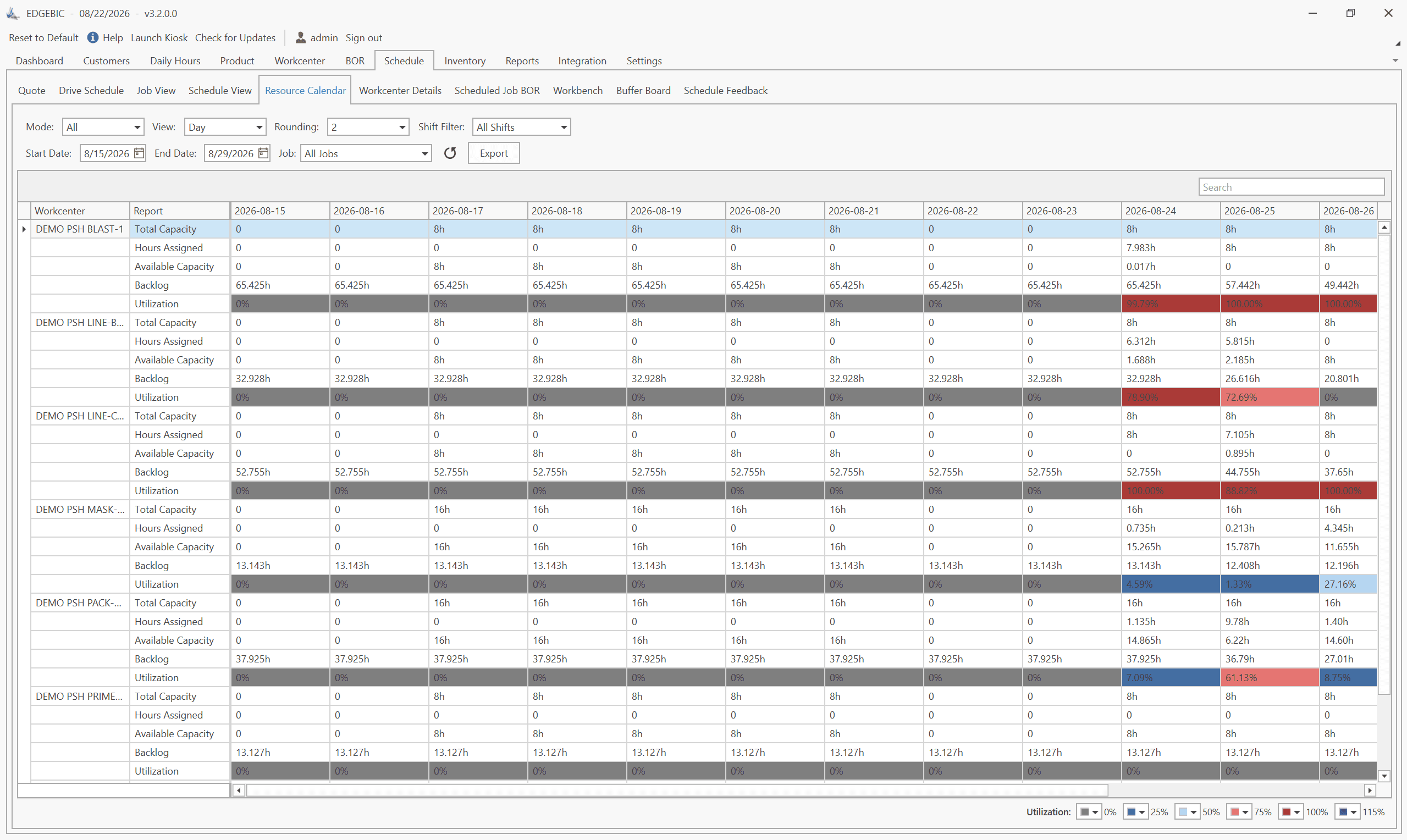
When production scheduling software like RMDB is used to sequence jobs across work centers, a rationalized SKU portfolio allows the optimizer to build longer runs on similar setups and reduce total changeover time further - a benefit that compounds across the schedule rather than applying only to the eliminated items.
Executing the Rationalization Decision
Analysis is the easy part. The organizational challenge is making and implementing discontinuation decisions in the face of sales and customer resistance.
Set decision thresholds before the analysis. Agree in advance on the revenue, margin, and volume minimums that a SKU must meet to remain active. When the thresholds are set before the data is revealed, it is harder for advocacy to override the analysis.
Require sales to defend exceptions in writing. Any SKU below the threshold that sales wants to retain should require a written strategic rationale and a revenue commitment. This surfaces the actual strategic value of each item and filters the list to genuine exceptions rather than reflexive objection.
Give customers adequate transition time. A 90-180 day notice period with a final-buy opportunity is standard practice and minimizes customer disruption. For customers with long production lead times or regulated supply chains (aerospace, medical), 12 months is more appropriate.
Track the outcomes. Six months after discontinuation decisions take effect, compare actual revenue impact against the projected impact. Most manufacturers find that 50-70% of the revenue from discontinued SKUs migrates to other items in the portfolio rather than being lost permanently. Documenting this outcome builds the organizational confidence to run rationalization as an ongoing process rather than a one-time event.
Maintaining a Rationalized Portfolio
The natural tendency is for complexity to regrow after rationalization. New SKUs will be proposed, customers will request customization, and without active controls, the portfolio will drift back toward its prior state within three to five years.
Sustainable rationalization requires a standing governance process:
New SKU approval thresholds: Every new SKU should clear the same thresholds used in the rationalization analysis - projected revenue, margin, and volume minimums over a defined payback period. Include estimated setup cost and inventory investment in the approval package.
Annual portfolio review: Schedule an annual review of the portfolio against the thresholds. Any SKU that has fallen below the minimums for two consecutive years enters the rationalization process automatically.
Sunset provisions at launch: When a new SKU is approved, set a review date - typically 18-24 months post-launch - at which the SKU must meet projected performance or enter the rationalization queue. This prevents the "we just need more time" pattern from indefinitely deferring discontinuation decisions.
RMDB's job-level visibility makes the annual review easier by surfacing actual machine time, changeover frequency, and order frequency by product - the exact data needed to run the rationalization analysis without a separate manual data pull. See the production scheduling software guide and the MRP guide for how scheduling and materials management interact with portfolio decisions.
Frequently Asked Questions
SKU rationalization is the systematic process of evaluating your product portfolio and eliminating or consolidating items that do not generate sufficient revenue, margin, or strategic value to justify their production complexity. The goal is to focus manufacturing capacity on the items that drive the most business value.
There is no universal answer, but Pareto analysis consistently shows that 20% of SKUs generate 80% of revenue in most manufacturing businesses. A useful benchmark is that every SKU you add beyond your core 20% should clear a defined minimum revenue, margin, and volume threshold - otherwise it is consuming capacity without delivering proportionate return.
Each additional SKU adds a setup event, a material requirement, a planning decision, and a potential inventory position to the production environment. When a plant runs 500 SKUs instead of 200, schedulers face more changeovers, more material coordination, shorter runs, and higher work-in-process inventory. Reducing SKU count directly reduces scheduling complexity and allows longer, more efficient production runs.
The key metrics are: gross margin per SKU, revenue contribution, inventory carrying cost, machine time consumed per unit of revenue, setup cost per production run, and forecast accuracy. SKUs with low margin, low volume, high setup cost, and poor forecast accuracy are strong rationalization candidates regardless of their absolute revenue number.
First, confirm the actual customer dependency - many SKUs assumed to be critical have only one or two customers who buy them sporadically. Offer a transition timeline of 90-180 days with a final-buy opportunity so customers can stock up. Where possible, recommend a substitute from your rationalized portfolio. Document the transition plan, communicate proactively, and track any revenue impact against the cost savings to confirm the decision was correct.
SKU rationalization is a structured, ongoing process that uses data to evaluate the full portfolio and make decisions about which items to keep, consolidate, or retire. Product discontinuation is one output of that process. Rationalization also includes consolidating variants, standardizing components, and redesigning product lines to reduce complexity - not just cutting items.
SKU rationalization is ultimately a capacity decision. Every item you remove from the active portfolio returns machine time, planner attention, and inventory capital to the items that deserve it most. Manufacturers who run rationalization as an ongoing governance process - not a one-time cleanup - consistently outperform their peers on margin and on-time delivery because their schedulers are working with a manageable, well-understood portfolio. To see how RMDB gives you the job-level visibility needed to run rationalization analysis from your actual scheduling data, reach out to our team for a demonstration.
Expert Q&A: Deep Dive
Q: What is the best way to build the business case for a SKU rationalization program internally?
A: The most persuasive approach is to quantify complexity cost at the SKU level. Pull your scheduling data and calculate: average changeover time per SKU, number of production runs per year per SKU, setup cost per run, and the machine time consumed per dollar of revenue. Then rank SKUs by complexity cost as a ratio of revenue. The bottom quartile will almost always reveal SKUs that are costing more to produce and manage than they generate in contribution margin. Present that data alongside the capacity freed if those SKUs were eliminated - schedulers and plant managers will immediately recognize the operational benefit, and finance will see the margin improvement.
Q: How long does a full SKU rationalization program typically take?
A: A focused rationalization of a 200-500 SKU portfolio typically runs 3-6 months from data collection to final discontinuation decisions. The first 6 weeks are data work: cleaning product cost data, pulling actual sales history, and building the SKU-level P&L. The next 4-6 weeks involve cross-functional review - sales, operations, finance, and product management each need to validate the analysis before decisions are made. Implementation - customer communication, final-buy inventory, and system cleanup - takes another 60-90 days. Plan for the process to be longer than expected; sales pushback on low-volume specialty items almost always extends the timeline.
Frequently Asked Questions
Ready to Transform Your Production Scheduling?
User Solutions has been helping manufacturers optimize their production schedules for over 35 years. One-time license, 5-day implementation.

User Solutions Team
Manufacturing Software Experts
User Solutions has been developing production planning and scheduling software for manufacturers since 1991. Our team combines 35+ years of manufacturing software expertise with deep industry knowledge to help factories optimize their operations.
Share this article
Related Articles
How to Create a Production Schedule in 7 Steps (Free Template)
How to create a production schedule step by step: horizon, real capacity, work orders, load check, sequence, dates, then publish. Worked example included.
Production Planning and Control (PPC): Functions and Examples
Production planning and control explained: routing, loading, scheduling, sequencing, dispatching and expediting, the types of scheduling, and worked examples.

Sequence-Dependent Setup Times: The Scheduling Problem That Costs You Capacity
When changeover time depends on what ran before, standard scheduling fails. Learn how setup matrices, sequence optimization, and APS software recover 10-25% of hidden capacity in paint lines, food, and coating operations.