


MRP vs JIT represents one of the most fundamental debates in manufacturing planning. Material Requirements Planning (MRP) uses a push-based approach that plans materials forward from a production schedule. Just-in-Time (JIT) uses a pull-based approach that triggers material flow based on actual consumption. Both have strengths, both have weaknesses, and the best manufacturers understand when to use each.
In this guide, we compare MRP and JIT head-to-head, explore the hybrid approaches used by leading manufacturers, and help you determine which strategy fits your operation. For MRP fundamentals, see our complete MRP guide.
MRP: The Push Approach
MRP plans materials forward from demand. It takes the master production schedule, explodes it through the bill of materials, nets against inventory, and generates planned purchase and production orders in advance of need.
How MRP plans materials:
- Determine what finished goods to produce (from the MPS)
- Calculate component requirements (BOM explosion)
- Net against available inventory (net requirements calculation)
- Apply lot sizing rules
- Offset by lead time to determine order release dates
- Issue purchase orders and production orders
MRP "pushes" materials into the system based on planned demand. Materials are ordered and produced in anticipation of need.
JIT: The Pull Approach
JIT plans materials backward from consumption. Instead of forecasting and pre-ordering, JIT triggers replenishment when materials are actually consumed on the production floor. The classic tool is the Kanban card: when a container of parts is emptied, the card signals that a replacement container should be produced or ordered.
How JIT plans materials:
- Production consumes materials from a buffer
- Consumption triggers a replenishment signal (Kanban)
- Upstream process or supplier produces/delivers replacement
- Buffer is replenished just before the next consumption cycle
JIT "pulls" materials through the system based on actual consumption. Materials arrive as close to the point of use as possible, minimizing inventory throughout the value stream.
Head-to-Head Comparison
| Factor | MRP (Push) | JIT (Pull) |
|---|---|---|
| Planning basis | Forecasted/scheduled demand | Actual consumption |
| Inventory philosophy | Calculated buffers via safety stock | Minimize all inventory |
| Order timing | Planned in advance by lead time | Triggered by consumption |
| Best for | Variable demand, complex BOMs | Repetitive, stable demand |
| Production model | Make-to-order, job shop | Repetitive, flow production |
| BOM complexity | Handles multi-level BOMs well | Works best with simple structures |
| Supplier requirements | Standard purchasing relationships | Reliable, frequent deliveries |
| Visibility | Forward-looking, planned horizon | Current state, real-time |
| Risk profile | Risk of over-ordering | Risk of stockouts |
| Supply chain resilience | Better with buffers | Vulnerable to disruptions |
When MRP Wins
MRP is the stronger approach in these situations:
Complex products with deep BOMs. When your product has 5 or more BOM levels and hundreds of components, you need the systematic explosion logic of MRP to ensure every part is ordered with the right lead time offset. JIT Kanban becomes impractical to manage at this scale.
Make-to-order and custom manufacturing. When every order is different, there is no repetitive consumption pattern for JIT to pull from. MRP plans materials specific to each customer order.
Long supplier lead times. If your critical materials have 8-16 week lead times, you cannot wait for a consumption signal to order. MRP's forward-planning capability is essential for long-lead items.
Lumpy, unpredictable demand. When demand varies significantly week to week, JIT buffers are difficult to size correctly. MRP adjusts material plans to match the specific demand each period.
Engineer-to-order environments. When the BOM does not exist until engineering completes the design, MRP's ability to plan from preliminary BOMs is essential.
When JIT Wins
JIT is the stronger approach in these situations:
Repetitive manufacturing with stable demand. When you produce the same products week after week at similar volumes, JIT's simplicity and low inventory are hard to beat.
Short supplier lead times. If materials can be delivered in 1-2 days, pull-based replenishment works well because the response time is short enough to prevent stockouts.
Simple product structures. Products with few components and flat BOMs are easy to manage with Kanban without needing MRP's explosion logic.
Reliable suppliers. JIT requires suppliers who can deliver frequently, on time, and in small quantities. Without supplier reliability, JIT creates stockouts.
High-volume, low-variety production. The classic JIT environment is an automotive assembly line producing thousands of the same product daily.
The Hybrid Approach: Best of Both Worlds
The most effective manufacturers do not choose MRP or JIT exclusively. They use a hybrid approach that applies each method where it fits best.
Use MRP for:
- Long-lead-time purchased materials
- Expensive custom components
- Overall production planning and scheduling
- Items with lumpy or order-specific demand
- Multi-level BOM explosion and coordination
Use JIT/Kanban for:
- Commodity items with short lead times (fasteners, adhesives, shop supplies)
- Standard components consumed at predictable rates
- Internal sub-assemblies in flow production cells
- Items where the cost of MRP processing exceeds the cost of a small buffer
Example hybrid setup for a machine manufacturer:
| Item Category | Planning Method | Rationale |
|---|---|---|
| Custom castings | MRP | 12-week lead time, order-specific |
| Precision bearings | MRP | Expensive, order-specific quantities |
| Standard bolts/nuts | Kanban | Low cost, reliable supply, daily consumption |
| Welding wire | Kanban | Commodity, local supplier, 1-day delivery |
| Electronic components | MRP | Variable demand, long lead times |
| Cutting fluid | Kanban | Steady consumption, easy to replenish |
This hybrid approach is exactly how RMDB from User Solutions helps manufacturers plan. MRP handles the complex, high-value, long-lead items that need forward planning. Simple Kanban rules handle the commodity items that do not warrant MRP processing overhead.
Lessons from Recent Supply Chain Disruptions
The COVID-19 pandemic and subsequent supply chain disruptions provided a real-world stress test for both approaches. Key lessons:
Pure JIT was too fragile. Manufacturers running minimal inventory with JIT for everything suffered the most. When a single supplier shutdown or shipping delay occurred, production stopped because there was no buffer to absorb the disruption.
MRP with safety stock was more resilient. Manufacturers with calculated safety stock buffers had time to find alternative suppliers or adjust production schedules when disruptions hit.
The winning approach was adaptive. The best-performing manufacturers quickly adjusted their MRP parameters: increased safety stock for high-risk items, diversified supplier sources, and used DDMRP buffer concepts to position strategic inventory at key points in the supply chain.
Going forward, the lesson is clear: lean is good, but fragile is not. Smart manufacturers use MRP to maintain calculated buffers based on supply chain risk, not just cost optimization.
Making the Decision for Your Operation
Ask these questions to determine your ideal approach:
- What is your production model? Make-to-order and job shop = MRP. High-volume repetitive = JIT or hybrid.
- How complex are your products? Deep, multi-level BOMs = MRP. Simple, flat BOMs = either.
- How reliable are your suppliers? Unreliable or long-lead = MRP. Reliable, local, fast = JIT is viable.
- How predictable is your demand? Lumpy and variable = MRP. Stable and repetitive = JIT.
- What is your risk tolerance? Low risk tolerance = MRP with safety stock. Higher tolerance = JIT or lean buffers.
For most small to mid-size manufacturers, especially job shops, MRP is the foundation with JIT principles applied selectively. This is the approach we recommend and support with RMDB.
Frequently Asked Questions
MRP is a push-based system that plans materials forward from a production schedule, ordering in advance based on forecasted or confirmed demand. JIT is a pull-based system that triggers production and procurement based on actual consumption, aiming to have materials arrive exactly when needed with minimal inventory.
Yes. Many manufacturers use a hybrid approach: MRP for long-lead-time purchased materials and overall production planning, combined with JIT/Kanban for short-lead-time items and shop floor replenishment. This gives you the planning visibility of MRP with the lean efficiency of JIT.
It depends on your production model. MRP is better for make-to-order and job shop environments with high product variety. JIT is better for repetitive manufacturing with stable demand. Most small manufacturers benefit from MRP as the primary planning approach, with JIT principles applied selectively.
JIT minimizes inventory buffers, which works well when supply chains are reliable. During disruptions like COVID-19 or shipping crises, JIT manufacturers lacked safety stock and could not absorb delays. MRP-based planning with appropriate safety stock levels proved more resilient because it maintains calculated buffers.
JIT is a component of lean manufacturing, not the whole thing. Lean encompasses waste elimination, continuous improvement, 5S, value stream mapping, and other principles. JIT specifically addresses the timing and quantity of material flow. You can practice lean principles without strict JIT procurement.
Plan Materials the Smart Way
Whether you lean toward MRP, JIT, or a hybrid approach, RMDB from User Solutions gives you the planning flexibility to match your material strategy to your operation. Finite capacity scheduling ensures your material plans are tied to feasible production schedules.
Schedule a free demo to see how RMDB supports your material planning strategy.
Expert Q&A: Deep Dive
Q: In your experience, which approach works better for the types of manufacturers you serve?
A: The vast majority of our customers are job shops and make-to-order manufacturers, and for them, MRP is the clear winner as the primary planning approach. The reason is simple: you cannot pull materials through a system when every order is different. JIT assumes repetitive production with predictable material consumption. Job shops have high variety, irregular demand, and long-lead purchased materials that require forward planning. That said, we encourage our customers to apply JIT principles where they make sense. For commodity items like fasteners, welding gas, and shop supplies, a Kanban replenishment approach is often simpler and more effective than running them through MRP. The key is being intentional about which approach you use for which items rather than adopting one philosophy for everything.
Q: How should manufacturers think about inventory buffers given recent supply chain volatility?
A: The last few years have fundamentally changed how manufacturers think about inventory. Pure JIT with minimal buffers exposed enormous vulnerabilities. But the answer is not to swing to the other extreme and stockpile everything. What we recommend is a risk-based approach to safety stock within your MRP system. Classify your items by supply risk: single-source items with offshore suppliers need larger buffers. Multi-source domestic items can run leaner. RMDB supports configurable safety stock levels per item, so you can maintain strategic buffers where risk is highest while running lean on items where supply is reliable. The concept from DDMRP of strategic buffer positioning is valuable here. See our guide on demand-driven MRP for more on this approach.
Frequently Asked Questions
Ready to Transform Your Production Scheduling?
User Solutions has been helping manufacturers optimize their production schedules for over 35 years. One-time license, 5-day implementation.

User Solutions Team
Manufacturing Software Experts
User Solutions has been developing production planning and scheduling software for manufacturers since 1991. Our team combines 35+ years of manufacturing software expertise with deep industry knowledge to help factories optimize their operations.
Share this article
Related Articles
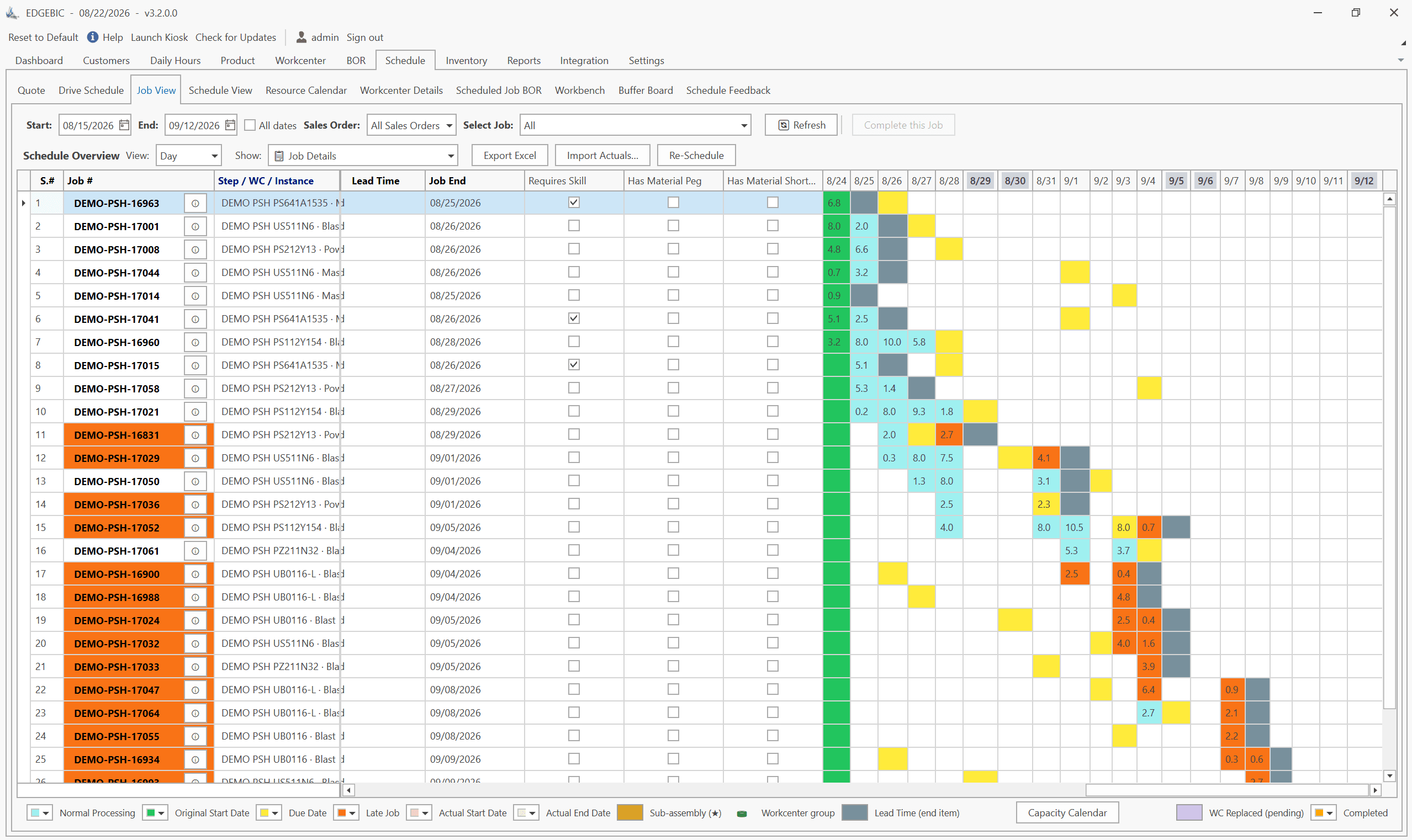
MRP vs APS: What MRP Assumes and What Finite Scheduling Fixes
MRP vs APS: MRP plans materials assuming infinite capacity and fixed lead times; APS schedules operations against real capacity. One job planned both ways.

Lean-MRP Hybrid: How to Combine Pull Scheduling with MRP for Long-Lead Materials
Lean and MRP appear to conflict - but most lean shops still need MRP for long-lead purchased materials. Here's how to combine pull scheduling and MRP at the right decoupling points.

MRP Data Accuracy: The #1 Reason MRP Implementations Fail (And How to Fix It)
Poor data quality kills MRP before it starts. Learn the three data pillars, how to hit the 98% inventory accuracy target, and a practical implementation checklist.