
MRP for Custom Manufacturing: Planning When Every Order Is Different
 User Solutions Team
MRP for custom manufacturing presents unique challenges that standard MRP textbooks rarely address. When every customer order is different, the bill of materials is not static, lead times are project-specific, and the production schedule changes with each new order, traditional MRP logic needs adaptation. But make no mistake: custom manufacturers need material planning discipline more than anyone, because a single material shortage can delay an entire one-of-a-kind order.
This guide covers how to make MRP work in make-to-order, configure-to-order, and engineer-to-order environments. For standard MRP concepts, see our complete MRP guide.
The Custom Manufacturing Challenge
Custom manufacturers face a fundamental tension with MRP:
| Standard MRP Assumes | Custom Manufacturing Reality |
|---|---|
| Stable, predefined BOMs | BOMs created or configured per order |
| Predictable demand patterns | Every order is unique |
| Fixed routings and cycle times | Variable processes depending on specs |
| Repeatable production | One-of-a-kind or small batch |
| Forecast-driven planning | Order-driven planning |
Despite these differences, the core MRP logic still applies. You still need to determine what materials to order, how much, and when. The challenge is getting the inputs right when the product definition evolves throughout the order lifecycle.
Production Models in Custom Manufacturing
Configure-to-Order (CTO)
The product has a standard base with configurable options. A pump manufacturer might offer 5 housing materials, 3 impeller types, 4 seal configurations, and 2 motor options. The customer selects options and the BOM is automatically generated.
MRP approach: Use configurable BOMs. MRP can plan immediately once the customer selects options because the BOM generation is automated.
Make-to-Order (MTO)
The product is built to customer specifications but uses known processes and standard product architectures. A cabinet manufacturer builds to customer dimensions and finishes but uses standard construction methods.
MRP approach: Template BOMs based on product families, with adjustments for customer-specific dimensions and specifications.
Engineer-to-Order (ETO)
The product requires engineering design work before manufacturing begins. An industrial equipment manufacturer designs each machine to customer application requirements.
MRP approach: Two-phase planning with preliminary BOMs for long-lead items and final BOMs after engineering release. This is the most challenging environment for MRP.
Making MRP Work: Configurable BOMs
For CTO and many MTO operations, configurable BOMs are the key to effective MRP:
Base Product: Industrial Pump
├── Housing [configurable: Cast Iron | Stainless 316 | Duplex SS]
├── Impeller [configurable: Open | Closed | Semi-Open]
│   └── Material [configurable: Bronze | SS 316 | Hastelloy]
├── Seal [configurable: Mechanical Single | Mechanical Double | Lip Seal]
├── Motor [configurable: 5HP | 10HP | 15HP | 25HP]
├── Baseplate [standard: Carbon Steel]
├── Fastener Kit [standard]
└── Gasket Set [configurable by housing material]
When a customer orders a Stainless 316 pump with a closed Hastelloy impeller and 15HP motor, the configurator generates the specific BOM and MRP immediately calculates material requirements.
Benefits:
- No need to maintain thousands of individual BOMs
- MRP planning starts immediately at order entry
- Reduces engineering involvement for standard configurations
The Two-Phase Planning Approach for ETO
For engineer-to-order, where the complete BOM does not exist at order entry, the two-phase approach saves weeks of lead time:
Phase 1: Preliminary Planning (At Order Booking)
Identify the 70-80% of materials that are common across your product family and order them immediately based on a template BOM:
| Material Category | Certainty | Action |
|---|---|---|
| Common raw materials (steel, aluminum) | 90%+ certain | Order immediately |
| Standard purchased components (fasteners, seals) | 80%+ certain | Order immediately |
| Long-lead custom items (castings, forgings) | Based on preliminary specs | Order with change clause |
| Engineering-specific components | Unknown until design complete | Wait for Phase 2 |
Phase 2: Final Planning (At Engineering Release)
Once engineering completes the design and releases the final BOM:
- Update the BOM with actual specifications
- MRP recalculates net requirements
- Order remaining custom-specific components
- Adjust quantities on previously ordered common materials if needed
Lead time recovery: This approach typically recovers 2-4 weeks of lead time compared to waiting for the complete BOM before starting any procurement.
Integrating MRP with Finite Capacity Scheduling
For custom manufacturers, MRP alone is insufficient. You need finite capacity scheduling to answer the question MRP cannot: "When can we actually produce this?"
MRP tells you what materials to order and when they need to arrive. Finite capacity scheduling tells you when work can be done given your available machines, labor, and tooling. Together, they ensure:
- Material orders are timed to a feasible production schedule
- Delivery dates reflect actual capacity, not just lead time calculations
- Resource conflicts between customer orders are identified and resolved
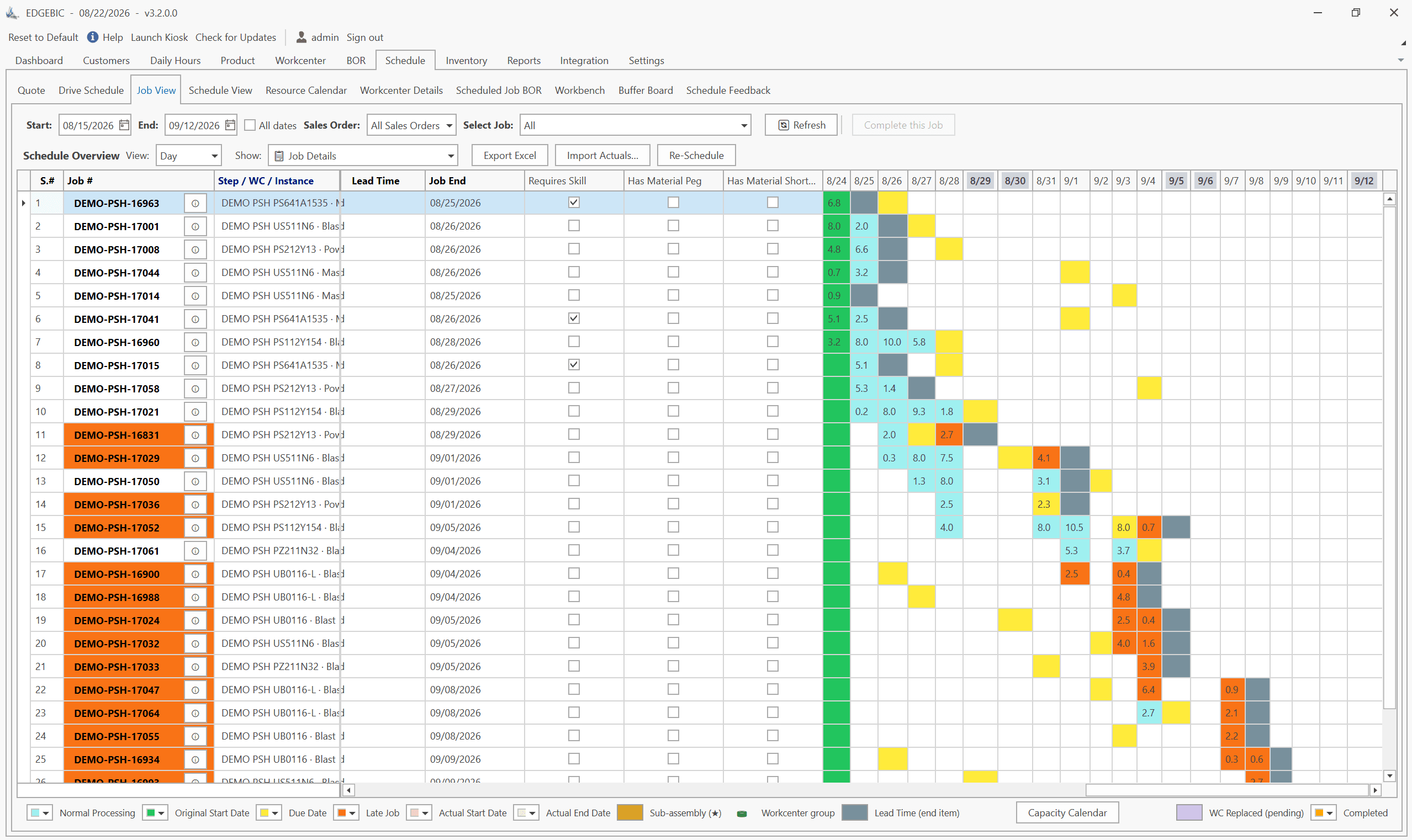
RMDB from User Solutions was built specifically for this integration. The Gantt-based scheduler determines when each order can be produced, and material planning ensures materials arrive to support that schedule. When a new customer order arrives, RMDB can:
- Schedule the order against available capacity
- Calculate a realistic delivery date
- Generate material requirements timed to the production schedule
- Identify material or capacity conflicts with existing orders
This capability is essential for quoting. When a customer asks "When can you deliver?", you need to check both material availability and capacity before giving a date. MRP vs spreadsheets cannot do this.
Safety Stock Strategy for Custom Manufacturing
Custom manufacturing requires a different safety stock philosophy than repetitive production:
| Item Type | Safety Stock Approach |
|---|---|
| Common raw materials | Maintain buffer based on historical consumption across all orders |
| Standard purchased components | Maintain buffer based on average order frequency |
| Custom-specific components | Zero safety stock; order lot-for-lot per customer order |
| Long-lead items with alternatives | Buffer if supplier lead time > customer tolerance |
The key insight is to buffer the common base, not the customization. See our safety stock guide for calculation methods.
Lot Sizing for Custom Manufacturing
Lot sizing in custom manufacturing is straightforward for order-specific items: use lot-for-lot. You order exactly what each customer order requires.
For common materials, the decision depends on whether combining requirements across orders provides cost savings:
| Scenario | Recommended Lot Sizing |
|---|---|
| Customer-specific component | Lot-for-lot |
| Common material, low value | EOQ or fixed order quantity |
| Common material, high value | Lot-for-lot or small POQ |
| Material with supplier minimums | Fixed order quantity = supplier minimum |
Common Challenges and Solutions
| Challenge | Solution |
|---|---|
| BOM not ready at order entry | Template BOMs + two-phase planning |
| Engineering changes after material ordered | Change management process with supplier notification clauses |
| Capacity unknown at quoting time | Finite capacity scheduling for delivery date quoting |
| Unique routings per order | Parametric routing templates with configurable operations |
| Overlapping orders competing for same resources | Visual Gantt scheduling with RMDB |
| Material lead time longer than customer expectation | Strategic safety stock on long-lead common items |
Implementation for Custom Manufacturers
If you are a custom manufacturer implementing MRP for the first time, follow our MRP implementation checklist with these additions:
- Build template BOMs for each product family before implementation
- Classify every item as common vs order-specific
- Set lot sizing to lot-for-lot for order-specific items
- Define configurable options in the BOM structure
- Establish the two-phase planning process with clear trigger points
- Integrate scheduling with material planning from day one
Frequently Asked Questions
Yes, but it requires adaptation. Custom manufacturers use configurable BOMs, template BOMs based on similar past orders, and a two-phase approach that starts procurement on common long-lead items before the design is finalized. MRP paired with finite capacity scheduling is essential for custom manufacturing.
A configurable BOM is a product structure that includes variable elements (options, parameters, dimensions) that are set based on each customer order. Instead of maintaining thousands of unique BOMs, you maintain a base structure with configurable options. The system generates the order-specific BOM when the customer specifications are known.
Use a two-phase approach. Phase 1: order long-lead common materials based on a preliminary or template BOM drawn from similar past orders. Phase 2: finalize the BOM when engineering completes the design and order remaining custom-specific components. This recovers weeks of lead time.
MRP is almost always better for custom manufacturing because every order has unique material requirements. Kanban works for repetitive production with predictable consumption, which is the opposite of custom manufacturing. MRP calculates specific requirements for each order.
MRP calculates what materials to order and when, but assumes infinite production capacity. Finite capacity scheduling determines when work can actually be done based on resource availability. For custom manufacturers, combining MRP with scheduling ensures material plans are tied to feasible production schedules.
Built for Custom Manufacturing
RMDB from User Solutions was designed for make-to-order and engineer-to-order manufacturers who need finite capacity scheduling integrated with material planning. Over 35 years of serving job shops, defense contractors, and custom fabricators.
Schedule a free demo to see how RMDB handles the complexity of custom manufacturing planning.
Expert Q&A: Deep Dive
Q: What is the biggest challenge with MRP in a custom manufacturing environment?
A: The biggest challenge is that the BOM does not exist when the customer places the order. In make-to-stock or repetitive manufacturing, BOMs are stable and well-defined. In custom manufacturing, the BOM is created or configured for each order, often while engineering is still finalizing the design. This creates a chicken-and-egg problem: MRP needs the BOM to plan materials, but the BOM is not ready until engineering finishes. Our approach with RMDB is to support configurable BOMs and template-based planning. We identify the 70-80% of components that are common across your product family and let MRP plan those immediately based on the template. The remaining 20-30% that are truly custom get planned once engineering releases the final BOM. This typically recovers 3-4 weeks of lead time because long-lead common materials are ordered at booking rather than at design release.
Q: How should custom manufacturers think about safety stock when demand is entirely order-driven?
A: This is where custom manufacturing differs most from repetitive. You do not carry safety stock on order-specific custom components because there is no recurring demand to buffer. However, you should absolutely carry safety stock on common materials that go into most orders. If you know that 90% of your products use the same grade of steel or the same type of fasteners, maintaining a buffer of those items lets you respond faster to new orders. Think of it as buffering the common base rather than the unique customization. In RMDB, we help custom manufacturers identify their common material base and set appropriate safety stock on those items while planning custom items lot-for-lot per order.
Frequently Asked Questions
Ready to Transform Your Production Scheduling?
User Solutions has been helping manufacturers optimize their production schedules for over 35 years. One-time license, 5-day implementation.

User Solutions Team
Manufacturing Software Experts
User Solutions has been developing production planning and scheduling software for manufacturers since 1991. Our team combines 35+ years of manufacturing software expertise with deep industry knowledge to help factories optimize their operations.
Share this article
Related Articles
MRP vs APS: What MRP Assumes and What Finite Scheduling Fixes
MRP vs APS: MRP plans materials assuming infinite capacity and fixed lead times; APS schedules operations against real capacity. One job planned both ways.
Lean-MRP Hybrid: How to Combine Pull Scheduling with MRP for Long-Lead Materials
Lean and MRP appear to conflict - but most lean shops still need MRP for long-lead purchased materials. Here's how to combine pull scheduling and MRP at the right decoupling points.

MRP Data Accuracy: The #1 Reason MRP Implementations Fail (And How to Fix It)
Poor data quality kills MRP before it starts. Learn the three data pillars, how to hit the 98% inventory accuracy target, and a practical implementation checklist.