
Manufacturing Workforce Management: Shift Planning, Skill Coverage, and Connecting People to Machines
 User Solutions Team
Manufacturing workforce management is the discipline of ensuring that the right people, with the right skills, are available at the right time to execute the production schedule. Most manufacturers have reasonably good machine scheduling. Far fewer have integrated their labor planning with their production scheduling in any systematic way - and the gap between those two groups shows up in schedule attainment rates, overtime costs, and the daily chaos of discovering that the person who needs to run a critical operation is on a different shift or out sick.
This guide covers the core elements of workforce management in manufacturing: shift planning, skill matrix development, absence management, and - critically - how to connect your labor capacity to your machine scheduling so that your production plan is actually executable.
Why Workforce Management Is a Scheduling Problem, Not an HR Problem
Most manufacturers treat workforce management as an HR function: hiring, attendance tracking, payroll, compliance. These are real responsibilities, but they miss the central operational challenge. The question that matters for production is not "do we have enough employees?" but "do we have the right employees available at the right time to run the scheduled work?"
That is a scheduling question, and it requires scheduling tools to answer it properly.
When a job is scheduled to run on a CNC mill during the first shift Tuesday, three conditions must be true simultaneously: the machine must be available, the materials must be staged, and an operator certified to run that process must be on shift. Most scheduling systems model the first condition thoroughly, give moderate attention to the second, and largely ignore the third. The result is schedules that look feasible on paper and fall apart on the floor when the right operator is not there.
True manufacturing workforce management closes this loop. It means your scheduling system knows not just when machines are available, but when qualified operators are available - and it generates schedules that satisfy both constraints at once.
The Four Layers of Manufacturing Workforce Planning
Effective workforce management in manufacturing operates at four distinct time horizons, each requiring different information and different decisions.
Strategic workforce planning (6-24 months out) addresses headcount requirements based on forecast demand. If you project 20% revenue growth driven by a new product line, strategic planning identifies the training investments, hiring lead times, and skill gap analysis needed to staff that growth. This layer is primarily an HR and operations leadership function.
Tactical workforce planning (4-12 weeks out) translates the production master schedule into shift-level staffing requirements. Which shifts need to run? How many operators at each skill level are needed per work center? Where are the coverage gaps that require overtime, temp labor, or cross-training deployment? This layer bridges HR planning and production scheduling.
Operational workforce scheduling (1-2 weeks out) assigns specific operators to specific shifts and work centers based on the confirmed production schedule, operator qualifications, and attendance availability. This is where the skill matrix becomes critical and where integration between your workforce management and production scheduling systems pays off most directly.
Real-time workforce management (day-of) handles absences, early callouts, and unexpected demand changes. When an operator calls in sick, the question is not just "who can cover the shift?" but "who can cover this specific operation?" Only a system that tracks operator qualifications at the process level can answer that question quickly.
Building a Skill Matrix That Actually Gets Used
A skill matrix is only valuable if it is current, accessible, and connected to the scheduling process. Most manufacturing skill matrices fail on at least one of these dimensions.
The structure of an effective skill matrix for scheduling purposes requires three data elements for each operator-process combination: qualification status (certified, in-training, or not qualified), proficiency level (novice, competent, or expert - which affects expected run rates), and any expiration date on the certification (relevant for safety-critical operations, welding certifications, hazmat handling, etc.).
Qualification status tells you who can legally and safely run a process. Proficiency level tells you what run rate to use when scheduling that operator on that process - a novice may run at 70% of the standard rate, which affects the time allocated in the schedule. Expiration tracking ensures you do not schedule an operator against a lapsed certification, which is a compliance risk.
Maintaining the skill matrix requires a clear ownership model. In most shops, the production supervisor or manufacturing engineer is the authoritative source for who is qualified to do what. HR maintains the certification records. Neither group maintains the operational skill matrix as a scheduling tool without explicit process ownership. Assign it explicitly, review it quarterly, and the data stays current.
Shift Planning: Matching Capacity to the Schedule
Shift planning is the process of determining how many shifts to run, when to run them, and how to staff each shift given your production requirements and your operator pool.
The inputs to shift planning are your production master schedule (how much output is needed, on which machines, during which weeks) and your workforce roster (who is available, on which days, with which qualifications). The output is a shift assignment plan that covers your production requirements with the minimum feasible overtime cost.
Common shift planning errors in manufacturing include:
Running fixed shifts regardless of demand. Many shops run the same three shifts every week whether the production schedule is light or heavy. Variable shift scheduling - adjusting the number of shifts per work center based on actual schedule requirements - reduces overtime on light weeks and prevents the understaffing problem on heavy weeks.
Ignoring skill concentration risk. Shops often schedule their best operators on day shifts, creating a skill gap on evenings and nights. When a complex job needs to run on second shift, the shop discovers that no one on that shift is qualified - a problem that skilled workforce analysis would have surfaced weeks earlier.
Failing to account for planned absences. Vacations, training days, and scheduled medical leaves are predictable. Including them in the shift plan rather than discovering them when the absent operator fails to appear is basic discipline that many shops do not practice consistently.
Connecting Labor Availability to Machine Scheduling
The practical question is how to integrate your workforce availability data with your machine-level production schedule. The answer depends on your scheduling tool's capabilities.
At minimum, your scheduling system should allow you to define operator groups - sets of operators qualified for a given work center or process - and then constrain job assignments to operators in the relevant group. This prevents the most common failure mode: scheduling a job on a machine during a shift when no qualified operator is available.
More sophisticated integration includes:
Operator-specific run rates. Different operators run the same machine at different rates based on experience. Scheduling software that supports per-operator efficiency factors generates more accurate lead time estimates and prevents the common problem of plans based on expert-operator rates being executed by newer operators.
Shared operator constraints. When one operator covers multiple machines, the schedule must prevent double-booking - the same person cannot be at the lathe and the mill at the same time. This requires the scheduler to model operators as a constrained resource, not just machines.
Absence integration. When an operator is marked absent in your HR or time-tracking system, that absence should flow into the scheduling tool automatically, triggering a recalculation of affected jobs. Without this integration, the scheduler is working from stale data and generating plans that do not reflect actual staffing.
Labor Scheduling and Overtime Management
Overtime is the most visible symptom of poor workforce management in manufacturing. When the production schedule consistently generates overtime demand, there are three possible causes: the schedule is over-committing available capacity, the workforce lacks the skills to hit standard rates on scheduled work, or real-time disruptions (absences, machine downtime) are cascading into unplanned overtime.
Finite capacity scheduling software addresses the first cause directly by preventing the scheduler from booking more work than available capacity - including labor capacity - can execute in straight time. When the schedule is built against realistic constraints, overtime becomes a decision rather than a surprise.
Overtime that is still needed after realistic scheduling is a signal worth analyzing. If overtime is concentrated at specific work centers or on specific skill groups, it identifies either a capacity investment need (more machines, more trained operators) or a training gap (more operators qualified at that process). EdgeBI analytics can surface these patterns from your scheduling and time-tracking data, giving operations leadership the evidence they need to make targeted investments.
How RMDB Supports Manufacturing Workforce Management
RMDB was designed for the operational reality of manufacturing scheduling - where machine capacity and labor capacity are both constraints that must be satisfied simultaneously.
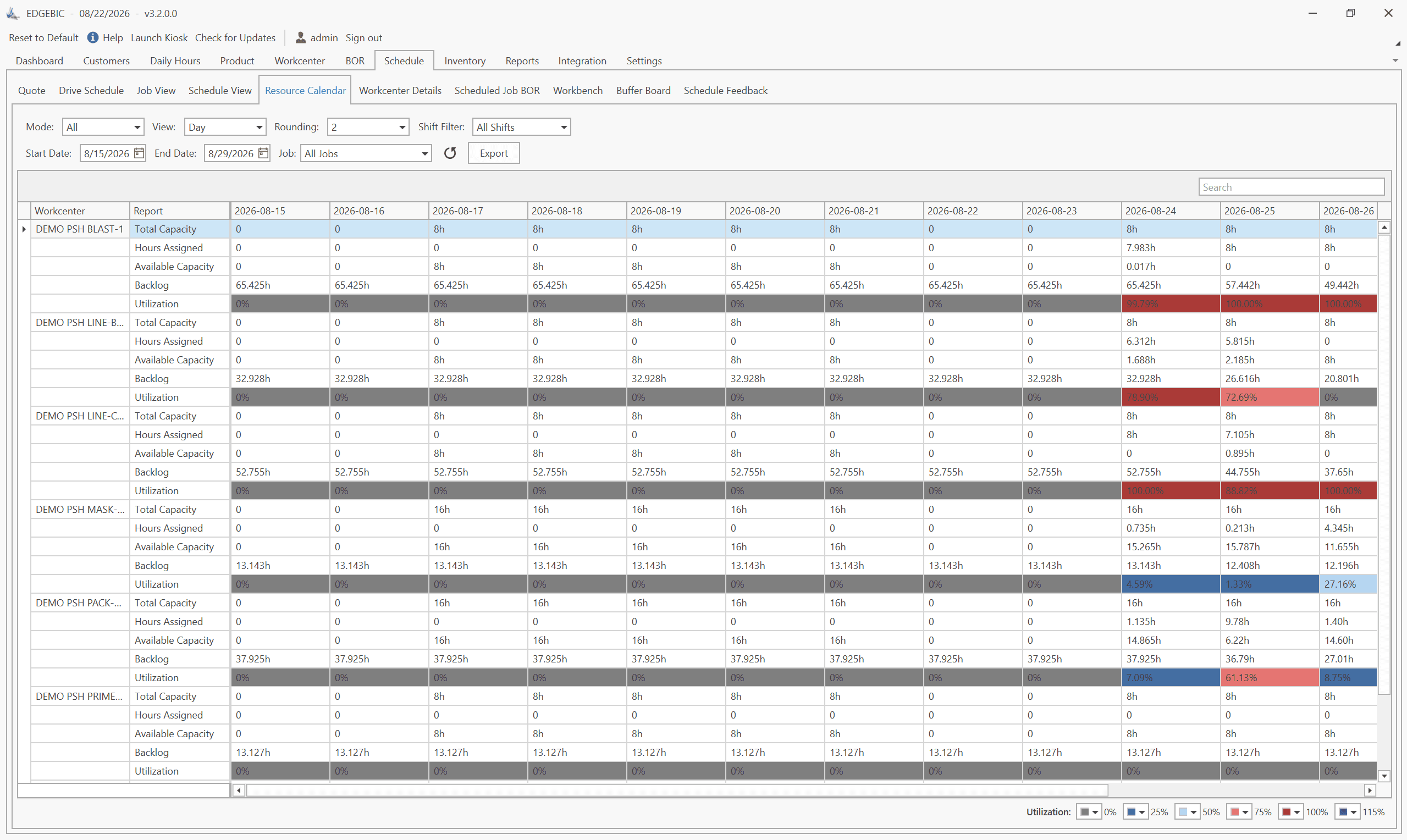
RMDB's resource management allows you to define operator skills, certifications, and availability schedules alongside machine definitions. When building a production schedule, the system checks both machine availability and qualified-operator availability before confirming a job assignment. The result is a schedule that is actually executable - not one that assumes every machine will be staffed by a qualified operator who happens to be present.
For shops managing complex shift structures or significant operator cross-training, RMDB's drag-and-drop Gantt interface lets planners adjust operator assignments in real time as schedules change. When an operator calls in sick, you can see immediately which jobs are at risk and reassign work to qualified operators who are on shift - a decision that might take an hour of spreadsheet work takes five minutes in RMDB.
Read our complete production scheduling software guide for the full framework on scheduling methodologies, tool selection, and implementation approaches that connect workforce planning to machine scheduling in a unified system.
Building a Cross-Training Program That Strengthens Scheduling
Cross-training is the long-term solution to workforce scheduling constraints. Every operator who is qualified on multiple processes increases your scheduling flexibility and reduces your vulnerability to absences.
A practical cross-training program for manufacturing ties directly to your scheduling constraint analysis. Run your production schedule for a typical month and identify which work centers are most frequently the bottleneck - where job queues are longest and where operator qualification gaps cause the most schedule disruption. Train to those constraints first.
A targeted cross-training investment of 40-60 hours per operator, focused on the two or three work centers that most frequently constrain your schedule, can meaningfully improve schedule attainment within a single quarter. The cost is quantifiable (training time, productivity dip during learning), and so is the benefit (fewer schedule breaks, less overtime at constrained work centers, improved on-time delivery).
Frequently Asked Questions
Manufacturing workforce management is the practice of planning, scheduling, and optimizing how people are deployed across production operations. It includes shift scheduling, skill coverage planning, attendance and absence management, and connecting labor availability to machine scheduling so that work centers are never staffed with operators who lack the required certifications or skills.
Machine scheduling determines when each job runs on each piece of equipment. Labor scheduling determines who is available to operate that equipment. The two must be aligned: a machine cannot run a job if the operator certified to run that process is on a different shift or absent. Effective scheduling software models both constraints simultaneously, preventing schedules that look feasible on paper but are impossible to execute because the right people are not available at the right time.
A skill matrix is a structured record of which operators are qualified to perform which operations, on which machines, at what proficiency level. It matters for scheduling because assigning an uncertified operator to a work center creates quality risk, safety risk, and likely rework. When your scheduling software references the skill matrix, it can only assign operators to jobs they are actually qualified to run - making the schedule realistic and executable from day one.
Workforce management is not separate from production scheduling - it is part of it. If your scheduling system does not account for who can actually run each job, it is producing plans that your floor cannot execute. RMDB closes that gap by modeling operator qualifications and availability alongside machine capacity. Contact us to see how RMDB handles the human side of your production schedule.
Expert Q&A: Deep Dive
Q: We have 40 operators across three shifts. Tracking who can run what machine is a nightmare. How do manufacturers manage this at scale?
A: The answer is a structured skill matrix that your scheduling system can actually read. Most shops start with a spreadsheet listing operators in rows and machines or processes in columns, with a qualification indicator in each cell. That is fine as a starting point, but it breaks down when the data is not connected to the schedule. The step that makes the difference is linking the skill matrix to your scheduling tool so that when you assign an operation to a work center, the system automatically filters the available operator pool to only those who are qualified. RMDB supports this through its operator skill and certification tracking - the scheduler sees both machine availability and qualified-operator availability as parallel constraints, and it only generates assignments that satisfy both. When you combine that with a shift calendar showing who is on shift, you eliminate the class of scheduling errors where a job is scheduled on Tuesday day shift but the only certified operator for that process works Wednesday night.
Q: Our best operators are constantly being pulled off their assigned jobs to help with problems elsewhere on the floor. How do we schedule around that?
A: This is a utilization and prioritization problem, and it gets worse the more you rely on a small number of highly skilled people. The first thing to do is make it visible. If your scheduling system tracks operator assignments, you can measure what percentage of scheduled time your key operators actually spend on their assigned jobs versus firefighting. That number is often shocking - it is common to find that 30-40% of a senior operator's time is consumed by unplanned interventions. Once you have the data, the conversation with management changes. Instead of vague concerns about being stretched thin, you have specific numbers: Operator X spent 12 hours last week helping troubleshoot problems that pulled them away from 8 scheduled operations that slipped. That makes the case for cross-training investments, for additional support staff, or for process improvements that reduce the frequency of floor fires. RMDB's work order tracking lets you log actual operator assignments versus planned, giving you the baseline to have that conversation.
Frequently Asked Questions
Ready to Transform Your Production Scheduling?
User Solutions has been helping manufacturers optimize their production schedules for over 35 years. One-time license, 5-day implementation.

User Solutions Team
Manufacturing Software Experts
User Solutions has been developing production planning and scheduling software for manufacturers since 1991. Our team combines 35+ years of manufacturing software expertise with deep industry knowledge to help factories optimize their operations.
Share this article
Related Articles
How to Create a Production Schedule in 7 Steps (Free Template)
How to create a production schedule step by step: horizon, real capacity, work orders, load check, sequence, dates, then publish. Worked example included.
Production Planning and Control (PPC): Functions and Examples
Production planning and control explained: routing, loading, scheduling, sequencing, dispatching and expediting, the types of scheduling, and worked examples.

Sequence-Dependent Setup Times: The Scheduling Problem That Costs You Capacity
When changeover time depends on what ran before, standard scheduling fails. Learn how setup matrices, sequence optimization, and APS software recover 10-25% of hidden capacity in paint lines, food, and coating operations.