
Backorders in Manufacturing: Causes, Customer Management, and How Finite Capacity Scheduling Prevents Accumulation
 User Solutions Team
Backorders in manufacturing are more than a logistics inconvenience - they are a signal that something in your demand management, capacity planning, or production scheduling has broken down. Left unaddressed, backorders compound: missed ship dates push jobs into the next week's schedule, crowding out future orders, which creates more backorders, which erodes customer confidence and eventually drives customers to competitors. Understanding what causes backorders, how to manage the customer relationship when they occur, and how finite capacity scheduling prevents accumulation is essential for any production manager trying to run a reliable, on-time operation. This guide covers all three dimensions with practical detail.
What a Backorder Actually Represents
A backorder exists the moment a customer order cannot be shipped on its promised date because production is not complete. That is the symptom. The root cause sits earlier in the chain - in a promise made without checking capacity, in a production plan that did not account for machine downtime, in a material shortage that no one saw coming, or in a scheduling approach that sequences work inefficiently and loses productive hours to excessive changeovers and waiting.
The distinction matters because the remedy differs by root cause. A manufacturer whose backorders are caused primarily by over-promising at order entry needs better order promising tools - specifically, available-to-promise (ATP) visibility that shows whether real capacity exists before the commit date is given. A manufacturer whose backorders stem from unplanned downtime needs better maintenance and buffer capacity strategies. A manufacturer whose backorders trace to poor sequencing needs better scheduling software. Treating all backorders as a capacity problem and simply adding overtime is the most common and most expensive wrong answer.
Root Causes of Manufacturing Backorders
Inaccurate demand forecasting. When actual orders exceed forecasted demand, production capacity and material procurement are both undersized for the real load. The mismatch shows up as backorders. In make-to-stock environments, this is the primary driver; in make-to-order environments, it is less relevant because orders are typically not accepted without at least implicit capacity verification.
Over-commitment at order entry. Many manufacturers quote lead times from habit - "our standard lead time is four weeks" - rather than from real-time capacity visibility. When the shop is already loaded to six weeks of work, every new order promised in four weeks is a future backorder at the moment it is accepted. This is a systemic failure of the order entry process, not a production failure.
Unplanned machine downtime. Equipment failures, tooling failures, and unexpected maintenance needs consume scheduled production hours. A machine that goes down for 16 unplanned hours on a 40-hour workweek eliminates 40% of that workcenter's output for the week. If the schedule was already loaded to capacity, those 16 hours cannot be recovered without overtime - and if overtime is not available or not enough, the jobs that were planned for that workcenter slide, which can cascade into backorders.
Material shortages. A job that reaches its first operation only to wait two days for material is a job that will likely ship late. Material shortages are often predictable - late supplier acknowledgments, purchase orders without confirmed delivery dates, lead times that exceed the customer's required delivery window - but they are frequently not surfaced in time to act. When material status is disconnected from the production schedule, planners discover shortages when the job hits the floor, not when there is still time to expedite or substitute.
Inefficient scheduling and sequencing. Even shops with adequate aggregate capacity lose productive hours to poor sequencing: high-changeover job sequences that could be re-ordered to group similar setups, jobs released to the floor before their material and tooling are ready, work-in-process pile-ups at bottleneck workcenters while upstream resources idle, and priority conflicts resolved by informal tribal knowledge rather than systematic scheduling logic. These losses are invisible in aggregate capacity reports but are the source of a significant share of late deliveries.
Capacity imbalances. Bottleneck workcenters - the single machine or operation that constrains total throughput - determine the output rate of the entire facility. Scheduling that ignores bottleneck constraints will reliably fill the bottleneck's queue with more work than it can process, creating a permanent backlog that appears as chronic late shipments.
Managing Customer Backorder Situations
When a backorder is unavoidable, how you communicate it determines whether you retain the customer or lose them. The research on customer retention is consistent: customers forgive service failures at a much higher rate when they are notified proactively, given a specific revised timeline, and provided with a clear explanation of what happened and what is being done about it. Customers who have to chase you for status, who receive vague assurances, or who discover the missed ship date on their own have dramatically higher churn rates.
Notify early. The moment you know an order will be late - not the day it was supposed to ship - contact the customer. "I am calling because I want to give you advance notice that your order, originally scheduled to ship Friday, will be delayed by five business days. Here is why, here is the new date, and here is what we are doing to expedite." That call, made three or four days before the original due date, gives the customer time to adjust their own plans and demonstrates that you are actively managing the situation.
Be specific, not apologetic. Vague apologies and assurances - "we are doing everything we can" - are less reassuring than specific commitments: "The revised ship date is May 14. Here is the tracking configuration. I will send you a confirmation email now and an update on May 10 if anything changes." Specificity signals control; vagueness signals the opposite.
Prioritize by customer impact. Not all backorders carry the same cost. A delay to a customer who is building an assembly that ships to their customer on May 15 is categorically more damaging than a delay to a customer who has buffer inventory. When managing a backorder queue, sequence your recovery efforts by downstream impact - what does this delay cost the customer - rather than by order value or simple chronology.
Track backorder metrics. Backorder rate (overdue orders as a percentage of total open orders), average days late, and the trend of both over time are the leading indicators that tell you whether your scheduling and capacity management is improving or deteriorating. Monthly review of these metrics by the production management team - not just quality or delivery reports - keeps backorder prevention on the operational agenda.
How Finite Capacity Scheduling Prevents Backorder Accumulation
The fundamental mechanism that turns backorders from chronic to rare is finite capacity scheduling - planning production against actual, verified available hours at each workcenter rather than against theoretical unlimited capacity.
In infinite capacity planning, the system accepts every order and backdates the start dates without checking whether machine time actually exists. Jobs pile up at bottleneck workcenters because the plan never acknowledged the constraint. The production team discovers the overload when jobs are already late, and the response is reactive: expediting, overtime, partial shipments, and apologies.
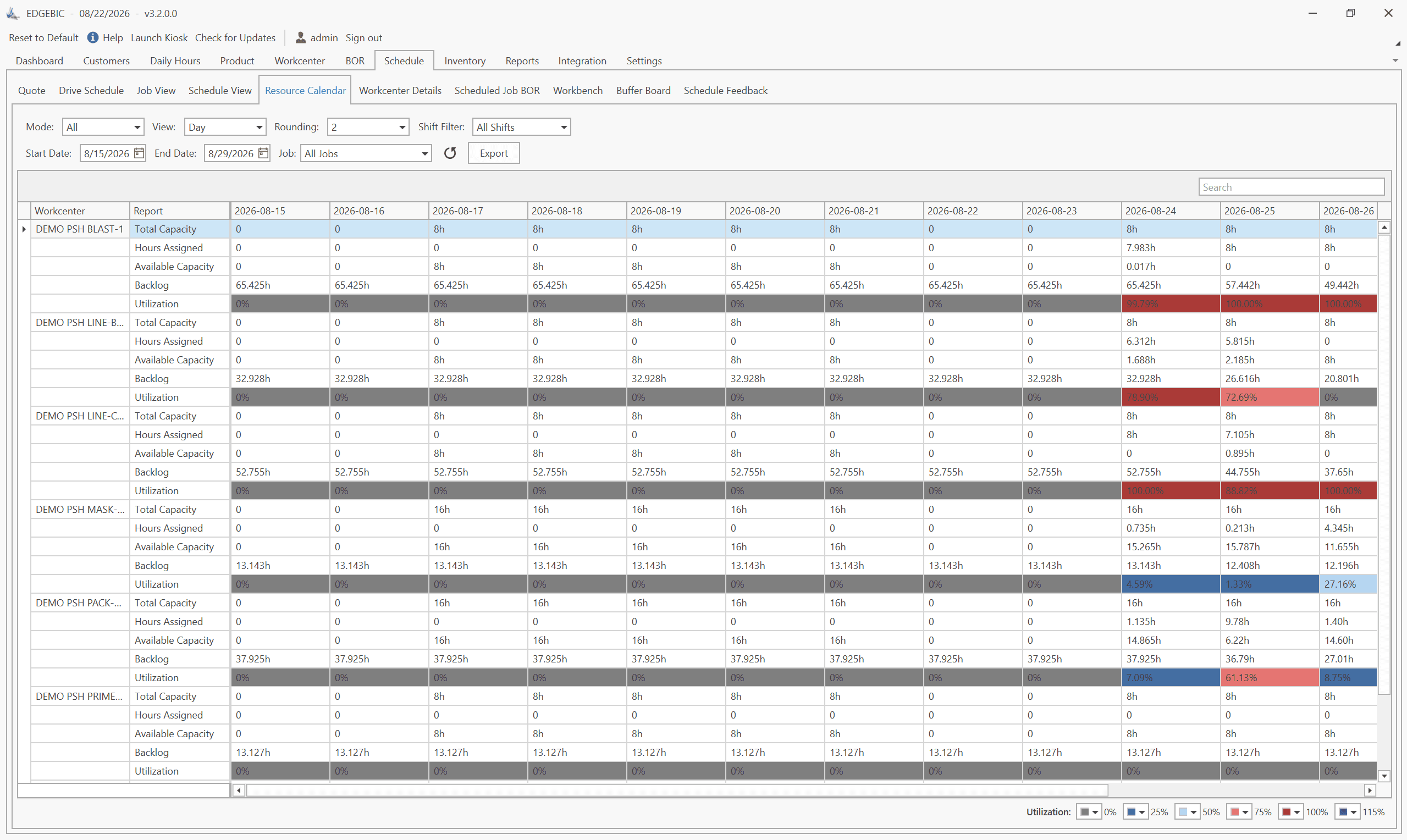
In finite capacity scheduling, the system builds the plan knowing how many hours each workcenter has available in each period. When a new order is entered, the scheduler checks real capacity before committing to a date. If the shop is already booked to week 6 on the relevant workcenter, the system shows that the order cannot ship until week 7 - before the promise is made. The manufacturer can then either set the expectation with the customer upfront, or take deliberate action to create capacity: authorize overtime, move other work to a later slot with customer agreement, or identify a subcontract option for overflow. All of these decisions happen in advance, not in reaction to a missed date.
RMDB uses finite capacity planning to give job shops and discrete manufacturers this real-time capacity visibility. The scheduling engine loads work orders against actual workcenter capacity, surfaces bottleneck conflicts as they arise, and gives the planner a visual dispatch board showing what can realistically be completed by when. When a new rush order comes in, the planner can immediately see the trade-off: which existing jobs would be displaced, by how much, and which customers would be affected. That information - available in real time, before any promise is made - is what prevents the cycle of over-commitment and backorder accumulation.
The production scheduling software guide covers the full framework for evaluating and implementing scheduling tools. The key question for backorder reduction specifically is whether the scheduling tool can answer two questions accurately: "Is capacity available for this order?" and "If I add this order, which existing orders does it displace?" Without real-time, workcenter-level capacity visibility, those questions cannot be answered reliably.
Building Buffer Capacity for Demand Surges
Even with accurate scheduling, demand volatility creates backorder risk. A manufacturing strategy that maintains zero excess capacity - running every workcenter at 100% utilization - has no ability to absorb demand spikes without generating backorders. The buffer capacity question is fundamentally an economic trade-off: the cost of maintaining reserved capacity versus the cost of backorders and customer attrition.
Most manufacturers running stable operations aim to load constraint workcenters at 80% to 85% of theoretical capacity. The remaining 15% to 20% is not waste - it is demand surge absorption capability, maintenance window accommodation, and the scheduling flexibility that allows high-priority jobs to be inserted without cascading delays. Operations running above 90% sustained utilization on bottleneck resources will experience chronic late deliveries because there is no slack to absorb any variability at all.
Buffer capacity strategies include cross-training operators to cover multiple workcenters (labor flexibility reduces the impact of single-operator bottlenecks), maintaining a pre-qualified subcontract relationship for overflow work, and using demand forecasting to schedule planned overtime in the weeks before historically high-demand periods rather than in reactive response to already-missed dates.
Material Readiness: The Scheduling Prerequisite That Prevents Avoidable Backorders
A job cannot start on time if its material is not available when it is scheduled to begin. Material readiness checking - verifying that all required raw materials, purchased components, and tooling are confirmed available before releasing a work order to the floor - is one of the highest-ROI practices for backorder reduction because it surfaces shortages when there is still time to act.
In RMDB, the scheduling system links work orders to their material requirements. Before a job is released, the planner can check material status: is the required quantity in stock or confirmed on an inbound purchase order with a delivery date that lands before the job's scheduled start? If the material is late, the planner can expedite the PO, adjust the job's start date in the schedule, or reschedule other work to fill the window - all before the floor discovers the shortage. This is the difference between a 2-hour delay at order start (solvable) and a 2-day delay in the middle of production (a backorder).
Key Metrics for Backorder Prevention
The metrics that predict backorder accumulation before it happens are more useful than the metrics that measure it after. Three leading indicators merit regular tracking:
Schedule adherence at the workcenter level. If a workcenter is completing 85% of its scheduled jobs on time within a given week, that 15% shortfall is accumulating into future weeks' load. Workcenter-level schedule adherence trends tell you where the constraint is building before the backorder rate reflects it.
On-time material availability. What percentage of jobs released to the floor have all required materials confirmed available at release time? If this number is below 90%, material-driven delays are a significant contributor to your backorder rate.
Promise date accuracy at order entry. What percentage of orders shipped on or before the original promised date? Tracking this separately from "on-time delivery" (which many manufacturers calculate from the current scheduled date, not the original promised date) reveals whether the scheduling problem is a production execution failure or an order-promising failure.
The production scheduling software guide includes a broader treatment of scheduling KPIs and how to establish a measurement baseline before implementing scheduling software.
Frequently Asked Questions
Backorders are caused by a mismatch between demand and available production capacity. The most common root causes are inaccurate demand forecasting, unplanned machine downtime, material shortages from supplier delays, poor scheduling that sequences jobs inefficiently and wastes capacity, and accepting orders without verifying that production capacity is available to fill them on time.
A backorder is a confirmed customer order that cannot be shipped on the promised date because production has not completed it. A production backlog is the queue of work orders ahead of current capacity - it is the workload measure on the production side. A healthy backlog is a sign of demand; an excessive backlog that cannot be cleared at current capacity is what generates backorders. Managing the backlog through scheduling is how manufacturers prevent backorders from accumulating.
Finite capacity scheduling plans jobs against actual available machine and labor hours rather than theoretical unlimited capacity. Before an order is promised, the scheduler checks real capacity and identifies the earliest date the order can actually be completed. If capacity is constrained, the scheduler sees this at order entry rather than discovering it when the due date is missed. This allows the manufacturer to either adjust the promise date upfront or take action to free capacity before the order becomes a backorder.
Early, specific, and proactive. Customers who learn about a backorder from you - before they have to chase you - absorb the news much better than customers who discover it on their own. The communication should include the original due date, the revised estimated ship date, the reason for the delay, what you are doing to expedite, and a point of contact for updates. Vague assurances erode trust; specific revised dates with a plan restore it.
Backorder rates vary significantly by industry and business model. Make-to-order job shops with variable demand and tight lead times typically see 3% to 8% of orders affected by some delay. High-volume discrete manufacturers with stable demand and longer lead times typically target under 2%. The more important metric is trend: a rising backorder rate is an early warning signal that capacity, scheduling, or material supply is deteriorating before it becomes a crisis.
Backorder accumulation is not inevitable - it is a scheduling problem with a scheduling solution. RMDB gives manufacturers the finite capacity visibility, material readiness checking, and dispatch board tools to make accurate delivery promises and keep them. If your shop is managing chronic late shipments and customer backorder complaints, contact User Solutions to see how RMDB's production scheduling capabilities can systematically reduce your backorder rate.
Expert Q&A: Deep Dive
Q: When a manufacturer is already in backorder trouble, what is the fastest path to clearing it?
A: The fastest path is triage: categorize every overdue order by customer impact and revenue, then build a recovery schedule that sequences backlogged work in impact priority rather than first-in-first-out. Most shops running FIFO in a backorder situation are shipping the least important orders first by accident. Reprioritize, add overtime to your highest-constraint workcenter, and contact every customer with a specific revised ship date before they contact you. Proactive communication while you are executing the recovery plan is what keeps customers from canceling orders and going to a competitor.
Q: How does poor scheduling create backorders even when capacity theoretically exists?
A: Capacity existence and capacity availability are not the same thing. A shop can have 200 machine hours per week available in aggregate but schedule them so inefficiently - wrong sequence, excessive changeovers, jobs waiting for tooling or material - that it only delivers 140 hours of actual productive output. The gap between theoretical and actual capacity is often filled by backorders. Finite capacity scheduling fixes this by sequencing jobs to minimize changeover time, surfacing material readiness issues before a job hits the floor, and keeping every workcenter loaded to its actual capacity rather than its theoretical maximum.
Frequently Asked Questions
Ready to Transform Your Production Scheduling?
User Solutions has been helping manufacturers optimize their production schedules for over 35 years. One-time license, 5-day implementation.

User Solutions Team
Manufacturing Software Experts
User Solutions has been developing production planning and scheduling software for manufacturers since 1991. Our team combines 35+ years of manufacturing software expertise with deep industry knowledge to help factories optimize their operations.
Share this article
Related Articles
How to Create a Production Schedule in 7 Steps (Free Template)
How to create a production schedule step by step: horizon, real capacity, work orders, load check, sequence, dates, then publish. Worked example included.
Production Planning and Control (PPC): Functions and Examples
Production planning and control explained: routing, loading, scheduling, sequencing, dispatching and expediting, the types of scheduling, and worked examples.

Sequence-Dependent Setup Times: The Scheduling Problem That Costs You Capacity
When changeover time depends on what ran before, standard scheduling fails. Learn how setup matrices, sequence optimization, and APS software recover 10-25% of hidden capacity in paint lines, food, and coating operations.