
Spreadsheet Scheduler
Gantt Charting and Project Management with Excel
Overview
Gantt Charting and Project Management Customizable Templates for all versions of Excel (including the expansive 2007+ and tablet supporting Office 365). Low cost and easy-to-use spreadsheet templates for Project Management, Simple Production Planning and Scheduling, Critical Path Method (CPM), Critical Path Analysis, Customer Job Scheduling, Generating Calendars and Gantt Charts with hourly, daily or weekly time buckets.
This collection can be used as a set of building blocks to develop custom applications because it uses simple formulas (source code provided), easily understood by the casual Excel user.
Gantt Charts & Scheduling
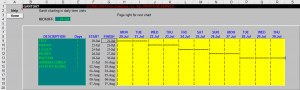
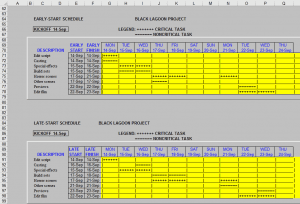
The Spreadsheet Scheduler includes simple Gantt Charting and CPM (Critical Path Management) models for hourly, daily, or weekly time units. By determining early and late starting points for each task, as well as task duration and precedence relationships, the template generates a Gantt Chart showing which tasks are critical.
Tasks that are critical must be done on time, otherwise the entire schedule will slip.
Critical Path Analysis
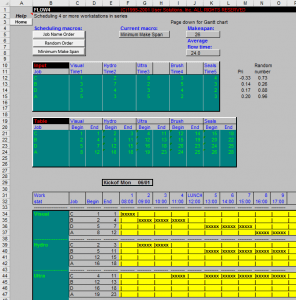
Work flow and work-in-process models provide techniques for scheduling customer jobs through single workstations, workstations in series, or workstations in parallel. These models enable more efficient planning and accurate customer deliveries.
Minimize average flow time, reduce the number of days late for jobs, and decrease the total number of late jobs with proper critical path planning.
What-If Analysis
Functionality includes the ability to do "what-if" analysis to accommodate changes without missing deadlines. Perfect for those looking to learn or teach project management concepts or be introduced to formal project management systems.
The 14 spreadsheet-based programs provide an easy-to-use set of tools to help any organization manage projects more efficiently and improve customer deliveries.
The scheduling techniques include:
- Job & task sequencing
- Gantt charts
- Due-date assignment
- Development of calendars
- Computation of lateness and other performance measures
- Scheduling of work according to precedence relationships
Applications
- Projects: Activities are the components (tasks) of a project. Use Gantt chart and CPM to schedule tasks and determine project completion time and critical activities.
- Manufacturing Shop Jobs: Jobs coming into a shop consist of several operations. Operations may require precedence restrictions (e.g., cannot drill hole in a part until the metal casting is made). Assign sequence to jobs to determine the overall flow or queue of jobs and schedule of operation.
- Work Flow Models: Use in creating work flow diagrams showing events and activities in a work process and the time requirements at each step. Can be used to spot process improvement opportunities and estimate process cycle time prior to implementation.
Scheduling Techniques
- Job (or task) sequencing: The dispatching or releasing of jobs through the shop (or tasks within a project) in a pre-determined order, using one of several techniques (priority rules) such as first come first served, shortest processing time, earliest due date.
- Due-date assignment: Assigning due dates to jobs based on date in, processing time, capacity.
- Gantt Chart: A horizontal bar chart used in scheduling. Tasks are listed on the vertical axis and task start and completion dates are reflected on the horizontal scale by bar positions and lengths.
- Precedence Relationships: Certain tasks in a project may have to be completed before others can be started. These precedence requirements can be input and critical paths determined.
- CPM: The critical path method is a network based technique of determining project makespan (or duration) and critical activities, as well as project slack.