

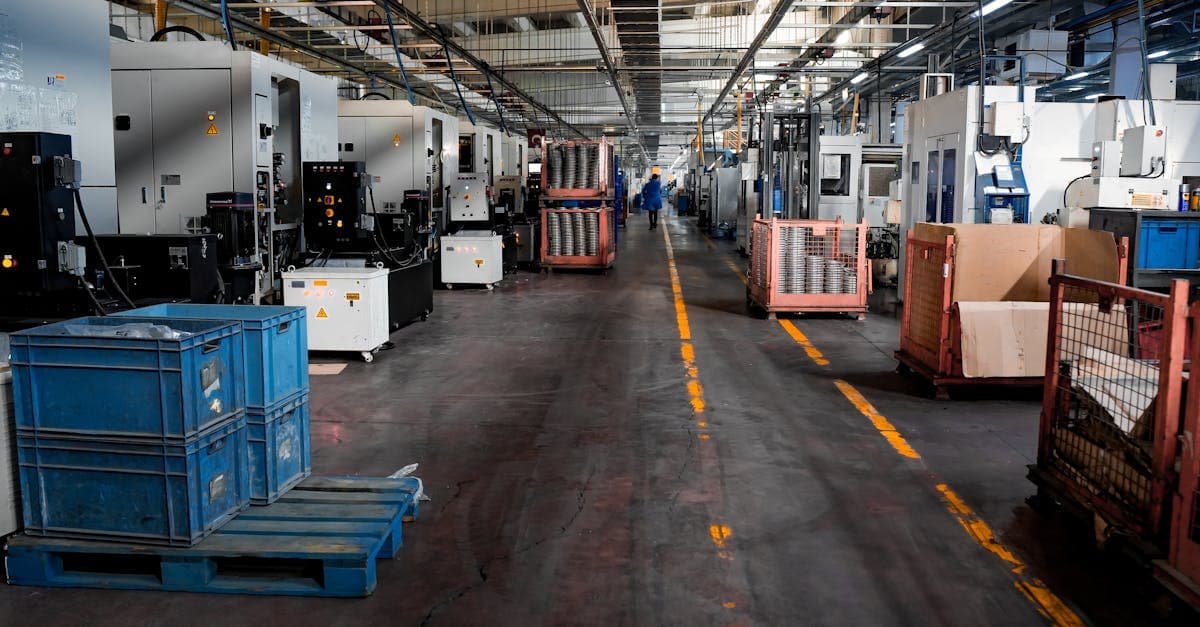
What is an Assembly Line?
An assembly line is a manufacturing process arrangement in which a product moves sequentially through a series of workstations. Each station performs a specific operation — adding a component, fastening, testing, or inspecting — and the partially completed product advances to the next station until it emerges as a finished good at the end. Assembly lines are the backbone of high-volume manufacturing, enabling companies to produce large quantities of consistent products at low per-unit cost.
How Assembly Lines Work
An assembly line divides the total work content of building a product into discrete tasks, then assigns those tasks to sequential stations. The product — or a carrier holding it — moves from station to station at a fixed pace called the takt time, which is determined by customer demand. If customers require 480 units per eight-hour shift, takt time is one minute per unit.
Each station must complete its assigned tasks within one takt time. If a station takes longer, it becomes a bottleneck and limits the entire line. Line balancing is the engineering discipline of distributing tasks across stations so that the work content at each station is as close to takt time as possible. A well-balanced line has high utilization and minimal idle time.
Assembly lines can be manual, automated, or a hybrid. Manual lines use human operators at each station with hand tools and fixtures. Automated lines use robots, conveyors, and programmable logic controllers. Most modern lines are mixed — robots handle repetitive or ergonomically difficult tasks while humans perform complex assembly, quality checks, and exception handling.
Material delivery to the line is critical. Stations must have the right parts at the right time. Kitting, line-side delivery, and kanban replenishment systems prevent line stoppages caused by part shortages. Even a few minutes of downtime on a high-volume assembly line translates to significant lost output.
Assembly Line Example
An appliance manufacturer produces dishwashers on an assembly line with 24 stations. Takt time is 72 seconds to meet a target of 400 units per shift. At station 1, the base frame is loaded onto the conveyor. Stations 2 through 8 install the tub, pumps, and plumbing. Stations 9 through 14 handle electrical wiring and the control board. Stations 15 through 20 attach the door, racks, and spray arms. Stations 21 through 23 run functional tests, and station 24 packages the unit for shipping.
Before line balancing, the longest station took 95 seconds while several stations finished in 50 seconds, creating bottlenecks and idle time. After rebalancing — redistributing tasks so every station operates between 65 and 72 seconds — throughput increases from 340 to 400 units per shift without adding labor. That is an 18 percent gain from sequencing work more effectively.
Why Assembly Lines Matter for Production Scheduling
Assembly lines require precise scheduling because every station depends on the one before it. A disruption at any point — a missing component, a quality defect, equipment failure — stops the entire line. Production schedulers must coordinate material availability, staffing, and maintenance windows to keep the line running.
Scheduling software like Resource Manager DB (RMDB) helps planners sequence product variants on mixed-model assembly lines, schedule changeovers between product families, and plan maintenance during shift breaks to maximize uptime. Finite capacity scheduling ensures that upstream feeder operations deliver subassemblies to the line on time, preventing the starving of stations.
For mixed-model lines that build multiple product variants on the same line, scheduling determines the sequence in which models are built. Proper sequencing levels the demand for different components and prevents operators from being overloaded when complex variants cluster together.
Related Terms
- Production Line — A broader term that includes assembly lines and other sequential production arrangements
- Takt Time — The pace at which the assembly line must produce to meet customer demand
- Subassembly — A partially completed component that feeds into the assembly line
Frequently Asked Questions
Learn more in our complete manufacturing glossary or production scheduling guide.
Frequently Asked Questions
Ready to Transform Your Production Scheduling?
User Solutions has been helping manufacturers optimize their production schedules for over 35 years. One-time license, 5-day implementation.

User Solutions Team
Manufacturing Software Experts
User Solutions has been developing production planning and scheduling software for manufacturers since 1991. Our team combines 35+ years of manufacturing software expertise with deep industry knowledge to help factories optimize their operations.
Share this article
Related Articles
What is ABC Analysis? Definition & Manufacturing Examples
Learn what ABC analysis is in inventory management, how the Pareto principle classifies inventory, and why it matters for scheduling.
What is Acceptance Sampling? Definition & Manufacturing Examples
Learn what acceptance sampling is, how it works in manufacturing, and why it matters for production scheduling and quality control decisions.
What is Advanced Planning & Scheduling (APS)? Definition & Manufacturing Examples
Advanced Planning & Scheduling (APS) definition: software that uses algorithms to optimize production schedules against real constraints. Learn how APS works in manufacturing with examples.